How to Evaluate a Greens Powder Label
A greens powder is easiest to judge when you know what you want it to add, how much it provides, and what else is already in your routine.
Treat a greens powder as a supplement with specific ingredients, not as proof that your diet is nutritionally complete. Check what the label says about amounts, compare it with other supplements you use, and look for quality-testing information. Pregnancy changes nutrient needs, so don’t assume a greens powder meets them. A label alone also can’t answer whether a specific formula fits with your medicines.
Start with the need, not the word “greens”
Before comparing tubs, name the job you want the powder to do. Are you trying to add a particular nutrient, or hoping a scoop will make up for missed vegetables? Those are different goals. A long ingredient list can look comprehensive without telling you how much of each ingredient you’re getting, or whether it addresses a need you actually have.
For any nutrient you’re targeting, check the amount per serving and the form listed. As a practical label-reading rule, if several ingredients share one combined amount, you may not be able to tell how much of any one plant is in the blend. A list of spirulina, chlorella, wheatgrass, or other greens tells you what is included, not by itself how much you’ll get or what health effect to expect.
Pregnancy makes this distinction especially useful: nutrient needs change, and a varied diet can help meet them. Pregnancy-specific supplement formulas also differ, so their ingredients and amounts need to be checked. Don’t assume a greens powder meets pregnancy-specific needs just because it contains many plants. 2
Check for overlap with your other supplements
Put the greens powder’s Supplement Facts panel beside any multivitamin, prenatal vitamin, or single-nutrient supplement you already use. Look for repeated vitamins and minerals, then compare the amounts instead of counting how many products contain the same nutrient. If a blend gives only one combined amount, treat the amounts of individual ingredients as unclear rather than assuming each is present in a meaningful amount.
This matters particularly during pregnancy, when recommended intakes and upper limits differ by nutrient. For example, the NIH Office of Dietary Supplements notes that excessive intake of preformed vitamin A can cause birth defects, while provitamin A carotenoids such as beta-carotene are treated differently. If a label lists vitamin A, check which form it contains and how much, and include your other supplements in the comparison. 2
Don’t use a greens powder to correct a suspected deficiency based on its marketing or ingredient list. A product’s label can show what it contains; it can’t establish what your body needs.
Treat quality testing as a quality check, not a benefit claim
Look for a named independent organization or a clear explanation of what testing was done. Independent quality testing can help verify that a supplement is properly manufactured, contains the ingredients and amounts listed on the label, and does not have harmful levels of contaminants. 2
That kind of testing answers a product-quality question. It does not show that the powder improves energy, digestion, immunity, or any other health outcome. Be cautious when a product’s promises lean on words such as “detox,” “cleanse,” or “complete nutrition” rather than transparent amounts and substantiated benefits.
Consider pregnancy, breastfeeding, and medicines separately
If you’re pregnant or planning a pregnancy, don’t assume a greens powder can stand in for pregnancy-specific nutrition. Recommendations include folic acid before and during early pregnancy to reduce the risk of neural tube defects, and the ODS notes that prenatal products vary in their ingredients and amounts. Compare the greens powder’s label with your pregnancy-specific plan rather than relying on the word “greens.” 2
Breastfeeding is a separate question. Some medicines can pass into breast milk and harm an infant, but that fact alone doesn’t establish whether a greens powder is safe or unsafe. Don’t treat a “greens” or “natural” label as a breastfeeding safety determination. 1
If you take a prescription medicine, a product label alone can’t tell you whether that specific formula fits with that medicine. Use the full ingredient list for a medicine-specific check rather than guessing from marketing terms. During pregnancy, MedlinePlus advises checking herbs and supplements before use, and says not to start or stop a medicine without discussing it with your provider. 3
Compare the cost with what you’ll actually use
Divide the price by the number of servings the label provides, then compare the cost with foods or a targeted supplement that better matches your goal. Consider whether you’ll use the full serving, whether the taste works for you, and whether the product duplicates something you already buy. If your aim is to eat more vegetables, foods you enjoy and can afford may be a more direct use of your budget. A powder can be a convenience choice, but it doesn’t become more valuable just because its ingredient list is longer.
A useful final check is simple: Can you name the need, find the relevant amount on the label, account for overlap, and verify the product’s quality information? If not, you may be paying for a formula that’s hard to evaluate.
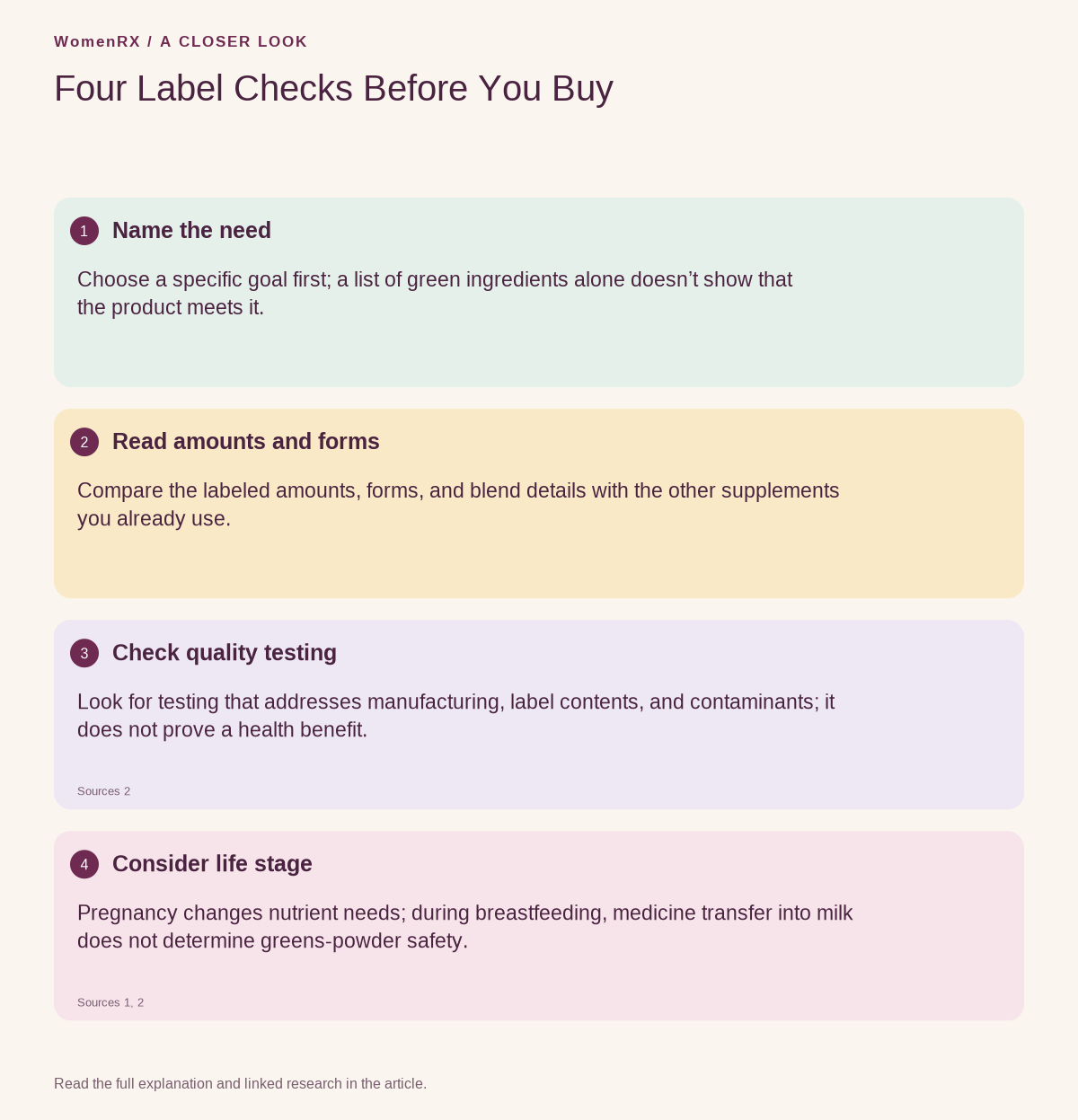
Four Label Checks Before You Buy
Name the need: Choose a specific goal first; a list of green ingredients alone doesn’t show that the product meets it.
Read amounts and forms: Compare the labeled amounts, forms, and blend details with the other supplements you already use.
Check quality testing: Look for testing that addresses manufacturing, label contents, and contaminants; it does not prove a health benefit.2
Consider life stage: Pregnancy changes nutrient needs; during breastfeeding, medicine transfer into milk does not determine greens-powder safety.12
Read the figure as text
Use these checks to decide whether a greens powder has a clear purpose, readable amounts, credible quality information, and a sensible place in your budget.- Name the need: Choose a specific goal first; a list of green ingredients alone doesn’t show that the product meets it.
- Read amounts and forms: Compare the labeled amounts, forms, and blend details with the other supplements you already use.
- Check quality testing: Look for testing that addresses manufacturing, label contents, and contaminants; it does not prove a health benefit.2
- Consider life stage: Pregnancy changes nutrient needs; during breastfeeding, medicine transfer into milk does not determine greens-powder safety.12
More questions, answered
What can a greens powder tell me about prenatal nutrition?
Not enough by itself. Pregnancy changes nutrient needs, and prenatal supplement formulas vary in their ingredients and amounts. Compare the full label with your pregnancy-specific nutrition plan instead of assuming a greens powder covers it. 2
Does third-party testing prove a greens powder works?
No. Independent quality testing can help check manufacturing, labeled ingredients and amounts, and contaminant levels. It does not establish that a product provides a particular health benefit. 2
Sources you can check
- Breastfeeding | Benefits of Breastfeeding | MedlinePlusAccessed 2026-09-25Return to first citation
- Dietary Supplements and Life Stages: Pregnancy - Health Professional Fact SheetAccessed 2026-09-25Return to first citation
- Pregnancy and Medicines | MedlinePlusAccessed 2026-09-25Return to first citation