Greens Powders: A Practical Label Check
A long ingredient list can’t tell you whether a greens powder meets a nutrition goal or delivers a tested benefit.
Treat a greens powder as a mix of ingredients, not a shortcut to a complete diet. Check what each serving actually contains, whether studies on an ingredient match the product’s claim, and whether the ingredients fit your health needs and life stage. Research on individual algae doesn’t establish benefits for blended powders, and some botanicals have gaps in pregnancy and reproductive safety data. 2 6
Start with the goal, not the blend
Before comparing tubs, name what you want the powder to do. Adding a particular nutrient, making a smoothie convenient, and trying to change a health measure are different goals. A broad promise like “daily greens” doesn’t tell you whether a product addresses any one of them.
A healthy eating plan can provide the energy and nutrients you need through a variety of foods and beverages, while fitting your preferences, traditions, and budget. That’s a useful starting point: a powder’s long ingredient list doesn’t show that it replaces food variety or fills a specific gap. 1
Four checks for the label
1. Find the serving size. Check what serving the listed amounts refer to. If you compare products or research, the amounts only make sense when you know whether they describe one scoop or a different serving.
2. Separate individual amounts from blend totals. Look for an amount beside each ingredient you care about. If several ingredients appear under one combined blend amount, the label doesn’t tell you how much of each is in that blend. You can’t reliably compare an ingredient’s amount with research on that ingredient when its individual amount isn’t stated. Multi-ingredient proprietary blends also pose challenges for assessing safety and research findings. 5
3. Match the claim to the research. Ask whether studies examined the same ingredient, a similar form, and the outcome the product promises. Research on one alga doesn’t establish that a powder combining it with other ingredients improves digestion, energy, or “detox.” A systematic review of Chlorella and gut microbiota included mostly animal studies and only a limited number of human trials. 2
Even studies of individual ingredients don’t always point to a clear benefit. A review of randomized trials found a neutral effect of Chlorella on blood pressure and blood lipids. A separate meta-analysis reported changes in several health markers, but rated the evidence for most outcomes as very low certainty. These findings don’t demonstrate that a commercial greens blend improves those outcomes. 3 4
4. Read every ingredient in light of your situation. Check herbs and extracts as well as the ingredients featured on the front of the package. Complex botanical mixtures can be difficult to assess, and interactions between botanical supplements and medicines are a recognized research and safety concern. The available findings don’t identify a specific interaction for a particular greens powder, so the full label matters if you take medication. 5
Pregnancy and breastfeeding call for a closer look
Some botanical ingredients have limited developmental and reproductive safety information. That gap doesn’t mean every botanical is harmful, but it does mean a “natural” or “women’s” label can’t answer whether a particular blend is appropriate during pregnancy or breastfeeding. 6
If you’re pregnant, breastfeeding, or trying to conceive, review the full ingredient list with your care team before using a multi-ingredient powder. Ask about the specific ingredients rather than treating greens powders as one uniform category. A product marketed to women isn’t automatically better suited to these life stages.
When another option may fit better
If you want to eat more vegetables, consider whether adding a vegetable, fruit, or other food you enjoy is practical for your routine and budget. Nutrition guidance supports a varied eating plan that fits your preferences, rather than a single required set of foods. 1
If you’re trying to address a known deficiency, symptoms, or a health condition, a broad blend may not tell you whether you’re getting the particular nutrient or support you need. Bring the label and your goal to a clinician or registered dietitian. The useful question isn’t simply “Is this greens powder good?” It’s “Does this ingredient, in this amount, fit my goal and situation?”
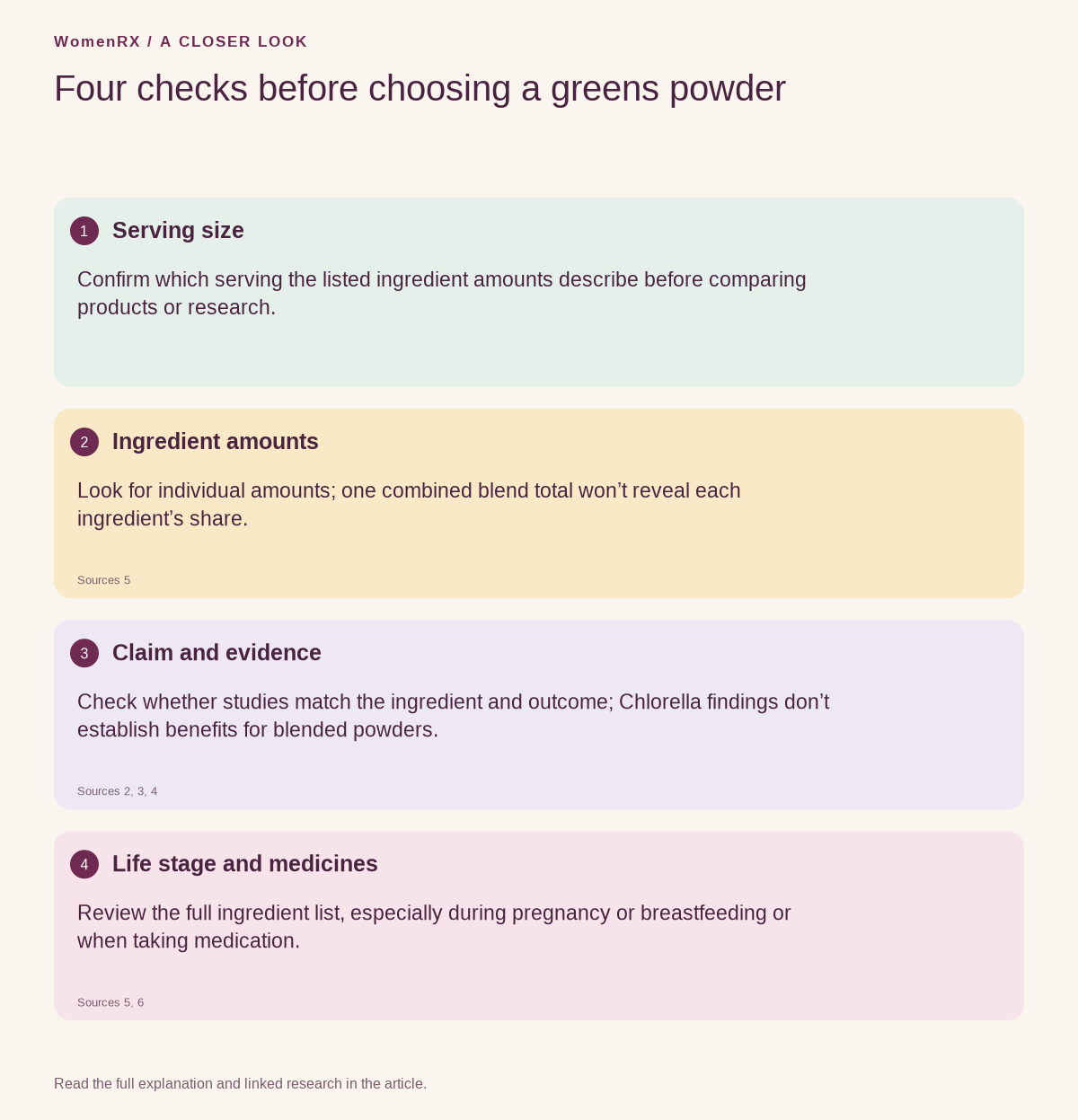
Four checks before choosing a greens powder
Serving size: Confirm which serving the listed ingredient amounts describe before comparing products or research.
Ingredient amounts: Look for individual amounts; one combined blend total won’t reveal each ingredient’s share.5
Claim and evidence: Check whether studies match the ingredient and outcome; Chlorella findings don’t establish benefits for blended powders.234
Life stage and medicines: Review the full ingredient list, especially during pregnancy or breastfeeding or when taking medication.56
Read the figure as text
Use these questions to distinguish a readable label and relevant research from a broad blend or promise.- Serving size: Confirm which serving the listed ingredient amounts describe before comparing products or research.
- Ingredient amounts: Look for individual amounts; one combined blend total won’t reveal each ingredient’s share.5
- Claim and evidence: Check whether studies match the ingredient and outcome; Chlorella findings don’t establish benefits for blended powders.234
- Life stage and medicines: Review the full ingredient list, especially during pregnancy or breastfeeding or when taking medication.56
More questions, answered
Does a greens powder count as a serving of vegetables?
An ingredient list alone can’t establish that a powder replaces a serving of vegetables or the variety of foods in an eating pattern. Nutrition guidance emphasizes a varied plan that fits your needs and preferences. 1
Sources you can check
- Nutrition: MedlinePlusAccessed 2026-09-25Return to first citation
- Effects of the Edible Microalga Chlorella on Gut Microbiota and on Brain Health: Current Evidence and Emerging Links.Felip O, García I, Santocildes G, Torrella JR, Viscor G, Torres JL, Ramos-Romero S. · Nutrients · 2026Return to first citation
- The Role of Chlorella and Spirulina as Adjuvants of Cardiovascular Risk Factor Control: A Systematic Review and Meta-Analysis of Randomised Controlled Trials.Pinto-Leite M, Martins D, Ferreira AC, Silva C, Trindade F, Saraiva F, Vitorino R, Barros R, Lima PA, Leite-Moreira A, Ferreira JP, S Barros A, Miranda IM. · Nutrients · 2025Return to first citation
- Beneficial effects of Chlorella species supplementation in the general population: a GRADE-assessed systematic review and dose-response meta-analysis.Mardani H, Karimi MA, Sharifi M, Ghazvineh D, Yari Z, Jafari A. · Nutrition & diabetes · 2026Return to first citation
- "…Not Intended to Diagnose, Treat, Cure or Prevent Any Disease." 25 Years of Botanical Dietary Supplement Research and the Lessons Learned.Gurley BJ, Yates CR, Markowitz JS. · Clinical pharmacology and therapeutics · 2018Return to first citation
- Incorporation of in vitro techniques for botanicals dietary supplement safety assessment - Towards evaluation of developmental and reproductive toxicity (DART).VanderMolen KM, Naciff JM, Kennedy K, Otto-Bruc A, Shan Y, Wang X, Daston GP, Mahony C. · Food and chemical toxicology : an international journal published for the British Industrial Biological Research Association · 2020Return to first citation