How to Compare Protein Foods for Your Meals
Beans, tofu, eggs, dairy, fish, and meat can all provide protein; the useful comparison is what you’ll eat, what it provides, and what it costs where you shop.
You don’t need one perfect protein food. As a rough starting point, MedlinePlus counts one large egg, ¼ cup tofu, ½ cup cooked beans or lentils, or 1 ounce of fish, meat, or poultry as portions providing about 7 grams of protein.11 For your budget, compare the protein and cost in the portions you’d actually use, not just package prices.13
Compare protein for your grocery budget
Use two package labels and their current prices. Enter weights in grams, using the same food state for the package and serving. For drained foods, use a drained amount and a matching nutrition label.
The sample uses invented prices and labels to explain the math. Ten grams is a comparison unit, not a meal target. This compares label protein, without adjusting for protein quality or other nutrients. Your entries stay on this page.
Start with the meal, not a ranking
Protein helps your body build and maintain muscle, bone, skin, and other tissues. You can get it from meat, fish, eggs, dairy, soy foods, beans, lentils, nuts, and seeds. There’s no need to make every meal depend on meat, and no single food is the best choice for every budget or eating pattern.111
Picture an ordinary lunch. If you have rice and vegetables, you could add beans, tofu, an egg, or fish. If you’re putting together a quick breakfast, yogurt with fruit or an egg alongside toast may be easier than cooking a larger meal. These are meal-building examples, not equal-protein swaps: the protein amount depends on the food and portion.1112
Put familiar servings side by side
MedlinePlus offers a useful rough comparison: one large egg, ¼ cup tofu, ½ cup cooked beans or lentils, and 1 ounce of fish, meat, or poultry are each examples of a portion providing about 7 grams of protein.11 These aren’t suggested limits on how much to eat. They’re a common starting measure, so you can see why an egg and a spoonful of beans aren’t necessarily comparable, or why the amount of tofu in your bowl matters.
Beans or lentils can be the main protein-containing food in a bowl. Tofu or tempeh can fill that role in a different kind of plant-based meal. Yogurt might be the center of breakfast, while nuts or seeds might be something you add to it. Eggs, fish, or meat offer other options if you eat animal foods.1112 The serving examples above don’t give a protein amount for every food on this list. For packaged foods, the label can help you make a closer comparison.13
Compare the protein you get for your money
Use the package price, its usable weight and the Nutrition Facts serving. Keep the food state consistent: a dry weight, cooked weight and drained weight are different starting points. The label gives the protein for its stated serving, so check both numbers before calculating. 13
Cost per serving = package price × serving weight ÷ usable package weight. Then divide that cost by the protein grams per serving and multiply by 10. The result is cost per 10 g of label protein, a comparison unit rather than a meal target.
Here is a worked example with invented prices and labels:
| Example | Package | Label serving | Cost per serving | Cost per 10 g protein |
|---|---|---|---|---|
| Food A | $3.00 for 500 g | 100 g supplies 8 g protein | $0.60 | $0.75 |
| Food B | $2.40 for 400 g | 100 g supplies 12 g protein | $0.60 | $0.50 |
Both example servings cost the same, but Food B supplies more protein. The calculator lets you replace these numbers with your own. It compares the listed protein amount, without adjusting for digestibility, amino-acid balance, other nutrients or the cost of the rest of a meal.
Price is only part of the choice. A food you enjoy, can prepare and will finish may serve you better than a cheaper package that goes to waste. Compare the portions you will actually use, especially when a package contains liquid you discard.
A dated comparison from published research
A 2025 analysis used USDA composition data and published national price inputs to estimate the cost of an amount supplying about 7 g of protein after a protein-quality adjustment. Its category averages were $0.28 for roughly 60 g egg, $0.46 for 145 g cooked beans or pulses, $0.69 for 54 g tofu, $0.21 for 210 g skim milk and $0.49 for 32 g canned fish. 18
These are historical research estimates, not September 2026 supermarket quotes. The quality adjustment also means they are not interchangeable with plain Nutrition Facts protein grams. They show why portion and comparison method belong beside a price; your current receipt and product labels determine the comparison at your store. 18
Build meals from plant or animal foods
Animal foods supply all the essential amino acids, the protein building blocks your body can’t make. Most individual plant proteins don’t supply them in the same balance. That doesn’t mean you must pair two particular foods at every meal: eating a variety of plant protein foods over the day can meet your amino acid needs.111
If you eat plants only, rotate among options such as beans, lentils, tofu, tempeh, edamame, nuts, and seeds. For example, you might have tofu with vegetables at one meal and lentils with a grain at another. If you eat both plant and animal foods, beans in one meal and eggs, yogurt, or fish in another can give you variety without making every meal a protein calculation.1112 Add produce and other foods you enjoy so that protein is part of a satisfying meal, not the whole meal.12
Nuts and seeds belong in the protein-food conversation, but compare the portion you actually use. A sprinkle on yogurt plays a different role in a meal than a bowl of lentils. Labels can help you see that difference without treating either food as a bad choice.1113
When your needs may deserve a closer look
Protein needs vary with age, health, and physical activity, so a target copied from someone else may not fit you.1 If you’re active, it can be useful to notice whether protein-containing foods appear across your usual meals rather than assuming dinner has to do all the work. Researchers have proposed per-meal amounts based partly on muscle-protein-synthesis responses, which vary with age, amino acid content, and resistance exercise; studies of meal distribution haven’t all found the same effects.17
Later in life, getting enough protein can become a more relevant question, especially if eating less has made meals smaller. A review of adults 65 and older found an association between higher protein intake and lower hip-fracture risk in cohort studies, but it said the evidence wasn’t strong enough to raise protein recommendations on bone-health grounds.3 A broader systematic review found the evidence for protein intake’s effects on bone disease and sarcopenia unclear.2 Those studies don’t give every older woman the same new target. Kidney disease or another medical condition also changes the conversation: evidence on protein intake and kidney function in older adults, including those with nondialysis chronic kidney disease, remains insufficient for a simple across-the-board rule.5
Pregnancy and breastfeeding are different nutritional circumstances, not reasons to borrow an athlete’s or older adult’s protein goal. Protein needs increase during these stages, while research directly measuring requirements across pregnancy and lactation is limited.159 If you’re pregnant or breastfeeding and eating vegetarian or vegan, a well-planned diet can be compatible with those stages, but protein isn’t the only nutrient to plan for; vitamin B12 and certain omega-3 fats also need attention.15 That’s a good time to get guidance shaped around your diet and circumstances rather than relying on a generic protein number.
Same serving price, different protein value
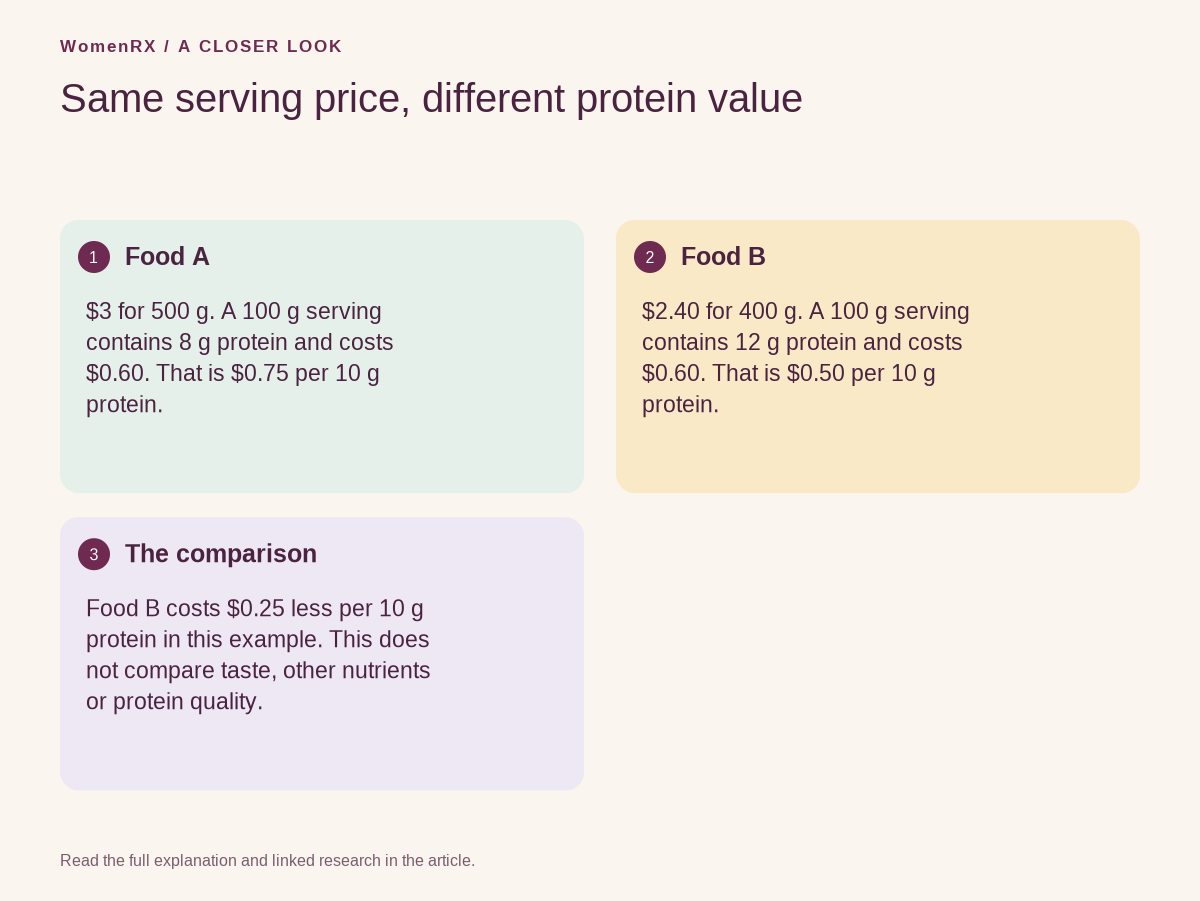
Food A: $3 for 500 g. A 100 g serving contains 8 g protein and costs $0.60. That is $0.75 per 10 g protein.
Food B: $2.40 for 400 g. A 100 g serving contains 12 g protein and costs $0.60. That is $0.50 per 10 g protein.
The comparison: Food B costs $0.25 less per 10 g protein in this example. This does not compare taste, other nutrients or protein quality.
Read the figure as text
An invented example to explain the comparison. Replace these inputs with your own labels and prices.- Food A: $3 for 500 g. A 100 g serving contains 8 g protein and costs $0.60. That is $0.75 per 10 g protein.
- Food B: $2.40 for 400 g. A 100 g serving contains 12 g protein and costs $0.60. That is $0.50 per 10 g protein.
- The comparison: Food B costs $0.25 less per 10 g protein in this example. This does not compare taste, other nutrients or protein quality.
Do I need to combine beans and grains in the same meal?
No. If you eat a variety of plant protein foods across the day, you don’t need a specific pairing at every meal to obtain essential amino acids.111
Sources you can check
- Dietary Proteins: MedlinePlusAccessed 2026-09-25Return to first citation
- The Effect of Protein Intake on Health: A Systematic ReviewLamina T, Brandt S, Abdi HI, Yam H, Hayi AG, Parikh R, Kirkland C, Claussen AM, Burstad K, Slavin JL, Teigen L, Steffen L, Hill-Gallant KM, Harindhanavudhi T, Kouri A, Duval S, Stang J, Butler M. · 2024Return to first citation
- High Versus low Dietary Protein Intake and Bone Health in Older Adults: a Systematic Review and Meta-Analysis.Groenendijk I, den Boeft L, van Loon LJC, de Groot LCPGM. · Computational and structural biotechnology journal · 2019Return to first citation
- Association Between Dietary Protein Intake and Kidney Function in Community-Dwelling Older Adults: A Systematic Review.Al Qannas F, Nurgozhina M, Owen A, Gasevic D, Polkinghorne KR, Bongetti E, Chen Y, Wild H. · Nutrition reviews · 2026Return to first citation
- Evaluation of dietary protein and amino acid requirements: a systematic review.Burstad KM, Lamina T, Erickson A, Gholizadeh E, Namigga H, Claussen AM, Slavin JL, Teigen L, Hill Gallant KM, Stang J, Steffen LM, Harindhanavudhi T, Kouri A, Duval S, Butler M. · The American journal of clinical nutrition · 2025Return to first citation
- MedlinePlus: Protein in diet, including tofu and other plant sourcesAccessed 2026-09-25Return to first citation
- MedlinePlus: Managing weight with healthy eatingAccessed 2026-09-25Return to first citation
- Food Labeling: MedlinePlusAccessed 2026-09-25Return to first citation
- [Vitamin B12, fatty acids EPA and DHA during pregnancy and lactation in women with a plant-based diet].Sandoval Leiva T, Muñoz Y, Tabilo Aguirre L, Estay Castillo P. · Nutricion hospitalaria · 2024Return to first citation
- Is It Time to Reconsider the U.S. Recommendations for Dietary Protein and Amino Acid Intake?Weiler M, Hertzler SR, Dvoretskiy S. · Nutrients · 2023Return to first citation
- Perspective: Milk and Dairy Provide Affordable High-Quality Protein and Merit Inclusion in the Protein Foods Group.Drewnowski A. · Current developments in nutrition · 2025Return to first citation