How to Compare Prebiotic Supplements Without Guessing
The fiber name and amount tell you more than a “gut health” promise, especially if gas or bloating is already a concern.
Start with the named fiber, the amount per serving, and whether other fibers or active ingredients are mixed in. Different fibers have different tolerance profiles. If you have IBS or a related bowel disorder, take particular care with inulin-type fructans: a review found worse flatulence in that subgroup, while prebiotics overall did not improve digestive symptoms compared with placebo. 2 3
First, find out what’s in the serving
“Prebiotic” isn’t the name of one ingredient. Products may use inulin, fructooligosaccharides (FOS), galactooligosaccharides (GOS), or a combination of fibers. Those names are a better starting point than a front-label claim because digestive tolerance differs by fiber type. 2
To compare two products, look at three things together: the named fiber, the amount per serving, and what else is in the formula. Don’t compare scoop sizes alone. If a blend lists only a combined amount, you can’t tell from that number how much of each fiber a serving contains. Added active ingredients also make it harder to connect a digestive reaction to one fiber. A single-fiber product won’t guarantee comfort, but its label gives you a clearer comparison.
The fiber types aren’t interchangeable
Inulin and inulin-type fructans: These deserve a closer look if flatulence is already a problem. A systematic review of 11 randomized trials involving 729 adults with IBS or other functional bowel disorders found no overall improvement in digestive symptoms or quality of life with prebiotics compared with placebo. In a subgroup analysis, inulin-type fructans worsened flatulence severity. That’s a finding in people with bowel disorders, not a prediction that everyone who takes inulin will feel worse. None of the included studies was rated at low risk of bias across every category the reviewers assessed. 3
FOS: This fiber is used by bacteria in the colon. A meta-analysis of eight randomized studies found higher Bifidobacterium counts with FOS than with control treatments, but no between-group difference in reported adverse gastrointestinal symptoms. That result doesn’t mean FOS prevents gas or relieves bloating. It means the measured bacterial change and the measured symptom outcome told different stories. 1
GOS and other fibers: GOS is among the fibers covered by a review of digestive tolerance across 103 clinical trials in adults without gastrointestinal disease. The review found that tolerance varies by fiber, but it doesn’t provide a simple GOS-versus-inulin ranking to apply to every shopper. Its findings also shouldn’t be substituted for research in people with IBS. 2
Match the promise to the outcome you want
A label may promise “microbiome support,” while you’re hoping for less bloating or more comfortable bowel movements. Those aren’t the same outcome. In the FOS trials, Bifidobacterium counts increased without a detected difference in adverse digestive symptoms. In the IBS and functional bowel disorder trials, prebiotics increased bifidobacteria overall but did not improve digestive symptoms or quality of life overall. 1 3
So ask what the claim actually rests on. Was the outcome a change in gut bacteria, or a change a person could feel? Was the research done in adults without digestive disease, or in people with the condition you’re trying to manage? If gas is your main concern and you have IBS, the condition-specific finding on inulin-type fructans is more useful than a broad “gut health” claim. 2 3
More isn’t automatically a better fit
In the FOS meta-analysis, higher doses and longer interventions were associated with larger changes in Bifidobacterium counts. That does not establish a better serving for symptom relief. Separately, the review of adults without gastrointestinal disease found that tolerable intake differs across fibers. These findings make the amount per serving worth comparing, but they don’t turn a larger serving into a better product. 1 2
For example, if one label clearly names FOS and its amount while another gives only a total for a multi-fiber blend, the first lets you make a more specific comparison. Neither label alone can tell you whether the product will ease your symptoms.
The trials discussed here do not establish that prebiotics work differently by sex. They also don’t establish whether a particular supplement is suitable during pregnancy or breastfeeding. If either applies to you, verify the ingredients and suitability for your circumstances before adding one.
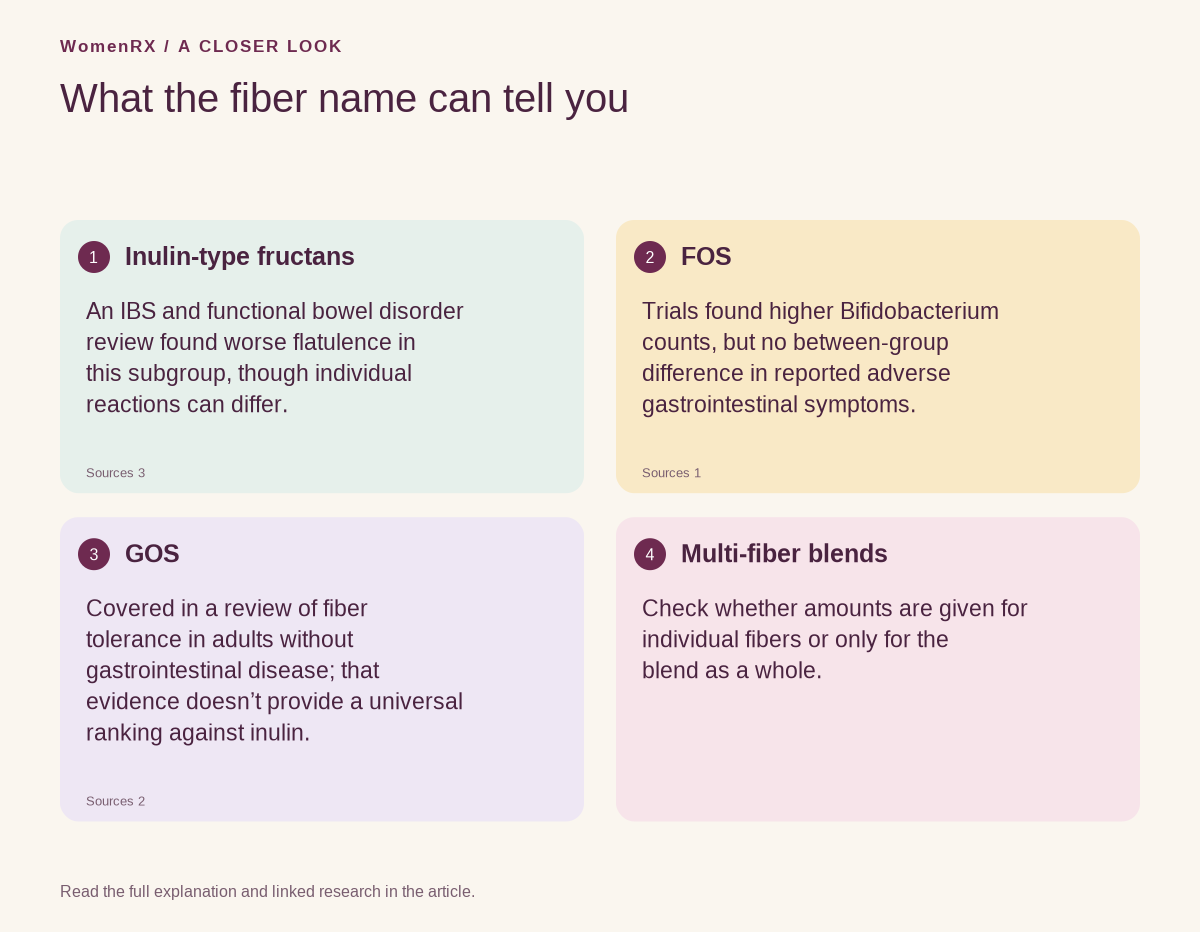
What the fiber name can tell you
Inulin-type fructans: An IBS and functional bowel disorder review found worse flatulence in this subgroup, though individual reactions can differ.3
FOS: Trials found higher Bifidobacterium counts, but no between-group difference in reported adverse gastrointestinal symptoms.1
GOS: Covered in a review of fiber tolerance in adults without gastrointestinal disease; that evidence doesn’t provide a universal ranking against inulin.2
Multi-fiber blends: Check whether amounts are given for individual fibers or only for the blend as a whole.
Read the figure as text
Use the ingredient name to find the most relevant evidence, then check whether the measured outcome matches your goal.- Inulin-type fructans: An IBS and functional bowel disorder review found worse flatulence in this subgroup, though individual reactions can differ.3
- FOS: Trials found higher Bifidobacterium counts, but no between-group difference in reported adverse gastrointestinal symptoms.1
- GOS: Covered in a review of fiber tolerance in adults without gastrointestinal disease; that evidence doesn’t provide a universal ranking against inulin.2
- Multi-fiber blends: Check whether amounts are given for individual fibers or only for the blend as a whole.
More questions, answered
Does a higher prebiotic serving mean better digestive results?
Not necessarily. Higher FOS doses were associated with larger changes in Bifidobacterium counts in a meta-analysis, but that finding doesn’t show better relief from bloating or other digestive symptoms. 1
Will a prebiotic help my IBS?
It isn’t a reliable assumption. Across randomized trials in adults with IBS or other functional bowel disorders, prebiotics did not improve digestive symptoms overall compared with placebo. Results differed by fiber type, including worse flatulence with inulin-type fructans in a subgroup analysis. 3
Sources you can check
- Effect of Fructooligosaccharides Supplementation on the Gut Microbiota in Human: A Systematic Review and Meta-Analysis.Dou Y, Yu X, Luo Y, Chen B, Ma D, Zhu J. · Nutrients · 2022Return to first citation
- Gastrointestinal Effects and Tolerance of Nondigestible Carbohydrate Consumption.Mysonhimer AR, Holscher HD. · Advances in nutrition (Bethesda, Md.) · 2022Return to first citation
- Prebiotics in irritable bowel syndrome and other functional bowel disorders in adults: a systematic review and meta-analysis of randomized controlled trials.Wilson B, Rossi M, Dimidi E, Whelan K. · The American journal of clinical nutrition · 2019Return to first citation