How to Compare Fish Oil: EPA, DHA, Testing, and Value
Compare the EPA and DHA you’ll actually get per serving, then look for clear, product-specific evidence about quality.
Start with the Supplement Facts panel: add the milligrams of EPA and DHA per serving, rather than relying on the total fish oil amount. Check how many capsules or how much liquid makes one serving, then compare cost per amount of EPA plus DHA. Testing disclosures can add useful transparency, but a quality phrase on its own doesn’t show what was tested or what the results were. 1 2 3
Read past the big number on the front
A bottle may advertise 1,000 mg of fish oil, but that number is not necessarily 1,000 mg of EPA and DHA. Those are two specific omega-3 fats. Find their separate amounts in the Supplement Facts panel and add them together to compare products.
A US study of supplement labels found wide variation in daily EPA and DHA amounts across products from leading manufacturers and retailers. Another product-label study also found a broad range of combined amounts per serving. 1 2
Check what counts as a serving
A serving might mean more than one capsule, or a stated amount of liquid. Use the serving size on the label when comparing products, and check how many servings the container holds. If one product provides more EPA and DHA per serving but requires several capsules, that may matter to you just as much as the headline amount.
Don’t treat a larger serving as a health recommendation. The amount that makes sense depends on why you’re considering fish oil and your circumstances. The label studies show what products contain or claim, not what amount a particular person should take. 1 2
Look for evidence behind quality language
Words such as “pure,” “fresh,” or “high quality” don’t tell you, by themselves, whether a product was checked for contaminants, oxidation, or whether its EPA and DHA match the label. If a company provides testing information, look for the specific product or batch, what was tested, and the results, rather than a broad promise. Testing for EPA and DHA content, contaminants, and oxidation addresses different questions.
That distinction matters because one analysis of fish oil products measured label content, oxidation indicators, and heavy metals, and reported variation in some results across the products studied. It wasn’t a survey of every fish oil product, so it can’t tell you whether a particular bottle on a store shelf meets a quality standard. The study also doesn’t establish that any one quality claim guarantees safety or effectiveness. 3
The two products compared below illustrate what a disclosure can and can’t tell you. NOW describes contaminant testing and links to a testing letter from 2022; that letter doesn’t establish results for a current batch. Nordic Naturals says it conducts third-party testing and offers a certificate-of-analysis lookup, but a certificate for a specific batch was not checked here. Neither disclosure proves a health benefit or makes one product the better choice. 6 7
Compare value per useful amount
To compare price, calculate the total EPA plus DHA in the container: combined milligrams per serving × servings per container. Then divide the price by that total. You can also convert the result to cost per 1,000 mg of combined EPA and DHA, which makes products with different serving sizes easier to compare.
Here’s how that math works with two US product listings checked September 26, 2026. NOW’s regular Omega-3 Fish Oil lists 2,000 mg of fish oil concentrate per two-softgel serving, but its 360 mg EPA and 240 mg DHA add up to 600 mg. At a listed $12.99 for 50 servings, that’s about $0.26 per serving or $0.43 per 1,000 mg EPA plus DHA, before tax or shipping. 6
Nordic Naturals Ultimate Omega Lemon soft gels list 1,280 mg total omega-3s per two-softgel serving. Its separately listed 650 mg EPA and 450 mg DHA add up to 1,100 mg. At a listed $29.95 for 30 servings, that’s about $1.00 per serving or $0.91 per 1,000 mg EPA plus DHA, before tax. These are different front-of-package quantities: NOW’s fish oil concentrate and Nordic’s total omega-3s should not be mistaken for EPA plus DHA. 7 6
This is a dated price comparison, not a recommendation to take 1,000 mg or a ranking of health outcomes. A lower cost per amount of EPA and DHA doesn’t establish that a product is better for your health. In a study of US supplement labels, health claims were common, but most were structure/function claims rather than FDA-reviewed qualified health claims; label language alone doesn’t show that a product delivers a claimed health outcome. 1
Pregnancy and breastfeeding call for a separate question
Pregnancy and breastfeeding aren’t just another reason to choose a product with a bigger EPA-plus-DHA number. A systematic review and meta-analysis of 11 trials in pregnant and/or breastfeeding women found no significant association between DHA/EPA supplementation and the child cognitive outcomes or birth weight it assessed. The authors also described limitations in the evidence, so this does not settle every possible outcome or establish that supplements have no role. 4
A separate review of studies during pregnancy and early postpartum reported wide variation in the omega-3 amounts studied and no clear consensus on effects across the pregnancy and infant outcomes it examined. 5 So, use label math to understand a product, but don’t use it alone to decide whether a supplement fits your pregnancy or breastfeeding needs. That is a different question from which bottle offers more EPA and DHA for its price.
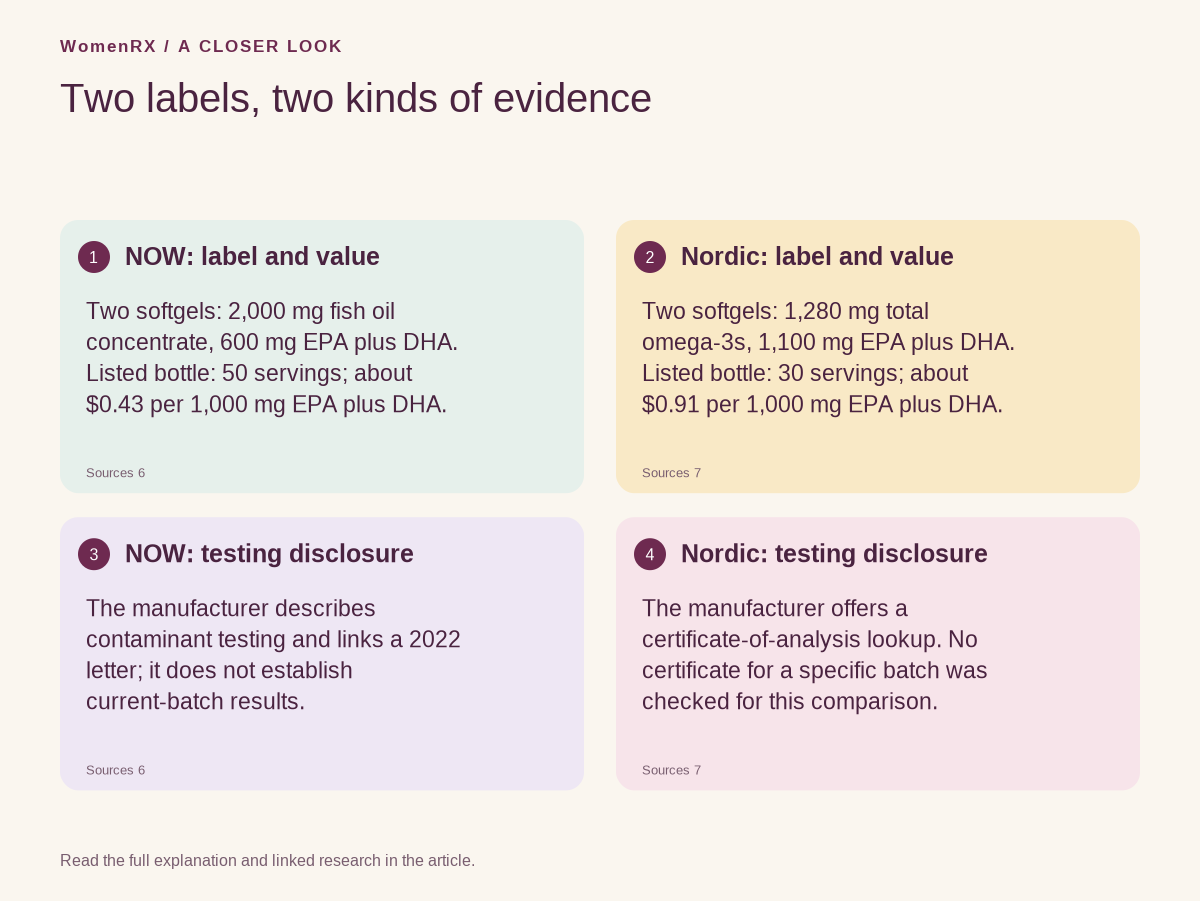
Two labels, two kinds of evidence
NOW: label and value: Two softgels: 2,000 mg fish oil concentrate, 600 mg EPA plus DHA. Listed bottle: 50 servings; about $0.43 per 1,000 mg EPA plus DHA.6
Nordic: label and value: Two softgels: 1,280 mg total omega-3s, 1,100 mg EPA plus DHA. Listed bottle: 30 servings; about $0.91 per 1,000 mg EPA plus DHA.7
NOW: testing disclosure: The manufacturer describes contaminant testing and links a 2022 letter; it does not establish current-batch results.6
Nordic: testing disclosure: The manufacturer offers a certificate-of-analysis lookup. No certificate for a specific batch was checked for this comparison.7
Read the figure as text
The September 26, 2026 listings show why EPA plus DHA, price, and testing need separate checks.- NOW: label and value: Two softgels: 2,000 mg fish oil concentrate, 600 mg EPA plus DHA. Listed bottle: 50 servings; about $0.43 per 1,000 mg EPA plus DHA.6
- Nordic: label and value: Two softgels: 1,280 mg total omega-3s, 1,100 mg EPA plus DHA. Listed bottle: 30 servings; about $0.91 per 1,000 mg EPA plus DHA.7
- NOW: testing disclosure: The manufacturer describes contaminant testing and links a 2022 letter; it does not establish current-batch results.6
- Nordic: testing disclosure: The manufacturer offers a certificate-of-analysis lookup. No certificate for a specific batch was checked for this comparison.7
More questions, answered
Is more total fish oil the same as more EPA and DHA?
No. Total fish oil and the amounts of EPA and DHA are separate label figures. Add the listed EPA and DHA amounts to compare the combined amount in a serving. 1 2
Does a fish oil health claim tell me how much EPA and DHA is inside?
No. Check the Supplement Facts panel for the amounts. A study of US supplement labels found substantial variation in EPA and DHA amounts, while health claims appeared on many products. 1
Sources you can check
- Health Claims and Doses of Fish Oil Supplements in the US.Assadourian JN, Peterson ED, McDonald SA, Gupta A, Navar AM. · JAMA cardiology · 2023Return to first citation
- Analysis of Omega-3 Fatty Acid Content in Fish Oil Products.Ward ED, Thomasson K, Fischer KR. · Journal of pharmacy practice · 2022Return to first citation
- Assessment of the safety of dietary fish oil supplements in terms of content and quality.Ozyurt G, Ekmen D, Durmuş M, Ucar Y. · Environmental science and pollution research international · 2022Return to first citation
- Impact of omega-3 fatty acid DHA and EPA supplementation in pregnant or breast-feeding women on cognitive performance of children: systematic review and meta-analysis.Lehner A, Staub K, Aldakak L, Eppenberger P, Rühli F, Martin RD, Bender N. · Nutrition reviews · 2021Return to first citation
- Effect of supplementary omega-3 fatty acids on pregnant women with complications and pregnancy outcomes: review from literature.Chowdhury MH, Ghosh S, Kabir MR, Mamun MAA, Islam MS. · The journal of maternal-fetal & neonatal medicine : the official journal of the European Association of Perinatal Medicine, the Federation of Asia and Oceania Perinatal Societies, the International Society of Perinatal Obstetricians · 2022Return to first citation
- NOW Omega-3 Fish Oil, Molecularly Distilled Softgels: current product factsAccessed 2026-09-26Return to first citation
- Nordic Naturals Ultimate Omega lemon soft gels: current product factsAccessed 2026-09-26Return to first citation