How PID Develops and When Pelvic Pain Needs Care
Pelvic inflammatory disease can follow an infection that travels upward into the reproductive tract, but it isn’t always caused by an STI or accompanied by obvious symptoms.
PID develops when bacteria reach the upper reproductive tract. Chlamydia and gonorrhea are common causes, but other vaginal bacteria can also be involved. Symptoms may be mild or absent, and no single test confirms PID. To lower risk, avoid douching and take steps to reduce STI exposure, including condoms and testing when exposure is possible. Seek prompt care for pelvic pain, especially if pregnancy is possible. 1 2 3
How an infection can reach the upper reproductive tract
PID is an infection and inflammation involving the upper reproductive tract, such as the uterus, fallopian tubes, and ovaries. It can develop when bacteria move upward from the lower genital tract. Chlamydia and gonorrhea are common causes, but they aren’t the only ones: bacteria that normally live in the vagina can also be involved. Some cases are linked to procedures that open the cervix. 1 3 4
That means PID is often connected to an STI, but it isn’t proof that someone has one. A clinician may consider STI exposure as one part of the assessment, while also considering other possible causes. 1 3
Symptoms can be subtle, or missing
The most common symptom is pain in the lower abdomen or pelvis. Other possible signs include unusual vaginal discharge, pain deep inside during sex, bleeding between periods or after sex. In the clinical criteria used for a Netherlands cohort, fever was one of several possible accompanying findings, not a required one. 1 3 5 Symptoms may come on quickly or build gradually. Some people with PID have mild symptoms or none at all. 1 3 4 Because fever wasn’t required by those criteria, its absence alone doesn’t rule out PID. 5
These symptoms can have causes other than PID, too. They aren’t a way to diagnose yourself, but they’re a reason to get assessed, particularly if you may have been exposed to an STI or the pain is new or persistent. 1 3
Steps that can lower risk
Because chlamydia and gonorrhea are common causes of PID, reducing STI exposure can help address one important route to the infection. Not having sex is the surest way to avoid STIs. If you do have sex, using condoms is advised. STI testing can also matter because many STIs have no symptoms; when an STI is identified, bacterial infections can be treated with antibiotics. 1 2 3
Avoid douching: it can upset the balance of bacteria in the vagina. These steps can’t prevent every case of PID, since bacteria that normally live in the vagina and some procedures that open the cervix can also be involved. 1 3
Why clinicians may act on the overall picture
There isn’t one test that confirms PID. A clinician may consider your symptoms and examination along with tests such as blood or urine tests, STI testing, or imaging. The diagnosis is clinical: the overall findings matter, not just one result. 1 5
A negative test for one STI doesn’t identify every possible cause of pelvic inflammation. PID can involve bacteria other than chlamydia or gonorrhea, and symptoms can be nonspecific. That’s why a clinician may decide that treatment is appropriate based on the overall assessment rather than waiting for one test to settle the question. 3 4 5
When to seek care
Arrange prompt medical evaluation for pelvic or lower abdominal pain, unusual discharge, pain during sex, or bleeding between periods or after sex, especially if you think you may have been exposed to an STI. Early treatment matters because untreated PID can lead to scarring and raise the risk of infertility, ectopic pregnancy, or ongoing pelvic pain. 1 3
If you’re pregnant or might be, get urgent medical assessment for pelvic pain; don’t assume the pain is PID. Severe or worsening pain, or pain that hurts with movement or touch, needs emergency evaluation. 3
The practical takeaway: seek assessment for concerning symptoms rather than using a test result or suspected STI exposure as the sole deciding factor. A clinician can evaluate the possibilities and determine whether treatment is needed.
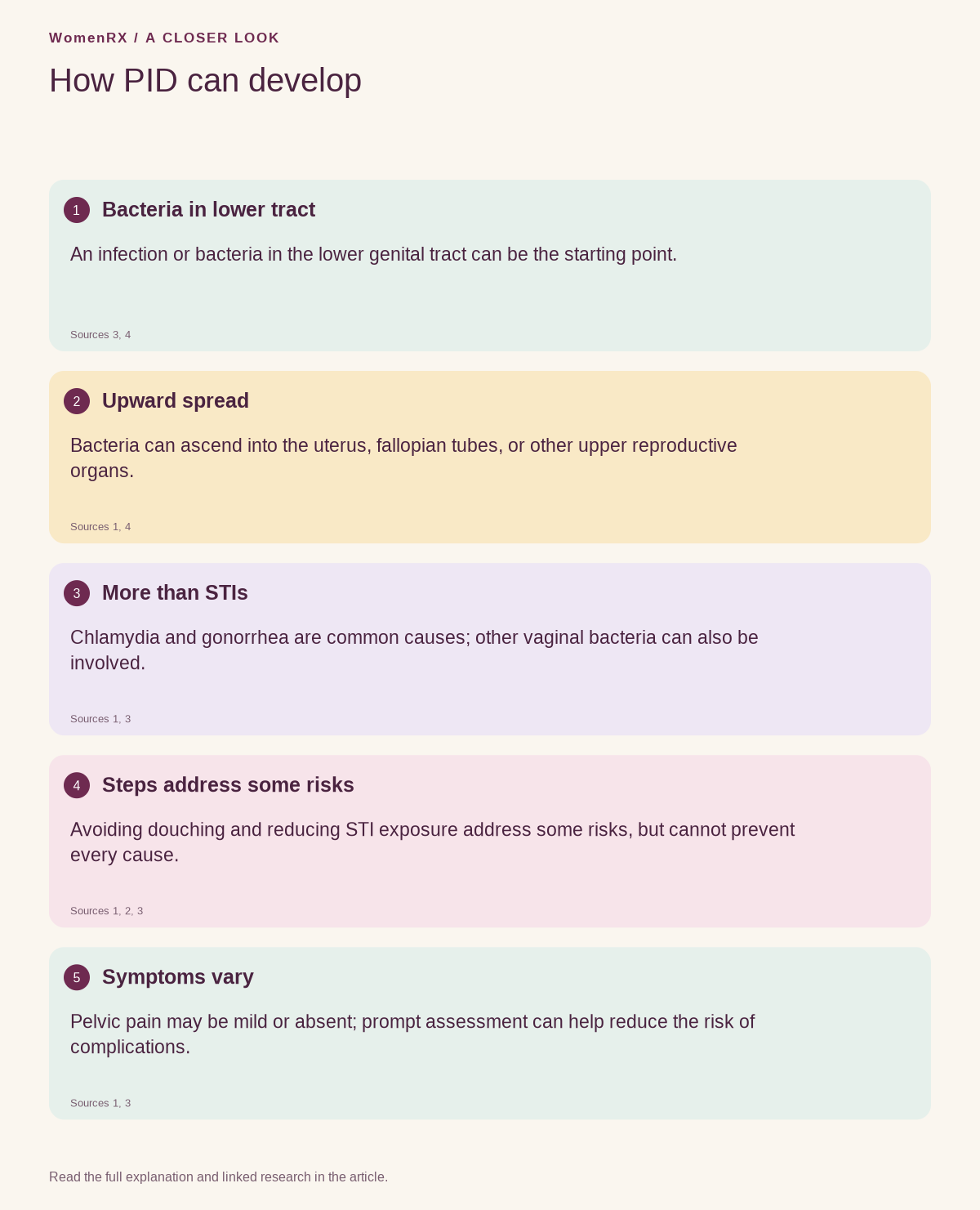
How PID can develop
Bacteria in lower tract: An infection or bacteria in the lower genital tract can be the starting point.34
Upward spread: Bacteria can ascend into the uterus, fallopian tubes, or other upper reproductive organs.14
More than STIs: Chlamydia and gonorrhea are common causes; other vaginal bacteria can also be involved.13
Steps address some risks: Avoiding douching and reducing STI exposure address some risks, but cannot prevent every cause.123
Symptoms vary: Pelvic pain may be mild or absent; prompt assessment can help reduce the risk of complications.13
Read the figure as text
A simplified view of how bacteria may reach the upper reproductive tract, why there isn’t just one cause, and which practical steps address some risks.- Bacteria in lower tract: An infection or bacteria in the lower genital tract can be the starting point.34
- Upward spread: Bacteria can ascend into the uterus, fallopian tubes, or other upper reproductive organs.14
- More than STIs: Chlamydia and gonorrhea are common causes; other vaginal bacteria can also be involved.13
- Steps address some risks: Avoiding douching and reducing STI exposure address some risks, but cannot prevent every cause.123
- Symptoms vary: Pelvic pain may be mild or absent; prompt assessment can help reduce the risk of complications.13
More questions, answered
Can you have PID without an STI?
Yes. Chlamydia and gonorrhea are common causes, but bacteria that normally live in the vagina and other non-STI-related causes can also be involved. 1 3
Does PID always cause fever?
No. In the clinical criteria used for a Netherlands cohort, fever was one possible finding among several, rather than a requirement. PID can also cause mild or no symptoms, so fever’s absence alone doesn’t rule it out. 1 4 5
Can anything prevent every case of PID?
No single prevention step covers every cause. Reducing STI exposure and avoiding douching may address some risks, but PID can also involve vaginal bacteria or follow procedures that open the cervix. 1 3
Sources you can check
- Pelvic Inflammatory Disease | PID | MedlinePlusAccessed 2026-09-25Return to first citation
- Sexually Transmitted Infections | MedlinePlusAccessed 2026-09-25Return to first citation
- Pelvic inflammatory disease - NHSAccessed 2026-09-25Return to first citation
- Non-Sexually Transmitted Infection (STI)-Related Pelvic Inflammatory Disease (PID).Polyzou E, Ntalaki E, Gavatha M, Akinosoglou K. · Microorganisms · 2025Return to first citation
- Limited Role of Mycoplasma genitalium, Chlamydia trachomatis, and Neisseria gonorrhoeae in Pelvic Inflammatory Disease and Tubo-Ovarian Abscess in the Netherlands: A Multicenter Prospective Cohort Study.Adriaens N, Bruisten SM, Vergunst CE, Jongen VW, Braam JF, Nijhuis RHT, Bukman A, van Kesteren PJM, Gruteke P, van Doorenmaalen M, van Dam AP. · Obstetrics and gynecology international · 2026Return to first citation