When to Get STI Testing After a New Partner or Exposure
You can arrange testing now, even if you feel fine, but the right samples and any follow-up depend on what happened and when.
If you have symptoms, a partner has an STI, or you’re worried about a recent exposure, arrange an STI evaluation rather than waiting for a single “right” testing day. Tell the clinician when the contact happened and whether it involved vaginal, oral, or anal sex; that helps determine which samples to take. An STI may not show up on a test immediately, and HIV detection windows differ by test type. 146
Start with the reason you’re testing
A new partner is a good reason to check whether you’re due for routine screening. Symptoms or a partner’s STI diagnosis call for a more specific conversation, even if you were screened recently. Many STIs cause no symptoms, while possible symptoms include unusual discharge, pain when you pee, sores, unusual bleeding, or anal discomfort. Tell the testing clinician what you’ve noticed rather than trying to choose tests from symptoms alone. 126
You don’t have to wait for symptoms to appear before making that appointment. But testing immediately after a possible exposure may not settle every question: an STI may not show up on a test right away. Ask which results can be interpreted now and whether any test should be repeated based on the exposure date and the particular test used. 1 HIV research, for example, shows that detection windows differ among HIV test types. That doesn’t establish one waiting period for every STI. 4
If you think the exposure could involve HIV and it happened within the past 72 hours, seek an urgent assessment rather than waiting for a testing window to pass. HIV post-exposure prevention is time-sensitive and may be considered during that period. 3
Ask for tests that match the contact
There isn’t one sample that checks every body site or every STI. Depending on your history, testing may involve blood, urine, or a vaginal, throat, or rectal swab. If you’ve had oral or anal sex, say so and ask whether throat or rectal testing makes sense. A vaginal or urine sample alone may not answer a question about those sites. 6
Here’s a practical way to start the conversation: “My last possible exposure was [date]. We had [types of sexual contact]. I have [symptoms, if any], and my partner was diagnosed with [infection, if known]. Which infections and body sites should we test, and will any negative result need follow-up?” The details help distinguish routine screening from evaluation of a particular exposure. CDC guidance says test choice depends on age, sexual practices, symptoms, and other risk factors. 6
Chlamydia and gonorrhea are common tests to discuss, but they aren’t a complete STI check. Ask whether HIV and syphilis testing belongs in your plan, too, especially if you don’t know when you were last tested. Other tests may depend on a partner’s diagnosis, your symptoms, and your history. CDC recommends HIV testing at least once for everyone ages 13 through 64 and HIV testing for women seeking STI evaluation. 67
Know what routine screening does, and doesn’t, cover
If you’re sexually active and younger than 25, CDC recommends chlamydia and gonorrhea screening every year. At 25 or older, annual screening for those infections may be appropriate if you have a new partner, multiple partners, or a partner with an STI. These are screening recommendations for people who may feel well, not instructions to wait until your next annual visit when you have symptoms or a known exposure. 6
If you’re pregnant, tell your prenatal care team about a new exposure or symptoms rather than assuming earlier tests cover what happened later. CDC recommends testing for syphilis, HIV, hepatitis B, and hepatitis C starting early in pregnancy. Some pregnant people need chlamydia and gonorrhea testing or repeat testing, depending on age and risk. 67
A Pap test or high-risk HPV test answers a different question: it screens for cervical cell changes or HPV types associated with cervical cancer. Having cervical screening doesn’t mean you’ve been tested for chlamydia, gonorrhea, HIV, or other STIs. You can ask about both at the same visit. 56
Make a plan for the result
Before you leave or finish a home-testing order, find out which infections the tests actually cover, when results are expected, and whom to contact about them. Some STIs can be tested for at home or with samples you collect and mail to a lab, but the available options differ by infection and sample type. If you have symptoms or a partner’s diagnosis, make sure the testing plan addresses those specifics rather than relying on a kit name that sounds comprehensive. 6
Two kinds of follow-up are easy to mix up. Repeat testing after a very recent exposure addresses the possibility that the first test was too early; ask whether that applies to the infection and test in question. 14 Retesting after treatment can look for a new infection: CDC recommends retesting about three months after treatment for chlamydia or gonorrhea. In pregnancy, chlamydia also has a separate test-of-cure recommendation four weeks after treatment. Ask which kind of follow-up applies to you. 7
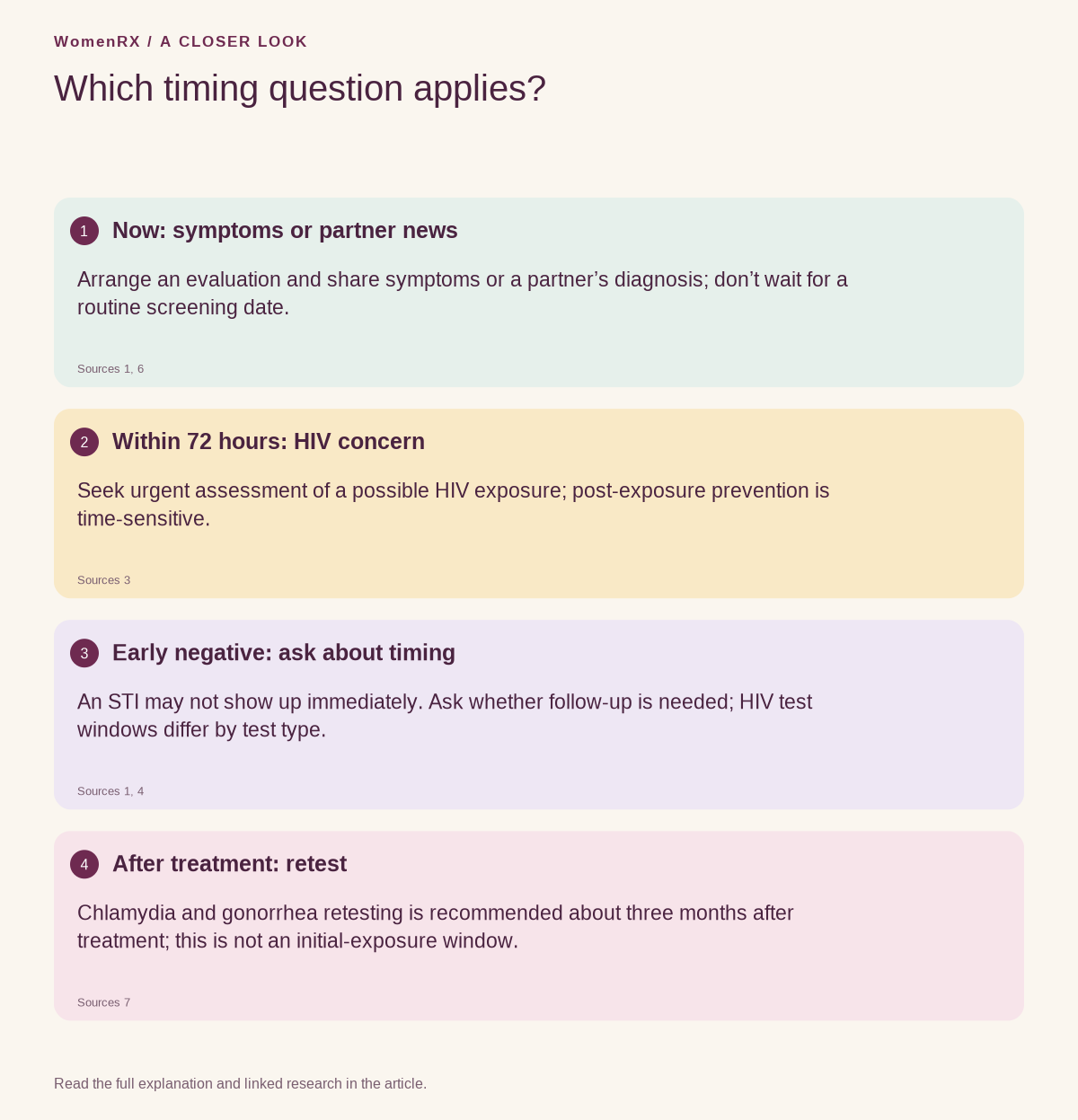
Which timing question applies?
Now: symptoms or partner news: Arrange an evaluation and share symptoms or a partner’s diagnosis; don’t wait for a routine screening date.16
Within 72 hours: HIV concern: Seek urgent assessment of a possible HIV exposure; post-exposure prevention is time-sensitive.3
Early negative: ask about timing: An STI may not show up immediately. Ask whether follow-up is needed; HIV test windows differ by test type.14
After treatment: retest: Chlamydia and gonorrhea retesting is recommended about three months after treatment; this is not an initial-exposure window.7
Read the figure as text
These are different reasons to act or test, not stages of one universal STI testing schedule.- Now: symptoms or partner news: Arrange an evaluation and share symptoms or a partner’s diagnosis; don’t wait for a routine screening date.16
- Within 72 hours: HIV concern: Seek urgent assessment of a possible HIV exposure; post-exposure prevention is time-sensitive.3
- Early negative: ask about timing: An STI may not show up immediately. Ask whether follow-up is needed; HIV test windows differ by test type.14
- After treatment: retest: Chlamydia and gonorrhea retesting is recommended about three months after treatment; this is not an initial-exposure window.7
Sources you can check
- Sexually transmitted infections (STIs) - NHSAccessed 2026-09-25Return to first citation
- Sexually Transmitted Infections | MedlinePlusAccessed 2026-09-25Return to first citation
- Research designs to generate evidence of HIV post-exposure prophylaxis effectiveness for new long-acting agents.Ortblad KF, Brown ER, Heffron R, Ngure K, Mujugira A, Donnell D. · Journal of the International AIDS Society · 2025Return to first citation
- Time Until Emergence of HIV Test Reactivity Following Infection With HIV-1: Implications for Interpreting Test Results and Retesting After Exposure.Delaney KP, Hanson DL, Masciotra S, Ethridge SF, Wesolowski L, Owen SM. · Clinical infectious diseases : an official publication of the Infectious Diseases Society of America · 2017Return to first citation
- Cervical Cancer Screening | Pap Smear | HPV | MedlinePlusAccessed 2026-09-25Return to first citation
- Getting Tested for STIs | STI | CDCAccessed 2026-09-25Return to first citation
- STI Screening RecommendationsAccessed 2026-09-25Return to first citation