How Long Does One Hot Flash Last?
One hot flash may last minutes, while recurring flashes can continue for years across the menopausal transition.
A single hot flash may last from about 3 or 4 minutes to around an hour.4 The years during which hot flashes recur are a separate question: a prospective study of 187 women in urban China reported a median duration of 4.5 years.1 Neither figure can tell you when your own symptoms will stop.
One episode is not the whole timeline
When you ask how long a hot flash lasts, you might mean the wave of heat you’re feeling right now. Or you might mean how many years those waves will keep coming back. Those are different clocks.
A review describes individual hot flashes lasting from about 3 or 4 minutes to around an hour.4 That tells you about one episode, not how often episodes happen. For example, a brief flash that wakes you repeatedly can affect your sleep more than its length alone suggests. Hot flashes and night sweats can disrupt sleep and daily activities.4
What a years-long median does, and doesn’t, tell you
In a prospective study that enrolled 187 women from an urban community in China, the median duration of hot flashes was 4.5 years.1 A median marks the middle of the durations recorded in that group. It isn’t a countdown that starts when your first flash appears, and it doesn’t mean symptoms stop after four and a half years for everyone.
The study found that whether women had vasomotor symptoms was related to menopause stage.1 Hot flashes can occur during perimenopause and after menopause, so reaching postmenopause doesn’t necessarily bring an immediate end to them.4 Neither your stage nor the study’s median gives you a dependable personal end date. The cohort offers a useful example of symptoms lasting years, but its result shouldn’t be treated as a forecast for every woman.
It can help to keep three questions separate: How long does a flash last? How often does it happen? And over how many years do flashes recur? A change in one doesn’t, by itself, answer the others.
You don’t have to wait for a predicted end date
If flashes or night sweats are disrupting your sleep or day, you can consider symptom relief without knowing how long they’ll continue. The North American Menopause Society identifies hormone therapy as the most effective treatment for vasomotor symptoms, with benefits and risks that depend on a woman’s circumstances. Its nonhormone guidance also recommends options including cognitive behavioral therapy, clinical hypnosis, and certain prescription medicines.23 These approaches are meant to reduce bothersome symptoms; the duration figures above are not a reason to wait them out.
Two clocks for hot flashes
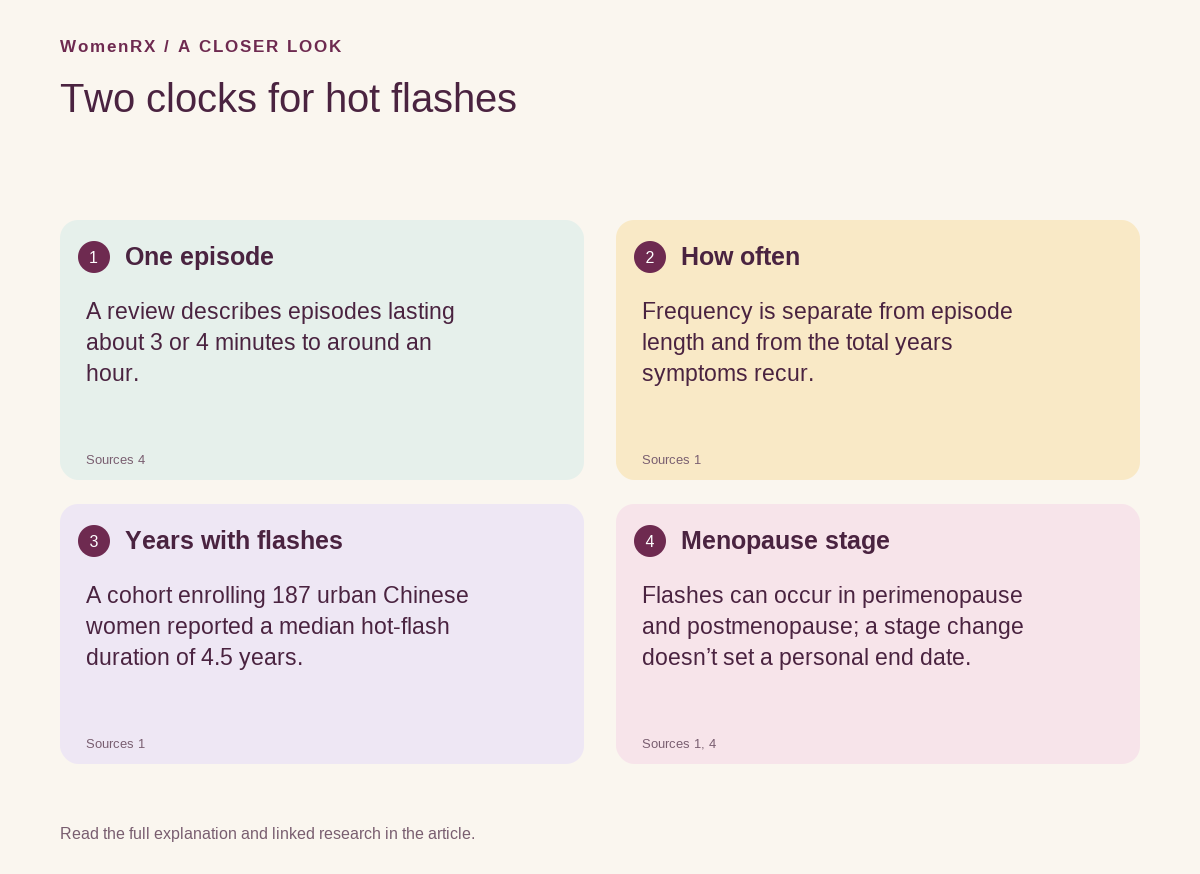
One episode: A review describes episodes lasting about 3 or 4 minutes to around an hour.4
How often: Frequency is separate from episode length and from the total years symptoms recur.1
Years with flashes: A cohort enrolling 187 urban Chinese women reported a median hot-flash duration of 4.5 years.1
Menopause stage: Flashes can occur in perimenopause and postmenopause; a stage change doesn’t set a personal end date.14
Read the figure as text
Compare the length of one episode with the years during which episodes may recur. They answer different questions.- One episode: A review describes episodes lasting about 3 or 4 minutes to around an hour.4
- How often: Frequency is separate from episode length and from the total years symptoms recur.1
- Years with flashes: A cohort enrolling 187 urban Chinese women reported a median hot-flash duration of 4.5 years.1
- Menopause stage: Flashes can occur in perimenopause and postmenopause; a stage change doesn’t set a personal end date.14
Sources you can check
- Vasomotor symptoms in aging Chinese women: findings from a prospective cohort study.Li J, Luo M, Tang R, Sun X, Wang Y, Liu B, Cui J, Liu G, Lin S, Chen R. · Climacteric : the journal of the International Menopause Society · 2020Return to first citation
- The 2022 hormone therapy position statement of The North American Menopause Society.“The 2022 Hormone Therapy Position Statement of The North American Menopause Society” Advisory Panel. · Menopause (New York, N.Y.) · 2022Return to first citation
- The 2023 nonhormone therapy position statement of The North American Menopause Society.Menopause (New York, N.Y.) · 2023Return to first citation
- Evening Primrose Oil for Menopause Hot Flashes: Systematic Review and Meta-Analysis.Thevi T, De S, Soe HHK. · Journal of menopausal medicine · 2024Return to first citation