Hives: What Might Be Triggering Them, and When It’s Urgent
A hive may fade while new ones appear, but breathing trouble, throat symptoms, or faintness call for emergency help.
Hives are usually itchy, raised bumps or patches that change shape or location. An individual wheal typically fades within 24 hours, though new ones can appear; recurring wheals or swelling for more than six weeks fit the chronic urticaria timeframe. Note patterns without assuming every flare is an allergy. Get emergency help for breathing trouble, throat symptoms, or faintness with a sudden reaction. 1 7 6 5
Start with the patch in front of you
Hives, also called urticaria, can look like raised bumps or larger patches in many shapes and sizes. They usually itch, but may sting or burn. On brown or Black skin, color changes may be hard to see, so the raised texture can be a more useful clue. 1
Watch one patch rather than judging the whole rash at once. An individual wheal typically lasts no more than 24 hours, even when fresh patches appear elsewhere. A photo when the rash is visible, followed by a note about whether that same spot faded, gives you a clearer description if you need care. If a patch stays fixed or the rash doesn’t resemble raised, itchy wheals, it’s worth having someone assess what else it might be. 7 1
A clue isn’t necessarily a cause
For a new flare, note when it started and what happened beforehand. For example, you might record a new medicine, a recent illness, something that touched your skin, or an activity that repeatedly comes before a flare. Add any lip or facial swelling and symptoms beyond the skin. If hives recur, keep the entries short and look for a consistent pattern rather than changing several foods or products at once. Trying to identify an avoidable trigger can help, but a pattern in a diary does not prove what caused the rash. 1 5
Hives can be part of an allergic reaction. They can also recur without a clear outside trigger. Chronic spontaneous urticaria describes recurring itchy wheals, swelling under the skin, or both for more than six weeks; the name does not mean you missed an obvious allergy. 5 6
If you suspect a prescribed medicine, write down its name and the timing of the flare, then contact the prescriber or pharmacist about what to do. Don’t stop it on your own based only on a suspected connection.
Choose the right level of help
Get emergency help now if a sudden reaction comes with trouble breathing, wheezing, throat tightness, a hoarse voice, faintness, or collapse. Sudden tongue or throat swelling is also an emergency. Anaphylaxis can involve hives, but it can happen without any visible rash. If you have an epinephrine auto-injector and a personal emergency plan, follow that plan; an antihistamine is not a substitute for epinephrine in anaphylaxis. 5 4
Arrange a routine assessment if the hives keep returning, disrupt sleep or daily life, or continue over the six-week chronic-urticaria timeframe. You needn’t wait six weeks to ask for help with a troublesome rash. Swelling without hives also deserves assessment: it does not always have the same cause as an itchy hive, and some medicines, including ACE inhibitors, are associated with a different type of swelling. 6 4
For an uncomplicated itchy flare, ask about symptom relief. Antihistamines are used for hives. Cetirizine is one option, but it can make some people sleepy, despite being described as a less-drowsy antihistamine. Loratadine and fexofenadine are other options discussed alongside it. A pharmacist can help you weigh suitability, particularly if you have a long-term condition or take other medicines. Don’t combine antihistamines unless a clinician recommends it. 1 2 3
What if flares seem to follow your cycle?
If episodes appear to line up with your menstrual cycle, pregnancy, or a change around menopause, include that timing in your notes. It’s a useful question to raise, not proof that hormones caused the hives. A systematic review found limited evidence on how chronic spontaneous urticaria differs by sex and gender; it discussed possible hormonal associations but did not establish a hormone-based explanation or treatment for an individual woman. If you’re pregnant, mention that when asking which symptom-relief option is appropriate for you. 6
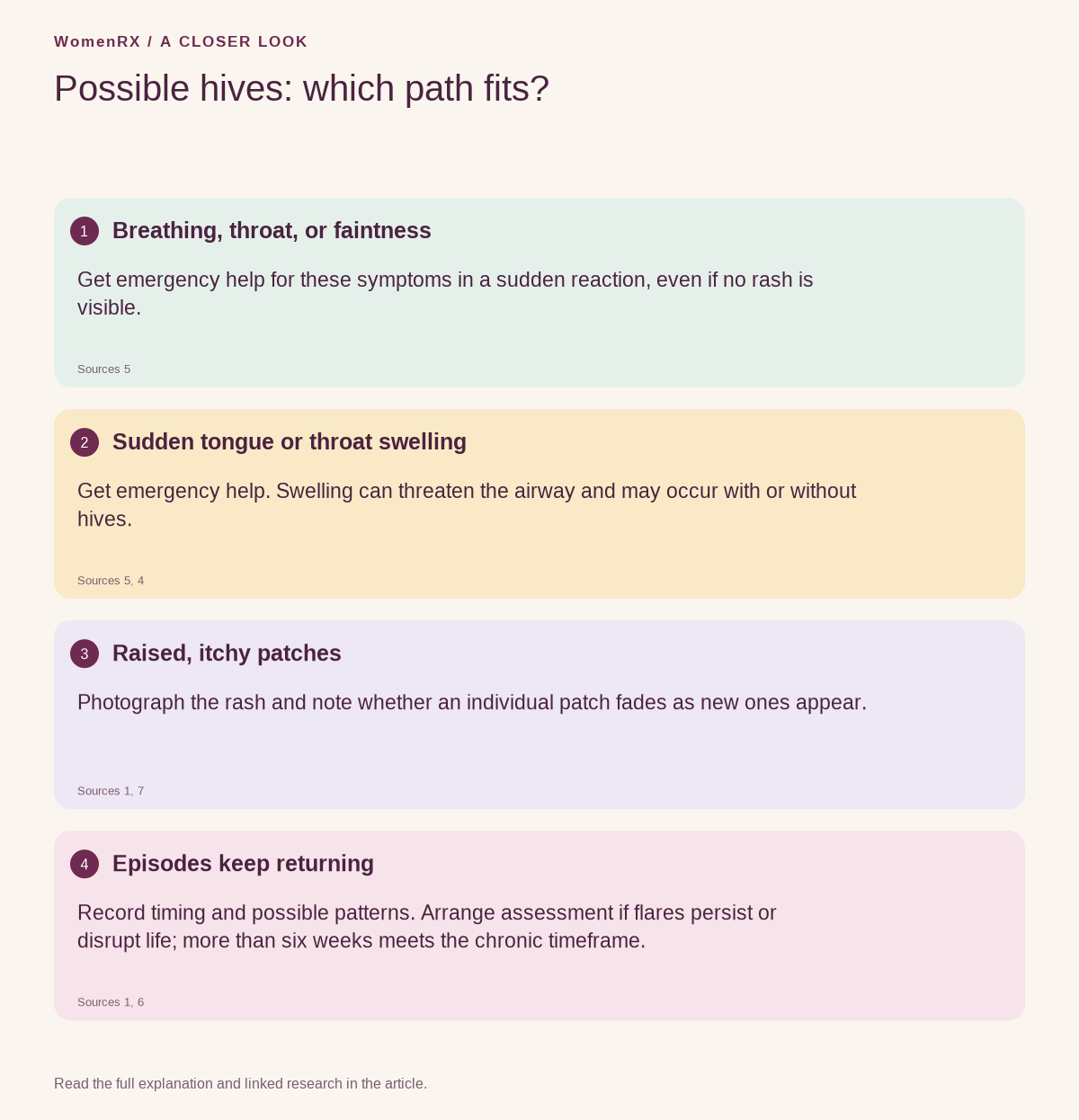
Possible hives: which path fits?
Breathing, throat, or faintness: Get emergency help for these symptoms in a sudden reaction, even if no rash is visible.5
Sudden tongue or throat swelling: Get emergency help. Swelling can threaten the airway and may occur with or without hives.54
Raised, itchy patches: Photograph the rash and note whether an individual patch fades as new ones appear.17
Episodes keep returning: Record timing and possible patterns. Arrange assessment if flares persist or disrupt life; more than six weeks meets the chronic timeframe.16
Read the figure as text
Start with symptoms beyond the skin, then consider how an individual patch behaves and whether episodes recur.- Breathing, throat, or faintness: Get emergency help for these symptoms in a sudden reaction, even if no rash is visible.5
- Sudden tongue or throat swelling: Get emergency help. Swelling can threaten the airway and may occur with or without hives.54
- Raised, itchy patches: Photograph the rash and note whether an individual patch fades as new ones appear.17
- Episodes keep returning: Record timing and possible patterns. Arrange assessment if flares persist or disrupt life; more than six weeks meets the chronic timeframe.16
More questions, answered
Does recurring hives mean I need an allergy test?
Not automatically. Chronic spontaneous urticaria can recur without a clear outside trigger. Bring photos and a brief record of the timing and any repeatable exposures to an assessment; those details can help guide what questions are worth pursuing. 6 1
Sources you can check
- Hives - NHSAccessed 2026-09-25Return to first citation
- About cetirizine - NHSAccessed 2026-09-25Return to first citation
- Common questions about cetirizine - NHSAccessed 2026-09-25Return to first citation
- Isolated angioedema in the emergency department: rarely an allergic reaction.Weerheim M, Steenvoorden S, Leuning D, Briët-Schipper N, Karim F. · The American journal of emergency medicine · 2026Return to first citation
- Anaphylaxis.Abrams EM, Alqurashi W, Fischer DA, Vander Leek TK, Ellis AK. · Allergy, asthma, and clinical immunology : official journal of the Canadian Society of Allergy and Clinical Immunology · 2024Return to first citation
- Is there a difference between women and men in chronic spontaneous urticaria? A systematic review on gender and sex differences in CSU patients.Preis S, Claussen C, Ziehfreund S, Biedermann T, Horster S, Zink A. · The World Allergy Organization journal · 2024Return to first citation
- Commonalities and differences in gene expression patterns in major depressive disorder and chronic spontaneous urticaria: implications for comorbidity.Jiang Y, Li W, Zheng L, Ba N. · Frontiers in genetics · 2025Return to first citation