Can Antihistamines Affect Weight? What to Review
The evidence doesn’t show that every antihistamine causes weight gain, so the specific medicine and the rest of your medication picture matter.
A weight change while taking an antihistamine is worth reviewing, but it doesn’t prove the medicine caused it. A systematic review described weight-change evidence for antihistamines as statistically nonsignificant or very low quality; an adult survey found an association with obesity but could not establish cause and effect. Review the exact drug, how often you take it, sleepiness, and other recent medication changes before considering a change. 3 6
The evidence is mixed, not a class-wide verdict
“Antihistamine” covers different medicines, and the available findings don’t support treating them as interchangeable when it comes to weight. A systematic review of randomized trials described weight changes for antihistamines as either not statistically significant or supported by very low-quality evidence. That leaves room for uncertainty about particular medicines, but it is not strong evidence that routine use causes weight gain. 3
A separate study using US adult survey data found that people taking prescription H1 antihistamines had higher weight, waist circumference, and insulin levels than matched adults who weren’t taking them. The study matched participants by age and gender, but its reported results don’t give a women-specific estimate. And an association in a survey can’t show whether the medicine caused the difference, or whether factors such as the reason for taking it or other medicines played a part. 6
The systematic review discusses antihistamines at the group level; its reported findings don’t establish whether cetirizine, fexofenadine, or another particular medicine has a different weight effect. That’s a limit on what these findings can tell you, not proof that no individual-drug research exists. A blanket claim about the whole class goes further than the evidence allows. 3
What to review before changing treatment
Start with the details that can make your situation clearer:
- Which medicine is it? Check the active ingredient, not just the brand name. The research findings summarized above don’t establish a weight effect for a particular antihistamine. 3
- How often have you been taking it? Note whether it’s occasional or regular use, and whether that pattern changed around the time your weight changed. Cetirizine and fexofenadine instructions describe use that may be brief or longer-term to prevent seasonal symptoms. That difference helps establish your exposure; it does not compare the medicines’ effects on weight. 1 2
- Has it made you sleepy? A review describes sedation as a concern with first-generation medicines and says second-generation medicines generally have a better safety profile. Sleepiness is a separate practical issue from proven weight gain, but it belongs in the medication review. 4
- What else changed? Note other medicines started or adjusted around the same time. Many types of medication can affect weight, so it can be misleading to focus on an antihistamine without looking at the wider picture. 3
- What are you treating? The best option depends on whether you’re treating symptoms such as allergic rhinitis or hives, how well the current medicine works, and whether side effects are getting in the way. 4
These details don’t diagnose the cause of a weight change. They help make a conversation about benefits, side effects, and alternatives more specific.
Sleepiness and weight are different questions
Some first-generation antihistamines can cause sedation. A review discusses weight gain among possible limitations of H1-blocking medicines and suggests that effects beyond H1 blocking may contribute for some older drugs. That is a proposed explanation, not proof that a particular antihistamine will change your weight. 4 5
If the medicine makes you drowsy, mention when you take it and how that affects your day. A less-sedating option may be worth discussing, but the right choice depends on what you’re treating and how well your current medicine controls it. A review summarizing guidance recommends second-generation antihistamines as first-line options for allergic rhinitis and urticaria, while noting they generally have a better safety profile. This isn’t a reason to stop an effective treatment on your own; it’s a reason to ask whether another approach could meet your needs. 4
A useful way to frame the review
You might say: “I’ve noticed a weight change while taking [ingredient] for [symptoms]. I use it [how often], and it [does or doesn’t] make me sleepy. Could this medicine be contributing, and what alternatives would still control my symptoms?” Bring the names of other medicines that changed during the same period, too.
The key is to review the actual medicine and circumstances, rather than assuming either that the antihistamine caused the change or that it couldn’t have played a role. The evidence is not strong enough to settle that question for every person or every drug.
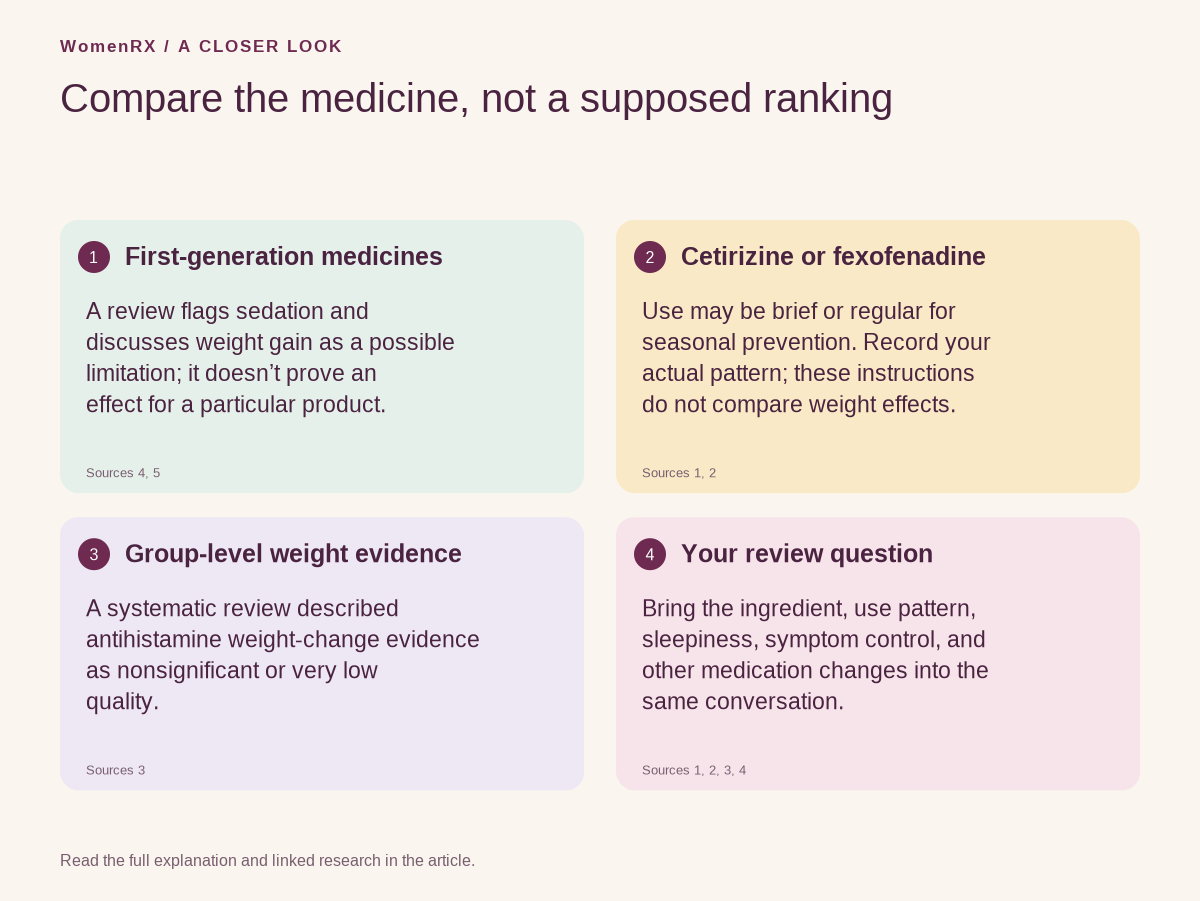
Compare the medicine, not a supposed ranking
First-generation medicines: A review flags sedation and discusses weight gain as a possible limitation; it doesn’t prove an effect for a particular product.45
Cetirizine or fexofenadine: Use may be brief or regular for seasonal prevention. Record your actual pattern; these instructions do not compare weight effects.12
Group-level weight evidence: A systematic review described antihistamine weight-change evidence as nonsignificant or very low quality.3
Your review question: Bring the ingredient, use pattern, sleepiness, symptom control, and other medication changes into the same conversation.1234
Read the figure as text
Different kinds of information help answer different questions: what the research says about weight, how your specific medicine is used, and whether sleepiness matters for you.- First-generation medicines: A review flags sedation and discusses weight gain as a possible limitation; it doesn’t prove an effect for a particular product.45
- Cetirizine or fexofenadine: Use may be brief or regular for seasonal prevention. Record your actual pattern; these instructions do not compare weight effects.12
- Group-level weight evidence: A systematic review described antihistamine weight-change evidence as nonsignificant or very low quality.3
- Your review question: Bring the ingredient, use pattern, sleepiness, symptom control, and other medication changes into the same conversation.1234
More questions, answered
What do the cited findings say about cetirizine or fexofenadine specifically?
The systematic review summarizes antihistamine weight-change evidence at the group level, and the adult survey reports results for prescription H1 antihistamines as a group. Those findings don’t establish a weight effect for cetirizine or fexofenadine individually, or show that one has a different effect from the other. 3 6
Does the weight research show a different effect in women?
The US adult study matched participants by age and gender but did not report a separate result for women. It can’t show whether the association differs for women. 6
Sources you can check
- How and when to take cetirizine - NHSAccessed 2026-09-25Return to first citation
- How and when to take fexofenadine - NHSAccessed 2026-09-25Return to first citation
- Clinical review: Drugs commonly associated with weight change: a systematic review and meta-analysis.Domecq JP, Prutsky G, Leppin A, Sonbol MB, Altayar O, Undavalli C, Wang Z, Elraiyah T, Brito JP, Mauck KF, Lababidi MH, Prokop LJ, Asi N, Wei J, Fidahussein S, Montori VM, Murad MH... · The Journal of clinical endocrinology and metabolism · 2015Return to first citation
- [Antihistamines for the treatment of urticaria in Mexico].Larenas-Linnemann D, Sánchez-Borges M, Del Río-Navarro BE, Alonzo-Romero Pareyón Mde L, Maldonado-García CA, Mendoza-López E, Ortega-Martell JA, Sienra-Monge JJ, Medina-Ávalos MA, ... · Revista alergia Mexico (Tecamachalco, Puebla, Mexico : 1993) · 2015Return to first citation
- Selective histamine H1 antagonism: novel hypnotic and pharmacologic actions challenge classical notions of antihistamines.Stahl SM. · CNS spectrums · 2008Return to first citation
- Association of prescription H1 antihistamine use with obesity: results from the National Health and Nutrition Examination Survey.Ratliff JC, Barber JA, Palmese LB, Reutenauer EL, Tek C. · Obesity (Silver Spring, Md.) · 2010Return to first citation