Heartburn on Mounjaro: What Trial Data Actually Show
Reflux was reported more often with Mounjaro than placebo in adult trials, but the percentages were low and can’t tell you what’s causing your symptoms.
Yes. In pooled placebo-controlled trials in adults, gastroesophageal reflux disease was reported by 0.4% of people taking placebo and 1.7% to 2.5% of people taking Mounjaro, depending on the dose. That makes reflux a reported possible side effect, not proof that tirzepatide caused heartburn for any one person. Note when symptoms happen and tell your prescriber if they persist or worsen. 2
What the Mounjaro trials found
The US prescribing information lists gastroesophageal reflux disease among gastrointestinal adverse reactions reported more often with Mounjaro than placebo in pooled adult trials. The figures were 0.4% with placebo, 1.7% with 5 mg, 2.5% with 10 mg, and 1.7% with 15 mg. These are the percentages of trial participants who reported the coded adverse reaction, not a guarantee that Mounjaro caused each person’s symptoms. The pattern also isn’t a steady increase across the three doses. 2
In the same trial pool, gastrointestinal adverse reactions overall were more common with Mounjaro than placebo. Nausea, vomiting, and diarrhea were among the symptoms reported, and most reports of these symptoms occurred during dose increases and decreased over time. That timing applies to those symptoms as described in the label; it doesn’t establish when reflux will happen or explain its cause. 2
A separate analysis of adverse-event reporting databases also found a GERD reporting signal for tirzepatide. These databases collect reports rather than tracking all treated people under controlled conditions, so a reporting signal can’t tell you the chance you’ll get reflux or prove the medicine caused it. It adds context, but the trial percentages are the clearer product-specific estimate here. 42
Why the numbers can’t diagnose your heartburn
Heartburn is a burning feeling in the chest when stomach contents move up toward the throat. Reflux symptoms can be worse after eating, when lying down, or when bending over. Heartburn also happens for reasons unrelated to a particular medicine, so symptoms alone can’t identify the cause. 1
For a useful conversation with your prescriber, notice the pattern rather than trying to draw a conclusion from one episode. For example, write down when the burning started, whether it follows meals or lying down, whether it began or changed around a dose adjustment, and whether you’re also having nausea, vomiting, or other stomach symptoms. These details may help your prescriber consider the timing and the whole symptom picture. The trial data don’t show that timing around a dose change proves Mounjaro caused reflux. 12
Don’t make a medication change based only on a trial percentage or a symptom search. If heartburn keeps happening, is getting worse, or is affecting your day, tell the prescriber who manages your tirzepatide. If you’re pregnant, trying to become pregnant, or breastfeeding, raise that separately as part of an individualized medication review; the reflux figures don’t answer whether tirzepatide is suitable in those circumstances.
General reflux steps, separate from Mounjaro evidence
Some practical measures are general reflux advice, not treatments tested specifically for Mounjaro-related symptoms. Symptoms may be easier to manage if you stay upright after eating rather than lying down. If night symptoms are a problem, raising the head of the bed may help; adding extra pillows isn’t the same approach and can increase pressure on the belly. 1
If you’re considering an over-the-counter product or another medicine, ask a pharmacist or prescriber what fits your situation, especially if you take other medicines. Don’t assume that a general reflux remedy addresses the reason your symptoms started.
Raise recurring heartburn with your prescriber, and seek medical advice if it’s happening most days, if food feels stuck when you swallow, if you’re frequently vomiting, or if you’re losing weight without meaning to. Those symptoms warrant attention rather than simply attributing everything to Mounjaro. 1
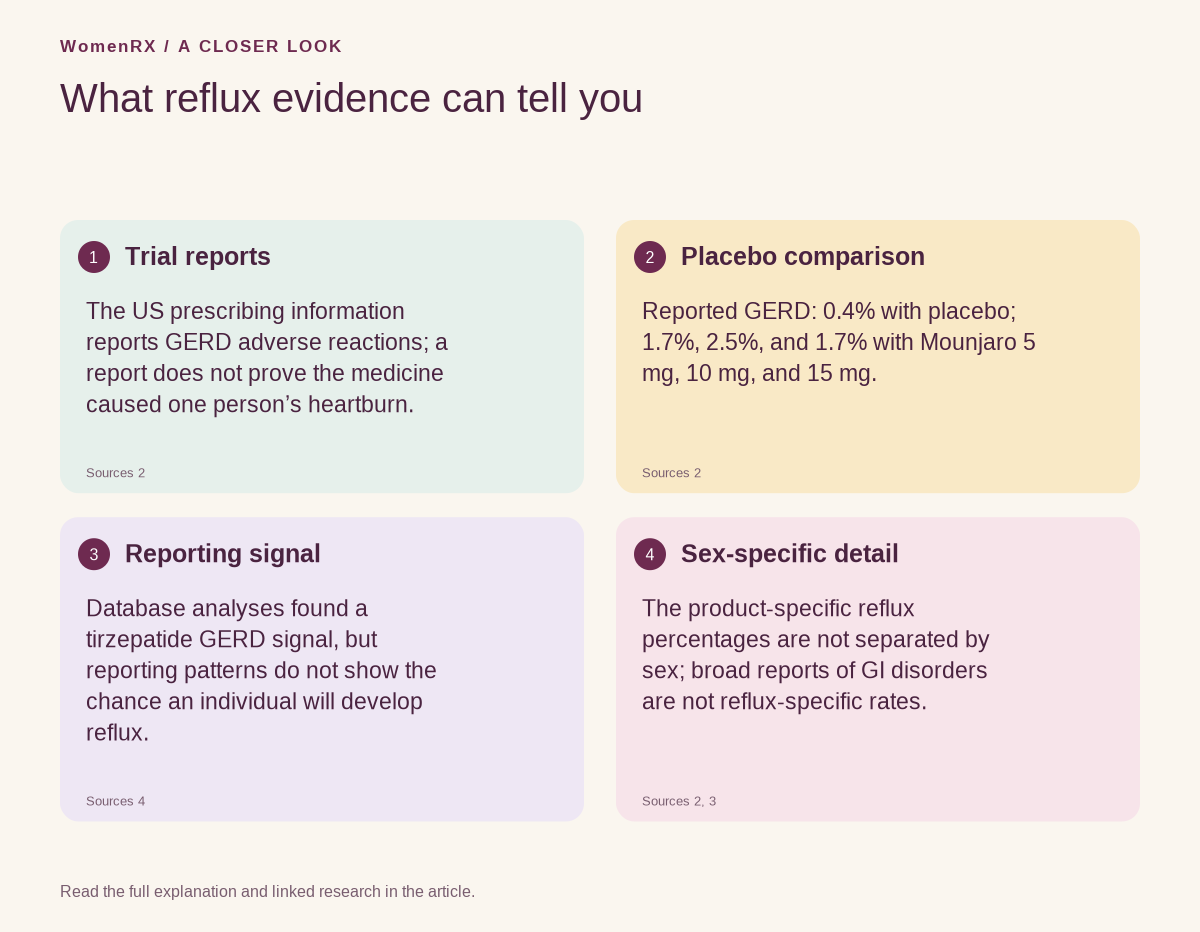
What reflux evidence can tell you
Trial reports: The US prescribing information reports GERD adverse reactions; a report does not prove the medicine caused one person’s heartburn.2
Placebo comparison: Reported GERD: 0.4% with placebo; 1.7%, 2.5%, and 1.7% with Mounjaro 5 mg, 10 mg, and 15 mg.2
Reporting signal: Database analyses found a tirzepatide GERD signal, but reporting patterns do not show the chance an individual will develop reflux.4
Sex-specific detail: The product-specific reflux percentages are not separated by sex; broad reports of GI disorders are not reflux-specific rates.23
Read the figure as text
Separate the Mounjaro trial percentages from reporting signals and individual symptom patterns.- Trial reports: The US prescribing information reports GERD adverse reactions; a report does not prove the medicine caused one person’s heartburn.2
- Placebo comparison: Reported GERD: 0.4% with placebo; 1.7%, 2.5%, and 1.7% with Mounjaro 5 mg, 10 mg, and 15 mg.2
- Reporting signal: Database analyses found a tirzepatide GERD signal, but reporting patterns do not show the chance an individual will develop reflux.4
- Sex-specific detail: The product-specific reflux percentages are not separated by sex; broad reports of GI disorders are not reflux-specific rates.23
More questions, answered
Does heartburn mean Mounjaro caused it?
No. Reflux was reported in Mounjaro trials, but heartburn can have other causes. The trial figures describe groups, not the cause of symptoms in an individual. The timing and pattern are useful details to share with your prescriber. 12
Did the reflux findings differ for women?
The product-specific reflux percentages are not broken down by sex in the prescribing-information figures. A separate analysis found a sex difference in reports of gastrointestinal disorders overall, but that broad category does not establish a difference in reflux rates for women and men. 23
Sources you can check
- Heartburn and acid reflux - NHSAccessed 2026-09-25Return to first citation
- MOUNJARO (TIRZEPATIDE) INJECTION, SOLUTION MOUNJARO KWIKPEN (TIRZEPATIDE) INJECTION, SOLUTION [ELI LILLY AND COMPANY] | US prescribing information and patient instructionsAccessed 2026-09-25Return to first citation
- Adverse events associated with tirzepatide: a focus on subgroup-specific differences.Yu Z, Qi Y, Gan Q, Wu G, Zhang X, Jiang C, Li J. · BMC pharmacology & toxicology · 2026Return to first citation
- Multi-Database Pharmacovigilance Analysis of Gastroesophageal Reflux Disease Associated with GLP-1 Receptor Agonists: A Cross-National Signal Validation Study.Choi JG, Gong EJ, Bang CS, Lee JJ. · Gut and liver · 2026Return to first citation