Hashimoto’s Supplements: What to Check Before You Take One
A supplement may correct a nutrient shortfall, but that’s different from treating Hashimoto’s or replacing thyroid hormone.
There isn’t one supplement shown to treat Hashimoto’s for everyone. Selenium studies suggest some thyroid antibody levels may fall, but that doesn’t establish better symptoms or mean you can stop levothyroxine. Check whether a deficiency or low intake is plausible, avoid high-dose iodine and selenium, and review supplement ingredients and timing, especially if you take thyroid medicine or are pregnant. 1 2 3 4
A Hashimoto’s diagnosis doesn’t automatically mean you’re deficient in selenium or iodine, and a supplement isn’t a substitute for thyroid hormone when it’s needed. The useful question is narrower: is there a specific nutrient gap to address, and could the product affect your treatment or lab results?
A lower antibody number isn’t the same as treating the disease
Selenium is involved in thyroid hormone metabolism. In a 2024 meta-analysis of randomized trials, selenium supplementation lowered thyroid peroxidase antibodies (TPOAb) across studies, and lowered TSH in participants who weren’t taking thyroid hormone replacement. But the review found no significant changes in T4 or T3 measures. The TPOAb result also varied considerably between studies, so it shouldn’t be read as proof that selenium improves how you feel or prevents hypothyroidism. 4
That helps explain why the evidence can sound inconsistent. An earlier systematic review summarized by the NIH Office of Dietary Supplements found no effect on TSH, thyroid ultrasound findings, or quality of life in the trials it assessed. The newer review included more studies and found effects on some blood markers. Taken together, these findings suggest a possible effect on selected lab results, not an established treatment that reverses Hashimoto’s. 1 4
If Hashimoto’s has led to hypothyroidism, levothyroxine remains standard treatment. A supplement shouldn’t replace it or prompt you to change your dose on your own. 4
Check for a nutrient gap, not just a thyroid diagnosis
Most people in the United States get enough selenium, though intake can be lower for some people, including those following vegetarian or vegan diets. Selenium status can be assessed using blood measures, but the relationship between a supplement and better thyroid outcomes isn’t settled. A Hashimoto’s diagnosis or positive thyroid antibodies alone doesn’t show that you’re selenium-deficient. 1
If you’re considering selenium, look at the whole picture: your diet, any relevant test results, and the amount already in a multivitamin or other product. More isn’t automatically better. Long-term excessive selenium can cause hair loss and brittle or lost nails, among other symptoms. 1
Iodine is also needed for thyroid hormone production, but extra iodine isn’t a Hashimoto’s treatment. Chronic high iodine intake has been associated with autoimmune thyroiditis, and iodine amounts in kelp and other seaweeds can vary widely. Avoid treating “thyroid support” or kelp as a reason to add high-dose iodine. 2 5
Check ingredients against levothyroxine
Calcium and iron can interfere with levothyroxine absorption. US prescribing information says to take levothyroxine at least four hours before or after medicines known to interfere with its absorption, including calcium carbonate and ferrous sulfate. If a multivitamin or prenatal contains iron or calcium, check with your prescriber or pharmacist about spacing it from your thyroid medicine. 3
Also look for biotin, sometimes included in hair, skin, and nail products. Levothyroxine prescribing information advises stopping biotin supplements for at least two days before TSH or T4 testing. Tell the person ordering your labs what you take so they can advise you about timing. 3
Pregnancy changes the supplement question
Iodine needs rise during pregnancy: the recommended intake listed by the NIH Office of Dietary Supplements is 220 micrograms per day for pregnant adults, compared with 150 micrograms for nonpregnant adults. Some, but not all, prenatal supplements contain iodine, so check the label rather than assuming. 2
Selenium is a different decision. The NIH fact sheet reports that the American Thyroid Association recommends against selenium supplementation for pregnant women who are TPOAb-positive. If you’re planning a pregnancy or are pregnant, bring the exact prenatal and any other supplements you take to the clinician managing your thyroid. 1
A quick label-and-context check
Before adding a product, ask: What specific nutrient am I trying to address? Is there a reason to suspect low intake or a documented deficiency? Does the product add iodine, selenium, iron, calcium, or biotin that I’m already getting elsewhere? And how will it fit with my levothyroxine and any upcoming thyroid tests? Those checks are more useful than choosing a product because it promises to “support” the thyroid.
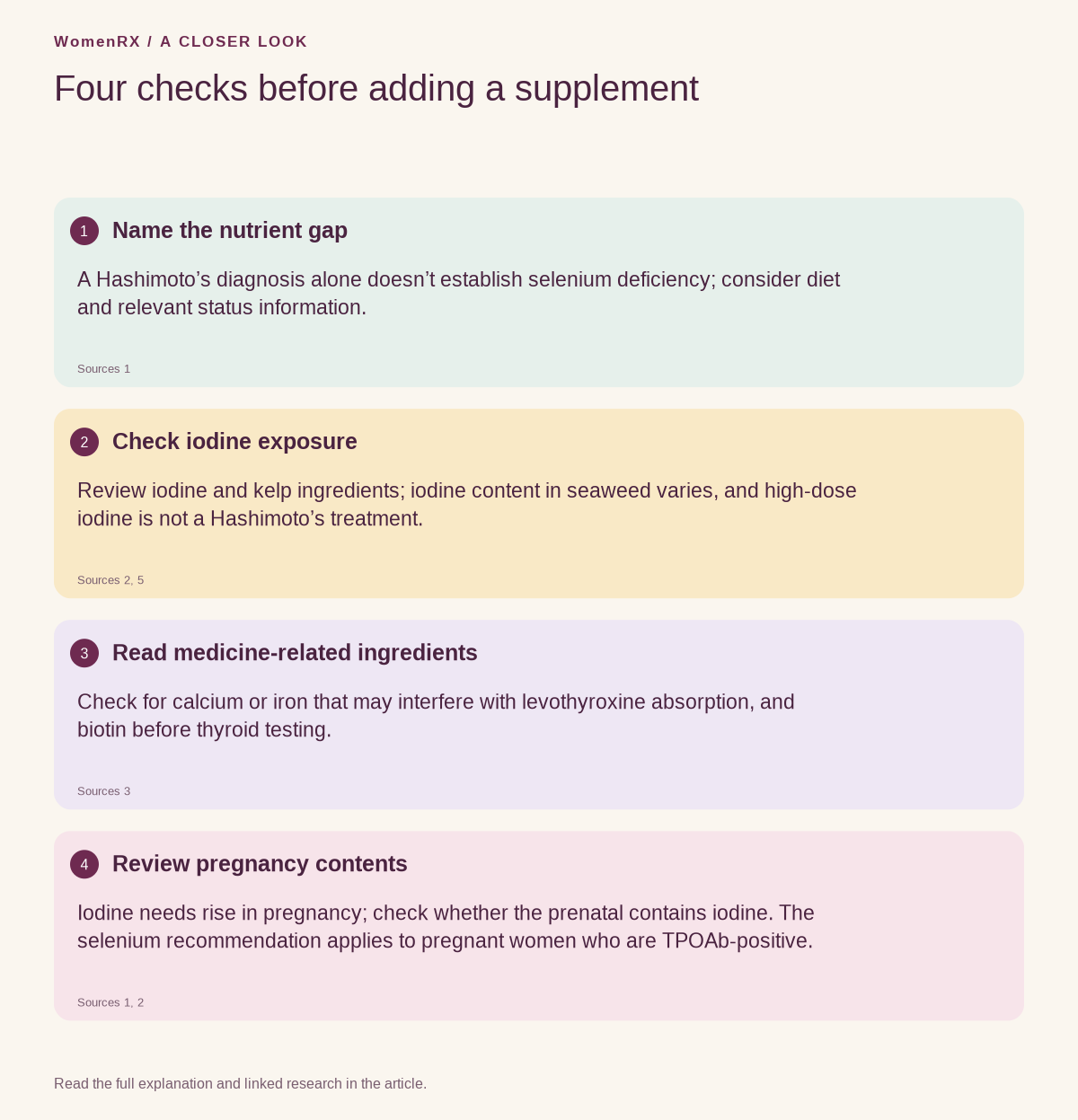
Four checks before adding a supplement
Name the nutrient gap: A Hashimoto’s diagnosis alone doesn’t establish selenium deficiency; consider diet and relevant status information.1
Check iodine exposure: Review iodine and kelp ingredients; iodine content in seaweed varies, and high-dose iodine is not a Hashimoto’s treatment.25
Read medicine-related ingredients: Check for calcium or iron that may interfere with levothyroxine absorption, and biotin before thyroid testing.3
Review pregnancy contents: Iodine needs rise in pregnancy; check whether the prenatal contains iodine. The selenium recommendation applies to pregnant women who are TPOAb-positive.12
Read the figure as text
Use these checks to distinguish a possible nutrient gap from a treatment claim and spot ingredients that matter for thyroid medicine or pregnancy.- Name the nutrient gap: A Hashimoto’s diagnosis alone doesn’t establish selenium deficiency; consider diet and relevant status information.1
- Check iodine exposure: Review iodine and kelp ingredients; iodine content in seaweed varies, and high-dose iodine is not a Hashimoto’s treatment.25
- Read medicine-related ingredients: Check for calcium or iron that may interfere with levothyroxine absorption, and biotin before thyroid testing.3
- Review pregnancy contents: Iodine needs rise in pregnancy; check whether the prenatal contains iodine. The selenium recommendation applies to pregnant women who are TPOAb-positive.12
More questions, answered
If selenium lowers TPO antibodies, does that mean Hashimoto’s is reversed?
No. TPOAb is a blood marker, and lowering it doesn’t by itself show that symptoms improved, thyroid function was restored, or thyroid hormone treatment is no longer needed. The trials and reviews report effects on some lab measures, not proof that selenium reverses Hashimoto’s. 1 4
Sources you can check
- Selenium - Health Professional Fact SheetAccessed 2026-09-25Return to first citation
- Iodine - Health Professional Fact SheetAccessed 2026-09-25Return to first citation
- LEVOTHYROXINE SODIUM TABLET [CARDINAL HEALTH 107, LLC] | US prescribing information and patient instructionsAccessed 2026-09-25Return to first citation
- Selenium Supplementation in Patients with Hashimoto Thyroiditis: A Systematic Review and Meta-Analysis of Randomized Clinical Trials.Huwiler VV, Maissen-Abgottspon S, Stanga Z, Mühlebach S, Trepp R, Bally L, Bano A. · Thyroid : official journal of the American Thyroid Association · 2024Return to first citation
- The Role of Iodine and Selenium in Autoimmune Thyroiditis.Duntas LH. · Hormone and metabolic research = Hormon- und Stoffwechselforschung = Hormones et metabolisme · 2015Return to first citation