Hair-Thinning Supplements Around Menopause: When They May Help
Hair thinning around menopause can have several causes, so a supplement decision starts with the pattern of loss and any reason to suspect a deficiency.
Supplements aren’t a general fix for hair thinning around menopause. They may be worth discussing when your history or examination suggests a nutrient deficiency, such as low intake, blood loss, or a condition that affects absorption. Targeted testing can help guide that decision, but evidence from supplement studies does not establish a benefit specifically for menopause-related hair thinning. 4 5 7
First ask what kind of thinning you’re seeing
Hair loss can happen for different reasons. Some is associated with aging, while other types may be temporary or related to a medical condition. The timing of a change around menopause doesn’t, by itself, show that hormones or a nutrient deficiency caused it. An examination of your hair and scalp can help narrow down what’s happening. 1
That first step matters because a supplement is not a diagnosis. If the cause is something other than a nutrient deficiency, taking extra iron, zinc, or biotin may not address it. A history, diet review, and examination can help determine whether checking for a deficiency is relevant. 7
Clues that can make nutrient testing relevant
Testing is more useful when there’s a reason to suspect a deficiency, rather than as a routine search for an explanation. Examples to mention include a diet that may not provide enough nutrients, blood loss, or a digestive condition that affects absorption. Inadequate calorie intake and malabsorptive digestive diseases are also among the risk factors clinicians consider when assessing zinc status. These clues don’t prove a deficiency; they can help make a discussion about targeted testing more useful. 2 4 7
Iron is one nutrient to consider when the history raises a concern. Clinicians may use blood measures, including ferritin, which reflects iron stores. Ferritin can be affected by inflammation, and no single measure captures the full picture, so more than one result may be considered. 4
Zinc results also need context. Blood zinc levels may vary with factors such as age, the time of the blood draw, infection, or illness, and they don’t always correspond to dietary or supplemental intake. A result shouldn’t be treated as a simple yes-or-no explanation for thinning. 2
What supplements can and can’t promise
A systematic review of nutritional interventions in people with hair loss and no known baseline deficiency found potential benefits for several approaches, including zinc and some multi-ingredient products. The studies covered different interventions, and the review called for larger randomized trials. These results don’t establish that a particular product will help a particular kind of thinning, or that supplements treat hair loss specifically associated with menopause. 5
One study randomized adult women with telogen effluvium, a type of diffuse shedding, to one of two multi-ingredient supplements and followed them for 180 days. Both groups showed improvements in some clinical measures, while one group showed improvement in a trichoscopy measure. Because both groups received combinations of ingredients, the comparison can’t isolate which ingredient, if any, accounted for a change. It also doesn’t establish an advantage over taking no supplement. 6
Biotin deserves particular caution as a popular hair supplement. Biotin deficiency is rare, and the evidence described for biotin supplements improving hair consists of case reports in children with unusual hair conditions, not evidence of benefit for midlife women with ordinary thinning. Biotin can also interfere with some laboratory test results, so mention it if you take a biotin-containing product and are having blood work. 3
Check the reason for hair loss before buying a supplement
Start by describing the pattern and timing of the change and sharing relevant health and dietary history. If there are clues such as low intake, blood loss, or a condition affecting absorption, ask whether a specific nutrient test could change the next step. If a deficiency is identified, correcting it is appropriate, but that doesn’t guarantee hair regrowth. 4 7
If you’re considering a product, bring its ingredient label to the discussion. A blend can contain several nutrients, so it may be hard to tell what is useful or what could be unnecessary. Unneeded supplements can carry risks, and high doses of supplemental iron may cause nausea or constipation. 4 7
The goal isn’t to rule supplements in or out for everyone. It’s to match the decision to the likely cause: assess the hair loss, look for a reason to suspect deficiency, and use targeted testing when it can guide whether a nutrient should be addressed.
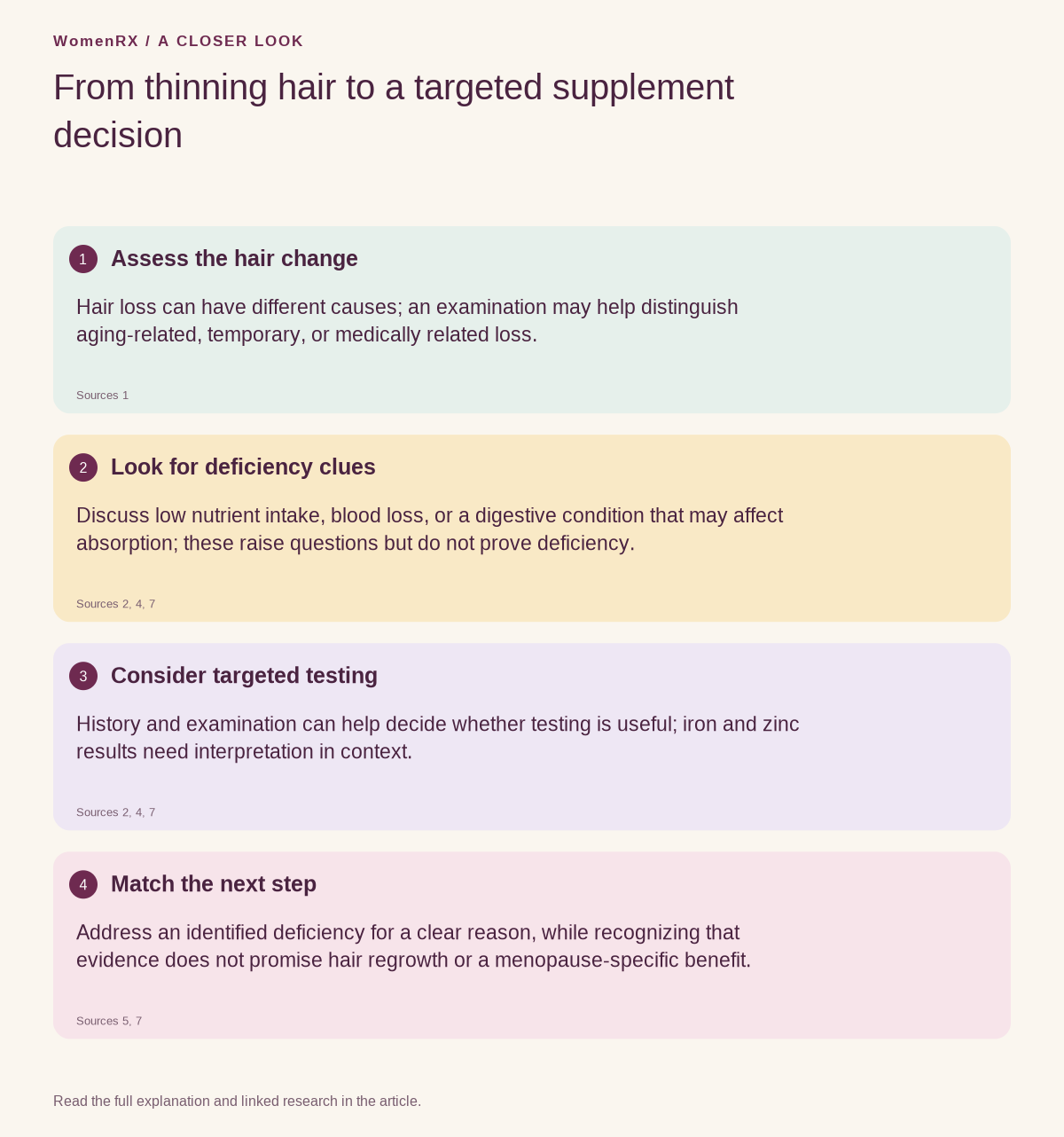
From thinning hair to a targeted supplement decision
Assess the hair change: Hair loss can have different causes; an examination may help distinguish aging-related, temporary, or medically related loss.1
Look for deficiency clues: Discuss low nutrient intake, blood loss, or a digestive condition that may affect absorption; these raise questions but do not prove deficiency.247
Consider targeted testing: History and examination can help decide whether testing is useful; iron and zinc results need interpretation in context.247
Match the next step: Address an identified deficiency for a clear reason, while recognizing that evidence does not promise hair regrowth or a menopause-specific benefit.57
Read the figure as text
Use the pattern of hair loss and relevant health or diet clues to decide whether targeted nutrient testing could guide a supplement choice.- Assess the hair change: Hair loss can have different causes; an examination may help distinguish aging-related, temporary, or medically related loss.1
- Look for deficiency clues: Discuss low nutrient intake, blood loss, or a digestive condition that may affect absorption; these raise questions but do not prove deficiency.247
- Consider targeted testing: History and examination can help decide whether testing is useful; iron and zinc results need interpretation in context.247
- Match the next step: Address an identified deficiency for a clear reason, while recognizing that evidence does not promise hair regrowth or a menopause-specific benefit.57
Sources you can check
- Hair loss - NHSAccessed 2026-09-25Return to first citation
- Zinc - Health Professional Fact SheetAccessed 2026-09-25Return to first citation
- Biotin - Health Professional Fact SheetAccessed 2026-09-25Return to first citation
- Iron - Health Professional Fact SheetAccessed 2026-09-25Return to first citation
- Evaluation of the Safety and Effectiveness of Nutritional Supplements for Treating Hair Loss: A Systematic Review.Drake L, Reyes-Hadsall S, Martinez J, Heinrich C, Huang K, Mostaghimi A. · JAMA dermatology · 2023Return to first citation
- Comparative evaluation between two nutritional supplements in the improvement of telogen effluvium.Sant'Anna Addor FA, Donato LC, Melo CSA. · Clinical, cosmetic and investigational dermatology · 2018Return to first citation
- Diet and hair loss: effects of nutrient deficiency and supplement use.Guo EL, Katta R. · Dermatology practical & conceptual · 2017Return to first citation