GLP-1 Medicines or Metformin for PCOS? A Clear Comparison
Metformin and GLP-1 medicines have different strengths in PCOS, and the evidence is firmer for short-term weight changes than for reproductive benefits.
Metformin has evidence for metabolic outcomes in PCOS, including insulin-related measures, while GLP-1 medicines have shown short-term weight benefits in women with PCOS and overweight or obesity. Neither is a universal PCOS treatment, and the evidence doesn’t establish that weight or menstrual changes translate into better pregnancy outcomes. Your metabolic goals, side-effect tolerance, and pregnancy plans all matter. 1 3 5
Start with the outcome you want to change
PCOS can involve irregular periods, elevated androgens, insulin resistance, and higher metabolic risk, but those concerns don’t all call for the same treatment. Metformin and GLP-1 receptor agonists overlap in some metabolic outcomes, yet they aren’t interchangeable PCOS medicines. The useful question is which outcome matters most to you, and how confident the evidence is for that outcome.
For metformin, PCOS reviews describe insulin-related benefits, including effects on insulin resistance, though results aren’t fully consistent. A broad review describes improvements in insulin resistance and modest weight effects, while a 2026 network meta-analysis found no significant effect on insulin resistance across the interventions it assessed. The mixed result is a reason not to assume that an insulin-related benefit is guaranteed for every person with PCOS. 4 5
For GLP-1 medicines, the clearest PCOS trial signal is short-term weight reduction in women with overweight or obesity. A systematic review of 11 randomized trials found a modest average BMI reduction when GLP-1 medicines were added to a comparison treatment, but rated the evidence low certainty. This was not proof that a GLP-1 medicine works better than metformin for everyone: the trials used different comparison treatments, and reproductive and other metabolic outcomes remained uncertain. 1
Weight results aren’t the same as PCOS control
A separate review of seven randomized trials, with 330 women with PCOS, reported improvements in BMI, insulin resistance, and menstrual frequency with liraglutide. But menstrual results varied considerably between studies, and there wasn’t enough reporting to combine results for ovulation or pregnancy. A change in period frequency is not the same as evidence of improved fertility or a healthier pregnancy. 3
There is also research on combining liraglutide with metformin. A 2025 review of 19 trials in women with PCOS and overweight or obesity found improvements across several metabolic and hormone measures compared with metformin alone. The authors rated the overall evidence low certainty, with substantial variation between studies. These findings make combination treatment a subject worth discussing when relevant, not proof that everyone needs both medicines or that the combination is best for every PCOS goal. 2
Match the trade-offs to your priorities
If weight management is a central goal, separate PCOS reviews report modest weight effects with metformin and short-term BMI reduction in GLP-1 trials among women with overweight or obesity. These findings come from different evidence sets, not a direct comparison, so they don’t establish which medicine will produce greater weight change for you. The GLP-1 review found no studies of quality of life or mental health, and long-term evidence was limited. 1 4 5
Side effects are part of the comparison, but the available PCOS evidence doesn’t support a fair, numerical comparison of tolerability between these medicines. In the liraglutide review, reported adverse events were mainly mild gastrointestinal symptoms. That finding is about the included liraglutide trials; it doesn’t tell you how often side effects occur with every GLP-1 medicine or how those rates compare with metformin. 3
If periods, ovulation, or pregnancy are your main concern, neither medication’s metabolic results should be treated as proof of a fertility benefit. The PCOS GLP-1 trials don’t establish pregnancy outcomes or pregnancy safety. If you may become pregnant or are planning pregnancy, bring up contraception and medication timing before making a treatment decision. These studies don’t establish a specific contraception recommendation or when to stop treatment. 1 3
Make the discussion specific
It may help to name the outcome you most want to address: weight, blood sugar or insulin-related measures, periods, or pregnancy planning. Then ask what evidence applies to that goal, what side effects are realistic to expect, and how you’ll tell whether the treatment is helping. If a clinician discusses a GLP-1 medicine alongside metformin, ask whether the rationale is your weight goal, a metabolic measure, or another specific concern. Those are different reasons to consider treatment, and the PCOS evidence doesn’t establish one best choice for everyone.
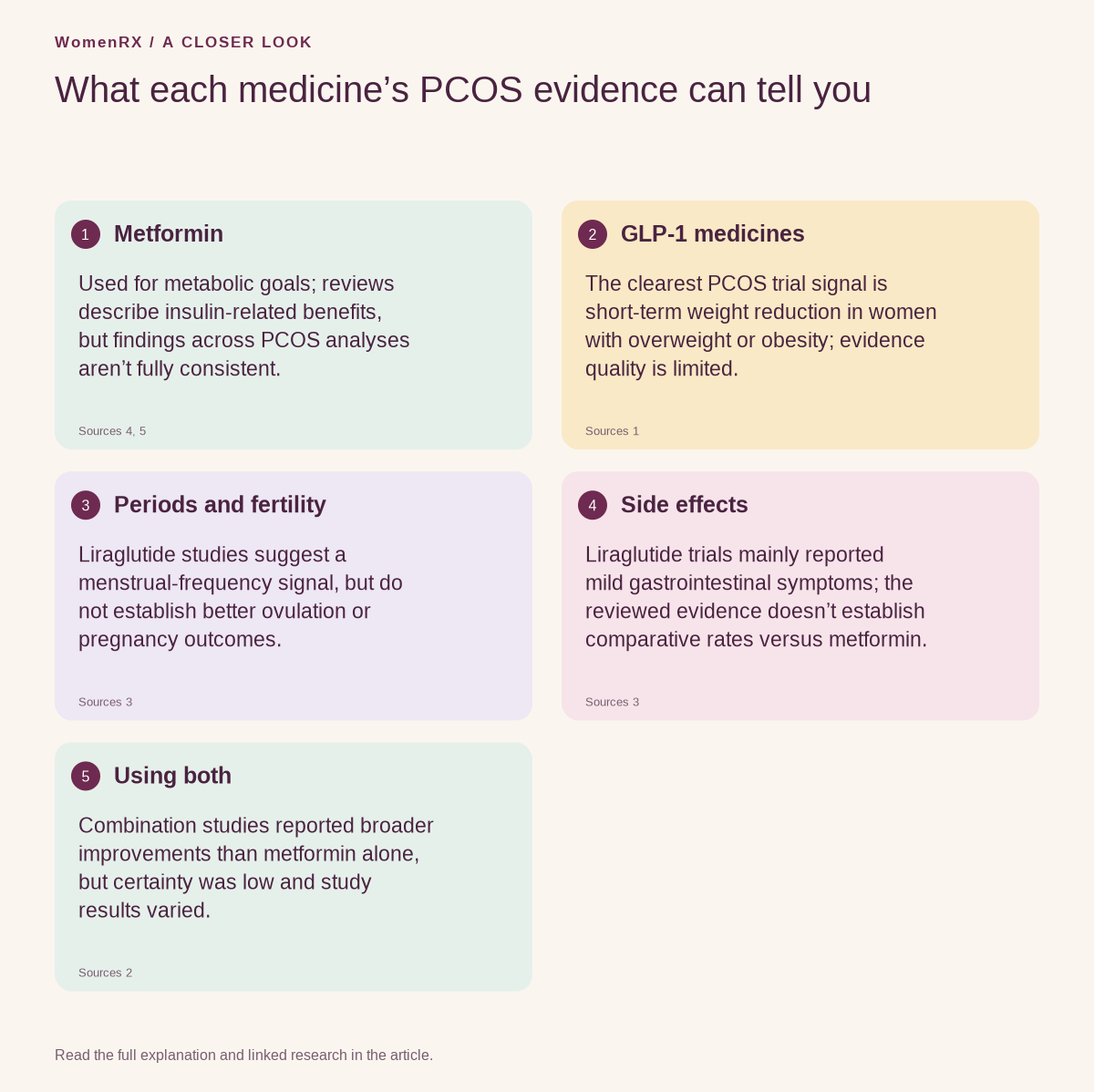
What each medicine’s PCOS evidence can tell you
Metformin: Used for metabolic goals; reviews describe insulin-related benefits, but findings across PCOS analyses aren’t fully consistent.45
GLP-1 medicines: The clearest PCOS trial signal is short-term weight reduction in women with overweight or obesity; evidence quality is limited.1
Periods and fertility: Liraglutide studies suggest a menstrual-frequency signal, but do not establish better ovulation or pregnancy outcomes.3
Side effects: Liraglutide trials mainly reported mild gastrointestinal symptoms; the reviewed evidence doesn’t establish comparative rates versus metformin.3
Using both: Combination studies reported broader improvements than metformin alone, but certainty was low and study results varied.2
Read the figure as text
These distinctions show why the choice depends on the outcome you care about, and why a promising result should not be stretched into a broader PCOS claim.- Metformin: Used for metabolic goals; reviews describe insulin-related benefits, but findings across PCOS analyses aren’t fully consistent.45
- GLP-1 medicines: The clearest PCOS trial signal is short-term weight reduction in women with overweight or obesity; evidence quality is limited.1
- Periods and fertility: Liraglutide studies suggest a menstrual-frequency signal, but do not establish better ovulation or pregnancy outcomes.3
- Side effects: Liraglutide trials mainly reported mild gastrointestinal symptoms; the reviewed evidence doesn’t establish comparative rates versus metformin.3
- Using both: Combination studies reported broader improvements than metformin alone, but certainty was low and study results varied.2
More questions, answered
Does a more regular period mean a GLP-1 medicine improved fertility?
Not necessarily. A small review found a signal for more frequent periods with liraglutide, but study results varied and there wasn’t enough reporting to pool ovulation or pregnancy outcomes. 3
Is taking both medicines proven to be better?
A review found metabolic and hormone improvements with liraglutide plus metformin compared with metformin alone, but it rated the evidence low certainty and found substantial variation between studies. That doesn’t establish the combination as the right choice for everyone. 2
Sources you can check
- GLP-1 receptor agonist treatment in women with polycystic ovary syndrome-a systematic review and meta-analysis.Forslund M, Wändell P, Forsberg L, Österberg M, Dagerhamn J, Wernersson E, Kärrman Fredriksson M, Ringborg A, Lindén Hirschberg A. · European journal of endocrinology · 2026Return to first citation
- Combined liraglutide and metformin therapy in overweight or obese women with polycystic ovary syndrome: A systematic review and meta-analysis.Ling J, Wang T, Huang W, Zhen Y, Zhang M, Fang X, Song W, Du X. · Diabetes, obesity & metabolism · 2025Return to first citation
- Efficacy of liraglutide on metabolic and reproductive outcomes in women with polycystic ovary syndrome: A systematic review and meta-analysis.Lu YT, Chang PH, Chen HJ, Hsueh YW, Chang CW, Hsu HC, Yang TC, Lin WC, Chang HM. · Diabetes, obesity & metabolism · 2026Return to first citation
- Comparative analysis of glucagon-like peptide-1 receptor agonists, metformin, and inositol in improving anthropometric and metabolic outcomes in women with polycystic ovary syndrome: a network meta-analysis.Omarion A, Ayasa Y, Omarion Z, Jayouse B, Ayesh H. · Frontiers in endocrinology · 2026Return to first citation
- The central role of IL-6 in the differential effects of GLP-1 receptor agonists and metformin across multiple health conditions.Elkoshi Z. · Frontiers in immunology · 2026Return to first citation