GLP-1 Medicines and PCOS: Separate the Goals
GLP-1 medicines may help with weight in some people with PCOS, but weight loss, menstrual symptoms, and pregnancy are different treatment questions.
If you have PCOS and overweight or obesity, a GLP-1 medicine may help with weight, but the evidence is less certain for blood sugar measures, periods, excess hair growth, and fertility.3 Pregnancy plans need to be part of the decision: US product information for weight-management medicines containing semaglutide and liraglutide says to stop them when pregnancy is recognized.16
Start with the goal, not the PCOS diagnosis
PCOS can affect periods, androgen-related symptoms such as excess hair growth, and metabolic health. Those concerns don’t all respond to the same treatment.3 If you’re considering a GLP-1 medicine, the useful first question is: What am I hoping it will change?
For example, a weight-related goal is different from wanting more predictable periods or trying to conceive. Having PCOS alone doesn’t establish that weight treatment is right for you. In a systematic review of randomized trials, the clearest GLP-1 finding was modest, short-term weight loss among women with PCOS and overweight or obesity. That finding shouldn’t be stretched into a promise about every PCOS symptom.3
What the studies show about weight and metabolic health
A 2026 systematic review included 11 randomized trials comparing GLP-1 receptor agonists with approaches such as placebo, lifestyle intervention, or other medicines in women with PCOS. When used as an add-on, GLP-1 medicines reduced BMI more than the comparison treatments, with a mean difference of 1.38 kg/m². The reviewers rated the certainty of that finding low.3
The metabolic picture is less settled. A separate meta-analysis focused on semaglutide in PCOS and reported lower LDL cholesterol and triglycerides compared with placebo or conventional treatment across eight randomized trials involving 526 participants. Its authors rated the overall evidence moderate to low and called for longer-term research.5 The broader GLP-1 review, however, found no difference in LDL cholesterol or triglycerides between groups and judged the evidence insufficient to draw conclusions about glucose and insulin outcomes.3
These reviews ask related but different questions: one focuses on semaglutide, while the other considers GLP-1 medicines as a group. Their lipid findings don’t justify assuming that every GLP-1 medicine reliably improves cholesterol in PCOS. If your main concern is diabetes or cardiovascular risk, weight change and those other outcomes deserve separate attention.
Weight loss isn’t proof that PCOS features will improve
You may hear that a GLP-1 medicine could make periods more regular or improve fertility. Some earlier studies raised those possibilities, but the 2026 randomized-trial review found insufficient evidence to draw conclusions about menstrual regularity or excess hair growth.34 It also didn’t establish a fertility benefit.3 A change in weight is therefore not a dependable substitute for a plan directed at the symptom you most want to treat.
That distinction matters in everyday decisions. If your main goal is relief from excess hair growth, ask what evidence supports the proposed treatment for that outcome. If your goal is pregnancy, ask about a conception plan rather than treating weight loss as fertility treatment. And if your goal is weight-related health, you can discuss that on its own terms without being told that everyone with PCOS needs to lose weight.
Bring pregnancy timing into the decision early
A pregnancy conversation is relevant even if you aren’t trying to conceive now. If pregnancy is possible but not intended, talk through contraception as part of the medication plan. If you do want to conceive, tell the prescriber before starting so the treatment choice and stopping plan fit your timeline. The evidence for GLP-1 medicines as fertility treatment in PCOS remains uncertain.3
The US prescribing information for Wegovy, a semaglutide product, says that weight loss offers no benefit during pregnancy and may cause fetal harm. It says to discontinue Wegovy when pregnancy is recognized in someone using it for weight reduction; human pregnancy data are insufficient to establish its drug-associated risks.6 The Saxenda information for liraglutide likewise says weight loss offers no benefit during pregnancy and advises discontinuing Saxenda when pregnancy is recognized.1 Those are product-specific statements, not a universal stopping schedule for every GLP-1 medicine. Don’t guess at a preconception interval from the time it took someone else to stop a different product.
What belongs in the safety conversation
The exact medicine matters for side effects, too. Liraglutide prescribing information describes gastrointestinal reactions that can sometimes be severe and warns about pancreatitis and acute gallbladder disease. Persistent or severe abdominal pain, sometimes spreading to the back or accompanied by vomiting, needs prompt medical attention.2 Before choosing a product, it’s worth discussing your relevant health history and how its possible adverse effects weigh against the specific benefit you’re seeking.
A practical way to frame the decision is: Which outcome am I treating, what evidence supports this medicine for that outcome in PCOS, and how does the plan change if pregnancy becomes possible or intended? The answers may differ substantially for weight, metabolic measures, PCOS symptoms, and conception.
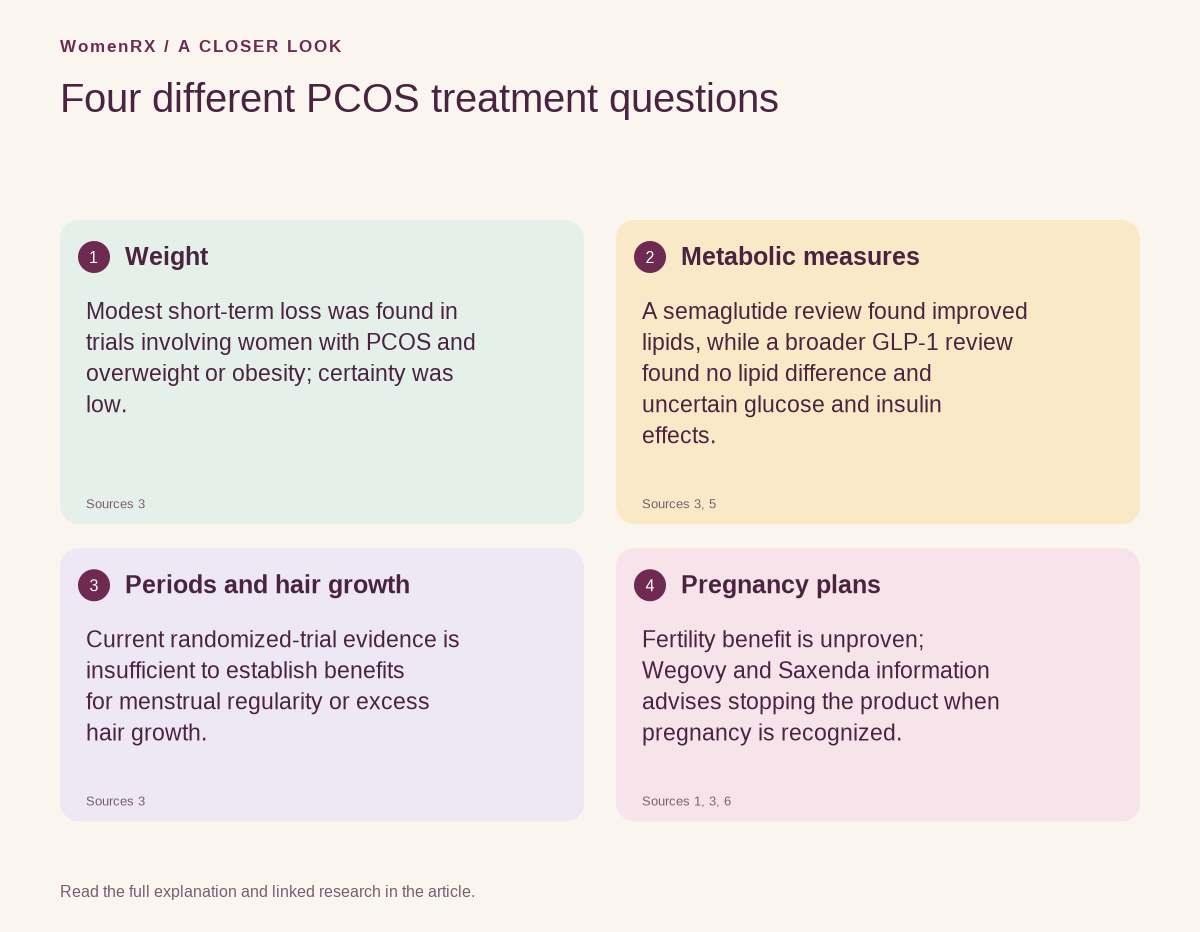
Four different PCOS treatment questions
Weight: Modest short-term loss was found in trials involving women with PCOS and overweight or obesity; certainty was low.3
Metabolic measures: A semaglutide review found improved lipids, while a broader GLP-1 review found no lipid difference and uncertain glucose and insulin effects.35
Periods and hair growth: Current randomized-trial evidence is insufficient to establish benefits for menstrual regularity or excess hair growth.3
Pregnancy plans: Fertility benefit is unproven; Wegovy and Saxenda information advises stopping the product when pregnancy is recognized.136
Read the figure as text
The evidence for a GLP-1 medicine depends on the outcome you’re hoping to change.- Weight: Modest short-term loss was found in trials involving women with PCOS and overweight or obesity; certainty was low.3
- Metabolic measures: A semaglutide review found improved lipids, while a broader GLP-1 review found no lipid difference and uncertain glucose and insulin effects.35
- Periods and hair growth: Current randomized-trial evidence is insufficient to establish benefits for menstrual regularity or excess hair growth.3
- Pregnancy plans: Fertility benefit is unproven; Wegovy and Saxenda information advises stopping the product when pregnancy is recognized.136
Sources you can check
- SAXENDA (LIRAGLUTIDE) INJECTION, SOLUTION [NOVO NORDISK PHARMACEUTICAL INDUSTRIES, LP] | US prescribing information and patient instructionsAccessed 2026-09-25Return to first citation
- VICTOZA (LIRAGLUTIDE) INJECTION [NOVO NORDISK] | US prescribing information and patient instructionsAccessed 2026-09-25Return to first citation
- GLP-1 receptor agonist treatment in women with polycystic ovary syndrome-a systematic review and meta-analysis.Forslund M, Wändell P, Forsberg L, Österberg M, Dagerhamn J, Wernersson E, Kärrman Fredriksson M, Ringborg A, Lindén Hirschberg A. · European journal of endocrinology · 2026Return to first citation
- GLP-1 receptor agonists in the treatment of polycystic ovary syndrome.Lamos EM, Malek R, Davis SN. · Expert review of clinical pharmacology · 2017Return to first citation
- Meta-analysis of the effects of semaglutide on body mass index (BMI) and blood lipid levels in polycystic ovary syndrome patients.Chen W, Xu D, Shao X, Song Q, Chen R. · Gynecological endocrinology : the official journal of the International Society of Gynecological Endocrinology · 2025Return to first citation
- WEGOVY (SEMAGLUTIDE) INJECTION, SOLUTION WEGOVY (SEMAGLUTIDE) TABLET [NOVO NORDISK PHARMACEUTICAL INDUSTRIES, LP] | US prescribing information and patient instructionsAccessed 2026-09-25Return to first citation