GLP-1 Medicines and Mood: What Changes Should You Discuss?
Mood symptoms deserve attention, but studies haven’t established that GLP-1 medicines cause or prevent depression or anxiety.
If anxiety or low mood begins or worsens while you’re taking a GLP-1 medicine, take the change seriously without assuming the medicine caused it. Human studies report mixed associations and can’t establish cause and effect. 3 4 5 Note when symptoms started and what else changed, then contact your prescriber to discuss your symptoms and treatment options. If you’re thinking about suicide or hurting yourself, seek immediate help; call 911 in an emergency. 2
What the research can, and can’t, tell you
The evidence doesn’t support a simple rule that GLP-1 medicines cause depression or anxiety, or that they treat those conditions. A review of real-world studies found no clear increase in depression or self-harm, while also calling for more research on mental-health outcomes. 3
Other observational studies point in different directions. In a Swedish study of people with diagnosed depression or anxiety who used diabetes medicines, periods of semaglutide or liraglutide use were associated with less worsening of some mental-health outcomes than periods without GLP-1 use. In a separate study of adults with type 2 diabetes, GLP-1 use was associated with higher rates of depression and anxiety than some, but not all, comparison medicines. 4 5
A large obesity cohort using postmarketing data also reported higher rates of psychiatric outcomes among GLP-1 users. But it excluded people with several psychiatric diagnoses or suicidal thoughts or attempts in the prior year, and its findings don’t settle whether the medicine caused the difference. 6
The observational findings described here cannot establish whether GLP-1 medicines cause mood changes. People taking different medicines can differ in health, treatment history, and other ways that affect mood. They also studied different populations and comparisons, so their results aren’t direct answers to what will happen to one person. The obesity cohort’s authors reported higher risks of anxiety and suicidal ideation or attempts for females than males. That comparison does not show whether the effect of GLP-1 treatment differs by sex. The reported findings also don’t address pregnancy, postpartum, perimenopause, or postmenopause separately. 4 5 6
Make a useful timeline, not a verdict
A change that follows starting a medicine or changing its dose is worth mentioning, but timing alone can’t prove what caused it. Before you talk with your prescriber, jot down when the mood or anxiety change began, whether it is getting better or worse, and how it affects sleep, work, relationships, or daily tasks. Note medication start or dose-change dates and other changes around the same time, such as illness or a stressful event. If pregnancy, the postpartum period, perimenopause, or postmenopause is relevant to you, mention it and any related mental-health concerns. These details can make the conversation more specific, but they cannot identify the cause of your symptoms or establish a drug interaction.
Also describe the experience in everyday terms. Anxiety can involve persistent worry, tension, restlessness, or a racing heartbeat. Depression can involve low mood or loss of interest that interferes with daily life. 1 2 If you’re also dealing with nausea or other treatment side effects, include that in the timeline; gastrointestinal disturbances are commonly reported with these medicines in real-world use. 3
Talk through your symptoms and treatment options
Tell the prescriber who manages your GLP-1 medicine what you’re noticing, when it started, and how disruptive it is. Ask whether your symptoms could have another explanation, whether the timing matters, and what options make sense for your treatment goals. If you already receive mental-health care, you can include that clinician in the discussion too. Psychotherapy and medicines are established treatment options for anxiety and depression, and the right approach depends on the person and symptoms. 1 2
Contacting your prescriber is a practical step for coordinating care, not proof that the GLP-1 medicine is responsible. If symptoms are affecting everyday life or worsening, don’t wait for them to become severe before raising them; depression can make basic activities difficult, and early help can support symptom management. 2
When it can’t wait
If you’re thinking about suicide or hurting yourself, get help right away. If there’s an emergency, call 911. 2 This need for immediate support takes priority over sorting out whether a medicine contributed to the change.
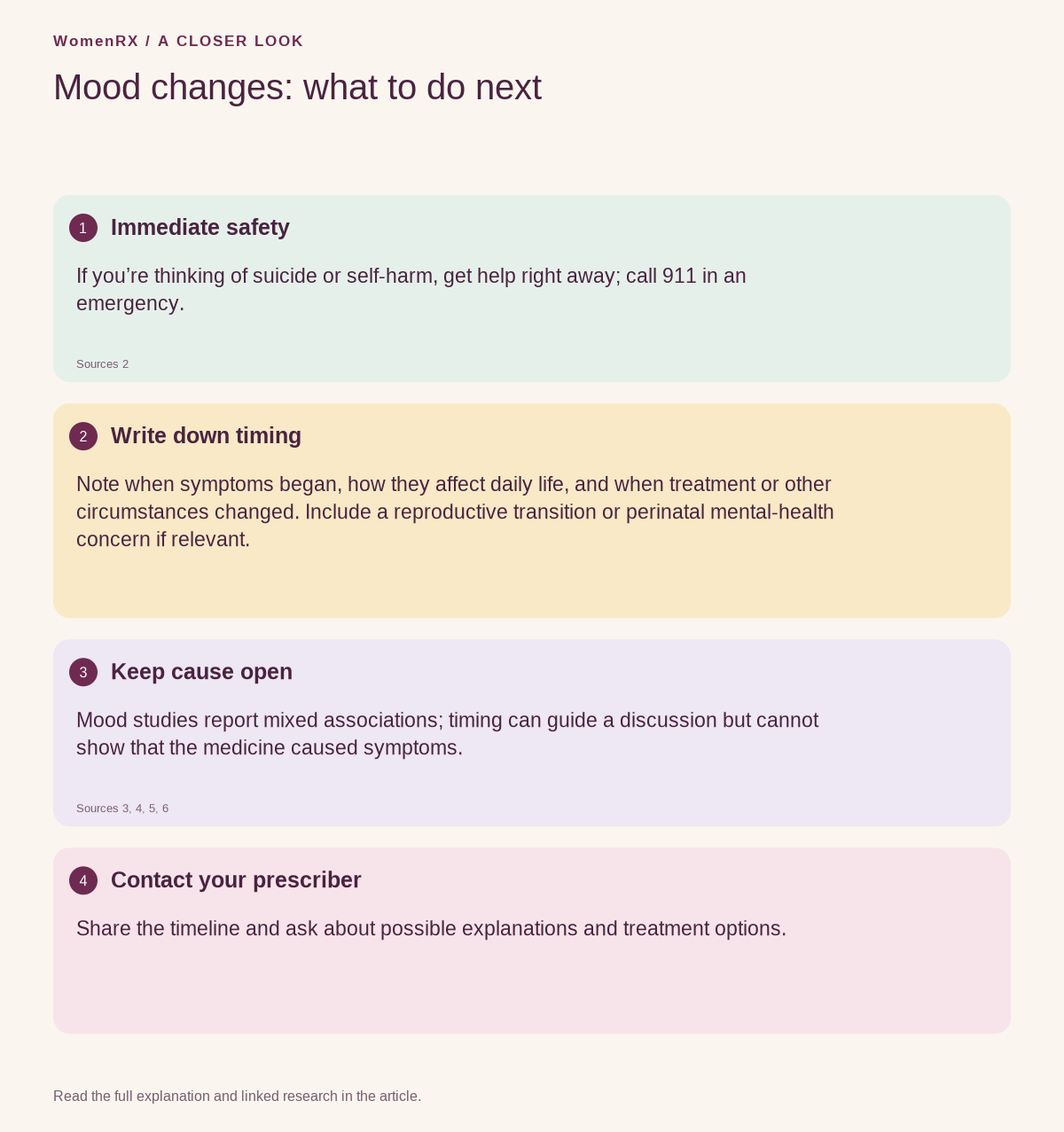
Mood changes: what to do next
Immediate safety: If you’re thinking of suicide or self-harm, get help right away; call 911 in an emergency.2
Write down timing: Note when symptoms began, how they affect daily life, and when treatment or other circumstances changed. Include a reproductive transition or perinatal mental-health concern if relevant.
Keep cause open: Mood studies report mixed associations; timing can guide a discussion but cannot show that the medicine caused symptoms.3456
Contact your prescriber: Share the timeline and ask about possible explanations and treatment options.
Read the figure as text
A simple path from immediate safety needs to a focused medication conversation. The timeline is a communication aid, not a diagnostic tool.- Immediate safety: If you’re thinking of suicide or self-harm, get help right away; call 911 in an emergency.2
- Write down timing: Note when symptoms began, how they affect daily life, and when treatment or other circumstances changed. Include a reproductive transition or perinatal mental-health concern if relevant.
- Keep cause open: Mood studies report mixed associations; timing can guide a discussion but cannot show that the medicine caused symptoms.3456
- Contact your prescriber: Share the timeline and ask about possible explanations and treatment options.
More questions, answered
Should I stop my GLP-1 medicine if my mood changes?
Contact your prescriber, explain what changed and when, and ask about your treatment options. The timing is useful information, but it doesn’t establish that the medicine caused the symptoms. These studies can’t tell you whether stopping or delaying a dose is right for you. 3 4 5
Do studies show different mental-health effects for women?
One obesity cohort reported higher risks of anxiety and suicidal ideation or attempts for females than males, but that comparison does not show whether GLP-1 treatment affects women differently from men. The reported findings don’t address pregnancy, postpartum, perimenopause, or postmenopause separately. 6 If one of these contexts is relevant to your symptoms, mention it during your medication and symptom review; it does not, by itself, establish a drug interaction.
Sources you can check
- Anxiety: MedlinePlusAccessed 2026-09-25Return to first citation
- Depression: MedlinePlusAccessed 2026-09-25Return to first citation
- Real-world evidence on the utilization, clinical and comparative effectiveness, and adverse effects of newer GLP-1RA-based weight-loss therapies.Thomsen RW, Mailhac A, Løhde JB, Pottegård A. · Diabetes, obesity & metabolism · 2025Return to first citation
- Association between GLP-1 receptor agonist use and worsening mental illness in people with depression and anxiety in Sweden: a national cohort study.Taipale H, Taylor M, Lähteenvuo M, Mittendorfer-Rutz E, Tanskanen A, Tiihonen J. · The lancet. Psychiatry · 2026Return to first citation
- Association of glucagon-like peptide-1 receptor agonist use with anxiety disorders, depression, self-harm, and suicidality: a large cohort study.Anagnostakis F, Kokkorakis M, Anastasiou G, Nagarajan S, Mantzoros CS. · Diabetes research and clinical practice · 2026Return to first citation
- The risk of depression, anxiety, and suicidal behavior in patients with obesity on glucagon like peptide-1 receptor agonist therapy.Kornelius E, Huang JY, Lo SC, Huang CN, Yang YS. · Scientific reports · 2024Return to first citation