Feeling Low or Anxious on Ozempic? What We Know
New mood symptoms deserve attention, even though current studies don’t show that Ozempic caused them.
If you’ve felt depressed or anxious since starting Ozempic, tell your prescriber. Timing matters, but it doesn’t prove the cause. Among people with existing depression or anxiety who used diabetes medication, semaglutide use was associated with a lower risk of serious worsening events than non-use. Among adults with type 2 diabetes, obesity, or both, semaglutide starters had fewer recorded mood outcomes than other GLP-1 starters. Neither comparison was specific to the Ozempic brand. 35
What the studies can and can’t tell you
A new feeling of dread, persistent worry, or low mood can be unsettling when it appears after you start a medication. The sequence matters: it gives you and your prescriber something specific to investigate. It doesn’t, by itself, show that Ozempic caused the change.
The strongest directly relevant findings here come from observational studies, not trials designed to test whether semaglutide causes or treats mood disorders. In a Swedish study of people who already had a depression or anxiety diagnosis and used diabetes medication, researchers compared periods when the same person used a GLP-1 medication with periods when they did not. Semaglutide use was associated with a lower risk of serious worsening of mental illness, including outcomes such as psychiatric hospitalization or extended psychiatric sick leave. The study did not measure every change in day-to-day mood, and an association is not proof that semaglutide protected anyone’s mental health. 3
Another study compared adults with type 2 diabetes, obesity, or both who started semaglutide with similar adults who started other GLP-1 medications. During its first-year follow-up, the semaglutide group had lower rates of newly recorded depression and anxiety. That comparison does not answer what would have happened without a GLP-1 medication, or whether Ozempic explains one person’s symptoms. These studies examined semaglutide or GLP-1 medications, not the Ozempic brand specifically. 35
There’s a further distinction between how you feel and what appears in a medical record. A claims study found fewer office visits for depression and anxiety among adults with type 2 diabetes who started GLP-1 medications than among those who started a different diabetes-drug class. Visit rates are useful information, but they aren’t a direct measure of everyone’s mood. 4
Taken together, these studies do not support saying that Ozempic generally causes depression or anxiety. They also do not give a reason to dismiss symptoms that began while you were taking it.
Make the conversation about your symptoms, not just the drug
Tell the clinician who prescribes Ozempic what changed and when. For example: “I started feeling anxious a few weeks after starting the medication. It’s affecting my sleep and work, and I’d like to talk through possible causes and whether to continue or change Ozempic.” If symptoms changed again after a medication change, include that detail. Bring up other medicines, recent health changes, and major stresses so the discussion isn’t reduced to a yes-or-no judgment about Ozempic.
Physical symptoms can add useful context. Anxiety can come with sweating, restlessness, and a rapid heartbeat. Ozempic’s medication guide advises discussing low blood sugar with your prescriber and telling them if you use insulin or a sulfonylurea. If either applies to you, mention it when describing what an anxious spell feels like. These details don’t diagnose the cause, but they can help your clinician consider more than one explanation. 21
Your stage of life belongs in that conversation, too. Say if you’re pregnant, recently postpartum, or in perimenopause. 6 The studies above don’t provide separate findings for these groups, so their overall results cannot tell you whether semaglutide affects mood differently at those times. If you’re pregnant or planning pregnancy, discuss that directly with your Ozempic prescriber because the injection’s medication guide has separate pregnancy guidance. 1
You don’t have to settle the question of causation before asking for help with how you feel. A primary care clinician can assess anxiety symptoms, consider whether another health problem may be involved, and discuss treatment options such as therapy or medication when appropriate. 2 If anxiety is getting worse or interfering with daily life, seek help rather than waiting for it to resolve on its own. 2
If you’re thinking about suicide or worried you might hurt yourself, call or text 988 now, or chat at 988lifeline.org. If your life is in immediate danger, call 911. 6
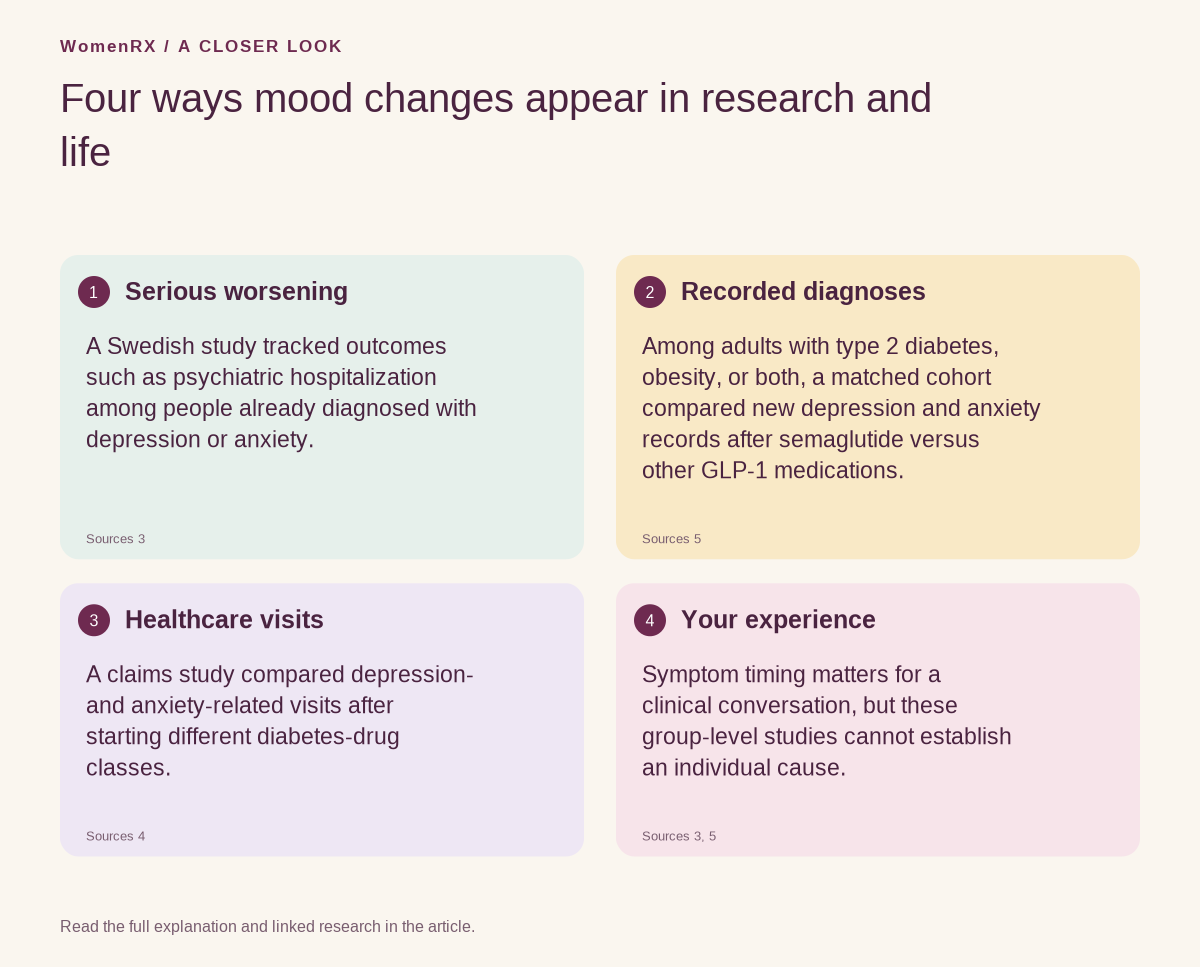
Four ways mood changes appear in research and life
Serious worsening: A Swedish study tracked outcomes such as psychiatric hospitalization among people already diagnosed with depression or anxiety.3
Recorded diagnoses: Among adults with type 2 diabetes, obesity, or both, a matched cohort compared new depression and anxiety records after semaglutide versus other GLP-1 medications.5
Healthcare visits: A claims study compared depression- and anxiety-related visits after starting different diabetes-drug classes.4
Your experience: Symptom timing matters for a clinical conversation, but these group-level studies cannot establish an individual cause.35
Read the figure as text
The studies answer related but different questions. None can determine why one person’s mood changed.- Serious worsening: A Swedish study tracked outcomes such as psychiatric hospitalization among people already diagnosed with depression or anxiety.3
- Recorded diagnoses: Among adults with type 2 diabetes, obesity, or both, a matched cohort compared new depression and anxiety records after semaglutide versus other GLP-1 medications.5
- Healthcare visits: A claims study compared depression- and anxiety-related visits after starting different diabetes-drug classes.4
- Your experience: Symptom timing matters for a clinical conversation, but these group-level studies cannot establish an individual cause.35
More questions, answered
Do lower mood-risk findings mean Ozempic treats depression?
No. The Swedish study found an association with a lower risk of serious worsening among people who already had depression or anxiety; it was not a trial showing that semaglutide treats either condition. 3
Sources you can check
- OZEMPIC (SEMAGLUTIDE) INJECTION, SOLUTION [A-S MEDICATION SOLUTIONS] | US prescribing information and patient instructionsAccessed 2026-09-25Return to first citation
- Anxiety: MedlinePlusAccessed 2026-09-25Return to first citation
- Association between GLP-1 receptor agonist use and worsening mental illness in people with depression and anxiety in Sweden: a national cohort study.Taipale H, Taylor M, Lähteenvuo M, Mittendorfer-Rutz E, Tanskanen A, Tiihonen J. · The lancet. Psychiatry · 2026Return to first citation
- Glucagon-Like Peptide-1 Use and Healthcare Resource Utilization for Depression and Anxiety Among Adults with Type 2 Diabetes: 2019 to 2023.Do D, Lee T, Inneh A, Patel U. · The journal of behavioral health services & research · 2025Return to first citation
- Neuropsychiatric Outcomes With Tirzepatide, Semaglutide, and Other GLP-1 Receptor Agonists.Chen SC, Wang TJ, Chou CK, Lee C. · Diabetes, obesity & metabolism · 2026Return to first citation
- Depression in Women: 4 Things to Know - National Institute of Mental Health (NIMH)Accessed 2026-09-25Return to first citation