Fatigue on Tirzepatide: What Your Symptom Log Can Show
A change in energy is worth tracking, but timing alone can’t tell you whether tirzepatide caused it.
Fatigue has many possible causes. A systematic review’s published summary reports increased fatigue risk with some weight-loss medicines, but does not establish or quantify fatigue risk for tirzepatide. 5 If your energy changed after starting treatment or changing dose, record the timing along with stomach symptoms, food and fluid intake, sleep, menstrual bleeding, pregnancy or postpartum context, and other medicines. 1 2 3 4
What the evidence can and can’t tell you
Fatigue is a real symptom, but it doesn’t point to one cause by itself. It can relate to sleep, stress, pregnancy, medical conditions, treatments, or everyday habits. 3 A systematic review’s published summary reports increased fatigue risk with some weight-loss medicines, but does not establish or quantify fatigue risk for tirzepatide. That doesn’t rule out tirzepatide as a possible contributor to how you feel. 5
Zepbound prescribing information reports that gastrointestinal reactions overall occurred more often with treatment than placebo. Most nausea, vomiting, and diarrhea events occurred during dose escalation and decreased over time. It may be useful to record whether fatigue coincides with these symptoms, but that timing doesn’t establish that they caused your fatigue. 1
Make the log useful, not complicated
A brief note once a day can help you and your care team see whether fatigue follows a pattern. Include:
- Treatment timing: when you started tirzepatide, when the dose changed, and which days your energy feels different.
- Stomach symptoms and intake: note nausea, vomiting, diarrhea, appetite changes, and whether you’ve been eating or drinking less than usual. These details may help explain the pattern; they don’t prove the cause.
- Sleep and daily demands: record whether you slept poorly, woke often, or had an unusually demanding day. Too little sleep and physical or emotional stress can contribute to fatigue. 3
- Other symptoms and medicines: note symptoms that appeared alongside the fatigue and list your prescription medicines, over-the-counter medicines, and supplements for review. Treatments and medical conditions can be among the many possible contributors. 3
The goal isn’t to monitor every detail. Look for a change that repeats, such as low energy after a dose change, on days when stomach symptoms affect your intake, or after several nights of disrupted sleep. A pattern gives your clinician a more useful starting point than “I’ve been tired,” but it can’t diagnose the cause.
Add the context that can matter for women
If you have heavy periods, include that in your notes. Blood loss is a possible cause of anemia, and anemia can cause tiredness; a clinician can assess it with an exam and blood tests. Don’t assume that fatigue means you need iron, since treatment depends on the cause. 2
Pregnancy is another possible contributor to fatigue. If pregnancy is possible, or you’re pregnant, include that context when you discuss the symptom with a clinician. 3 After birth, recovery, bleeding, and the demands of caring for a newborn can also affect how much rest you get. 4
If sleep has changed, record what changed and how often. Poor sleep can contribute to fatigue regardless of its cause. 3 Don’t treat a life-stage label as an explanation for fatigue on its own.
When to bring it up
If fatigue continues for several weeks, MedlinePlus advises contacting a healthcare provider to help identify the cause. 3 Bring your notes and a list of your medicines. Useful questions include: “Could the timing relate to treatment or a dose change?” “Could nausea, vomiting, diarrhea, or reduced intake be part of the picture?” and “Would my symptoms or menstrual history make testing for anemia or another cause relevant?” The answers depend on your situation; the log is there to make that conversation more specific.
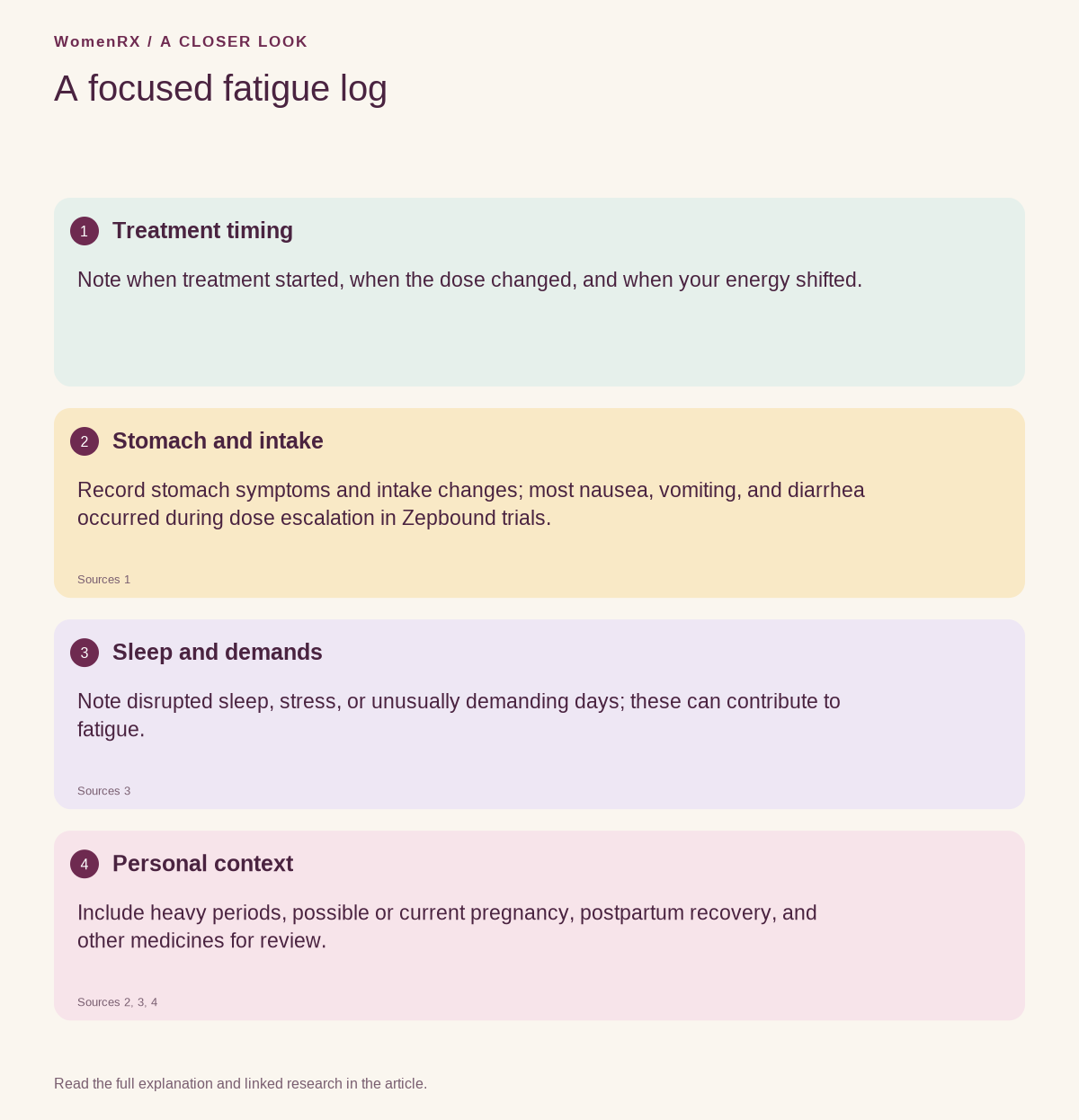
A focused fatigue log
Treatment timing: Note when treatment started, when the dose changed, and when your energy shifted.
Stomach and intake: Record stomach symptoms and intake changes; most nausea, vomiting, and diarrhea occurred during dose escalation in Zepbound trials.1
Sleep and demands: Note disrupted sleep, stress, or unusually demanding days; these can contribute to fatigue.3
Personal context: Include heavy periods, possible or current pregnancy, postpartum recovery, and other medicines for review.234
Read the figure as text
Record a few details that can help distinguish a timing pattern from other possible contributors.- Treatment timing: Note when treatment started, when the dose changed, and when your energy shifted.
- Stomach and intake: Record stomach symptoms and intake changes; most nausea, vomiting, and diarrhea occurred during dose escalation in Zepbound trials.1
- Sleep and demands: Note disrupted sleep, stress, or unusually demanding days; these can contribute to fatigue.3
- Personal context: Include heavy periods, possible or current pregnancy, postpartum recovery, and other medicines for review.234
More questions, answered
Does fatigue after a dose change prove tirzepatide is the cause?
No. Timing can be a helpful clue, especially if it repeats, but fatigue has many possible causes. Record what changed and what else was happening, then review the pattern with your care team. 3
Could heavy periods be relevant to fatigue?
Yes. Heavy menstrual bleeding can contribute to anemia, and anemia can cause tiredness. Fatigue alone can’t confirm anemia; diagnosis involves an exam and blood tests. 2
Sources you can check
- ZEPBOUND (TIRZEPATIDE) INJECTION, SOLUTION ZEPBOUND (TIRZEPATIDE) INJECTION, SOLUTION ZEPBOUND KWIKPEN (TIRZEPATIDE) INJECTION, SOLUTION [ELI LILLY AND COMPANY] | US prescribing information and patient instructionsAccessed 2026-09-25Return to first citation
- Anemia | MedlinePlusAccessed 2026-09-25Return to first citation
- Fatigue: MedlinePlusAccessed 2026-09-25Return to first citation
- Postpartum Care: MedlinePlusAccessed 2026-09-25Return to first citation
- Comparative effects of drugs for adults with overweight or obesity: systematic review and network meta-analysis.Nong K, Shi Q, Xie X, Wang Y, Agarwal A, Guyatt GH, Zhang H, Gao Y, Khunti K, Le Roux CW, Widyahening IS, Fan Q, Liu T, Mao Y, Florez ID, Du H, Pan X, Zou X, Wang C, Sun X, Li J, H... · BMJ (Clinical research ed.) · 2026Return to first citation