Estrogen Patch vs Pill: Is Either Linked to More Weight Gain?
Research doesn’t establish that an estrogen patch causes less weight gain than a pill, so weight alone doesn’t point to a clear winner.
Current findings don’t show that an estrogen pill leads to more weight gain than a patch, or that a patch prevents it. Reviews of hormone-therapy trials report no additional weight gain beyond what commonly occurs around menopause, but those findings cover different regimens rather than proving one route is better. A short study of non-oral estradiol found no weight change, but didn’t compare a patch with a pill. 3 4
What weight studies do, and don’t, show
If weight gain is your main concern, the available research doesn’t identify estrogen patches as better than pills. A clinical review reports that a Cochrane review of 28 randomized trials found no evidence that estrogen alone or estrogen combined with a progestogen changed body weight beyond the gain usually seen around menopause. The review also reports no evidence that hormone therapy prevents menopause-related weight gain. These findings summarize different regimens; they don’t settle how every formulation affects every person. 3
The route-specific question remains harder to answer. A small clinical trial followed 86 early postmenopausal women using non-oral estradiol, either nasal estradiol or estradiol gel, with or without cyclic progesterone. Weight, BMI, and waist circumference remained unchanged during the short treatment periods. But the study didn’t test a patch against a pill, and it can’t establish what happens with those two routes over longer use. 4
So the practical takeaway is limited but useful: current findings don’t support choosing a patch specifically to prevent weight gain. They also don’t prove that all oral and transdermal formulations have identical effects.
The scale can miss changes in body composition
A number on the scale combines fat, muscle, bone, and water. It can’t tell you which of those changed, or why. Waist size and body composition offer different information from total weight, so “I gained weight” and “my body shape changed” aren’t necessarily the same observation. 1
Midlife can bring shifts in body composition, including more abdominal fat and less lean mass. A clinical review describes these changes as associated with the menopausal transition, independent of chronological age. It also summarizes research suggesting hormone therapy may help limit central fat accumulation or preserve favorable body composition. That isn’t the same as showing weight loss, preventing all weight gain, or showing that a patch works better than a pill. 3
This distinction matters when interpreting personal changes. Stable scale weight doesn’t rule out a change in fat or muscle, and a change in pounds by itself doesn’t identify whether menopause, treatment, or another factor played a role. 1 3
Let treatment goals and risks guide the route
Hormone therapy is used for established menopause-related indications, not as a weight-loss treatment. The North American Menopause Society says its benefits and risks vary with factors that include the type, dose, duration, route, timing of treatment, and whether a progestogen is used. It recommends individualizing treatment and periodically reassessing it. 2 A clinical review likewise says hormone therapy shouldn’t be prescribed as a primary weight-loss intervention. 3
If you’re choosing between a pill and a patch, ask how each option fits your treatment goals and personal health considerations. Weight evidence doesn’t currently make one route the clear choice. If your weight or waist changes after starting or changing treatment, note what changed and when; the timing is useful context, but it doesn’t prove the treatment caused it.
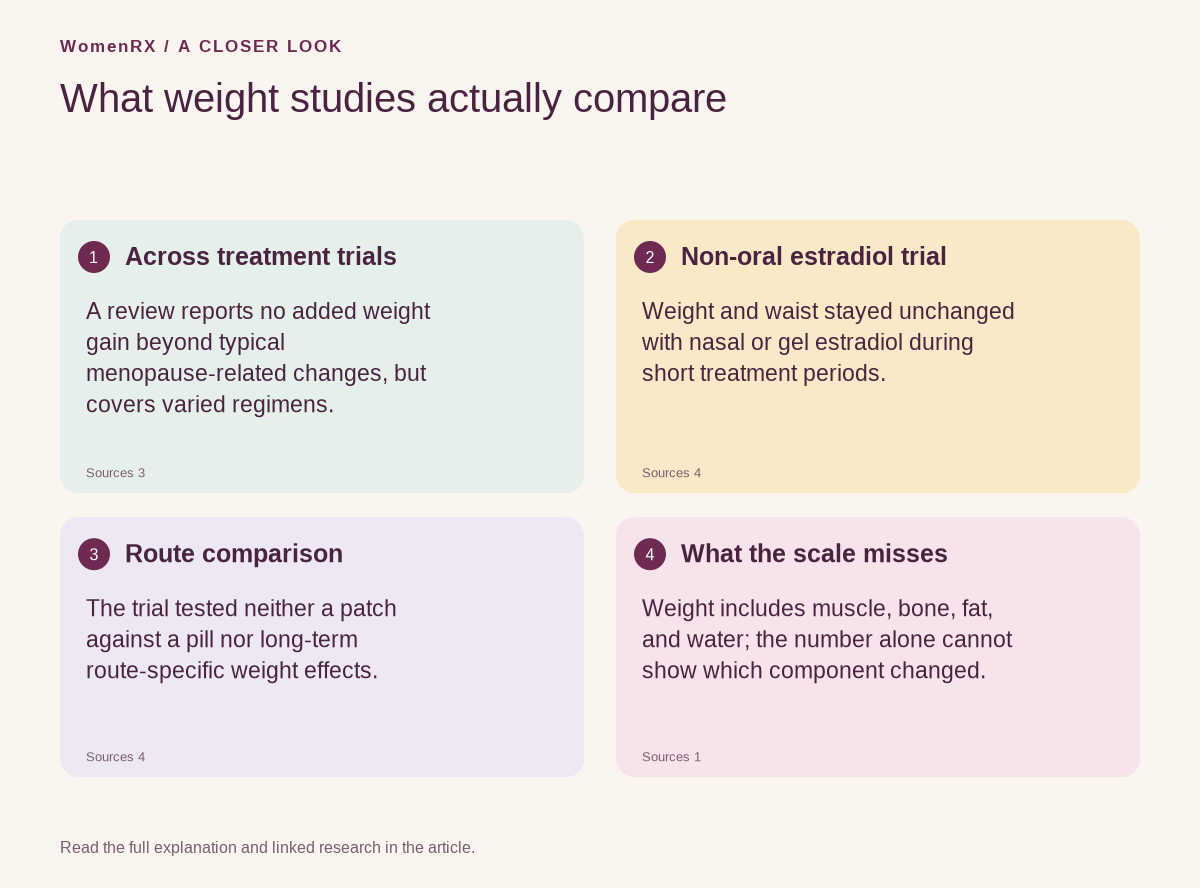
What weight studies actually compare
Across treatment trials: A review reports no added weight gain beyond typical menopause-related changes, but covers varied regimens.3
Non-oral estradiol trial: Weight and waist stayed unchanged with nasal or gel estradiol during short treatment periods.4
Route comparison: The trial tested neither a patch against a pill nor long-term route-specific weight effects.4
What the scale misses: Weight includes muscle, bone, fat, and water; the number alone cannot show which component changed.1
Read the figure as text
These findings measure different outcomes and use different treatments, so they don’t establish a weight-gain advantage for a patch or a pill.- Across treatment trials: A review reports no added weight gain beyond typical menopause-related changes, but covers varied regimens.3
- Non-oral estradiol trial: Weight and waist stayed unchanged with nasal or gel estradiol during short treatment periods.4
- Route comparison: The trial tested neither a patch against a pill nor long-term route-specific weight effects.4
- What the scale misses: Weight includes muscle, bone, fat, and water; the number alone cannot show which component changed.1
More questions, answered
Can menopause hormone therapy reduce belly fat?
Some research summarized in a clinical review suggests hormone therapy may limit central fat accumulation or support favorable body composition. That doesn’t establish weight loss, and it doesn’t show that a patch has this effect more than a pill. Hormone therapy isn’t a weight-loss treatment. 3
Sources you can check
- Body Weight: MedlinePlusAccessed 2026-09-25Return to first citation
- The 2022 hormone therapy position statement of The North American Menopause Society.“The 2022 Hormone Therapy Position Statement of The North American Menopause Society” Advisory Panel. · Menopause (New York, N.Y.) · 2022Return to first citation
- Clinical review: Menopause hormone therapy in weight management.Younglove C. · Obesity pillars · 2026Return to first citation
- Effects of micronized progesterone added to non-oral estradiol on lipids and cardiovascular risk factors in early postmenopause: a clinical trial.Casanova G, Spritzer PM. · Lipids in health and disease · 2012Return to first citation