Estrogen and GLP-1 Medicines: What Human Studies Show
Animal findings make a hormone connection plausible, but human research hasn’t established that estrogen changes how women respond to GLP-1 medicines.
Estrogen has not been shown to explain differences in women’s response to GLP-1 medicines. In one small study of people with breast cancer, menopausal status and concurrent cancer endocrine therapy were not significantly linked to reaching 5% weight loss at 12 months. That result is limited, and it does not test menstrual-cycle changes or menopausal hormone therapy. 2
The short answer: plausible biology, unproven treatment difference
It’s reasonable to ask whether changing estrogen levels affect weight loss with a GLP-1 medicine. Menstrual cycling, menopause, and hormone therapy could be relevant variables to study. But a biological possibility is not the same as evidence that estrogen changes a person’s response to treatment. Human findings so far don’t establish that connection.
One relevant human study followed 75 people with breast cancer who were prescribed a GLP-1 receptor agonist. Their average weight was lower by 2.9 kg at six months and 4.2 kg at 12 months; the average change at 12 months was 5%. The group was mostly postmenopausal, and most had diabetes. In analyses of who reached at least 5% weight loss, menopausal status and concurrent endocrine therapy weren’t statistically significant predictors. 2
That finding is a useful clue, not proof that hormones make no difference. The study was small, involved people with breast cancer, and can’t settle how the results apply to women using these medicines for other reasons. A separate review of breast-cancer-specific research describes the evidence as largely retrospective and reports that aromatase inhibitor or tamoxifen use has been associated with smaller weight reductions in some data. These findings don’t establish that estrogen itself caused the difference. 3
What the animal research can, and can’t, tell us
In a study of ovariectomized mice, researchers examined D-allulose, a sugar reported to stimulate the body’s release of GLP-1. The mice had less visceral fat accumulation and better measures of glucose metabolism with D-allulose; some benefits were reduced in mice without GLP-1 receptors. 1
That is a preclinical finding about a dietary component and the body’s own GLP-1 signaling in mice. It is not a trial of a GLP-1 medicine, doesn’t show that estrogen changes medication response in women, and can’t tell us what happens during menstrual cycling, menopause, or hormone therapy in people.
Why the exposures need to be separated
A study of cancer endocrine treatment isn’t automatically a study of menopausal hormone therapy. Nor does a comparison between people who are premenopausal and postmenopausal tell us whether a particular person’s changing hormone levels alter her response. Those are different questions, and they need to be measured separately.
To show that estrogen changes GLP-1 medicine response, human research would need to record the relevant hormone exposure and compare treatment outcomes across clearly defined groups. For example, researchers could distinguish menstrual-cycle stage, menopause status, and menopausal hormone therapy rather than treating them as one category. They’d also need enough participants to make meaningful comparisons and account for other factors that could affect weight change, such as diabetes and cancer treatment. This is what would help separate an estrogen-related effect from a coincidental difference between groups.
What to take away
There’s a reason to study estrogen and GLP-1 signaling, but the animal findings don’t demonstrate a difference in women’s medication response. The small human breast-cancer study offers a limited real-world clue, while the broader clinical question remains unsettled. Menstrual cycling, menopause, and menopausal hormone therapy should be treated as unanswered research questions, not established explanations for why one woman loses more weight than another.
From hormone hypothesis to human evidence
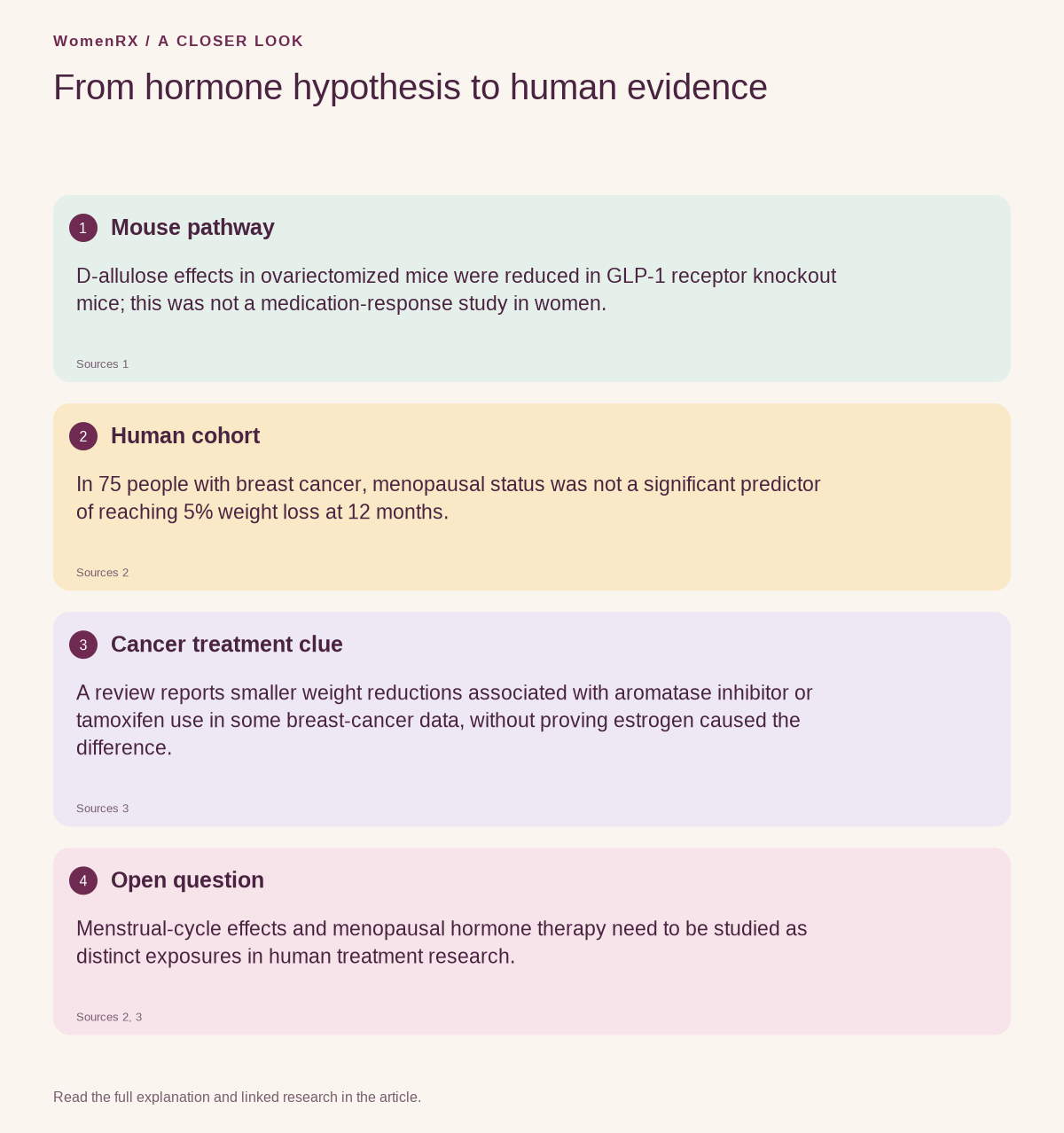
Mouse pathway: D-allulose effects in ovariectomized mice were reduced in GLP-1 receptor knockout mice; this was not a medication-response study in women.1
Human cohort: In 75 people with breast cancer, menopausal status was not a significant predictor of reaching 5% weight loss at 12 months.2
Cancer treatment clue: A review reports smaller weight reductions associated with aromatase inhibitor or tamoxifen use in some breast-cancer data, without proving estrogen caused the difference.3
Open question: Menstrual-cycle effects and menopausal hormone therapy need to be studied as distinct exposures in human treatment research.23
Read the figure as text
These findings sit at different evidence levels: a mouse model suggests a GLP-1 pathway, while a small human cohort offers limited treatment-response data.- Mouse pathway: D-allulose effects in ovariectomized mice were reduced in GLP-1 receptor knockout mice; this was not a medication-response study in women.1
- Human cohort: In 75 people with breast cancer, menopausal status was not a significant predictor of reaching 5% weight loss at 12 months.2
- Cancer treatment clue: A review reports smaller weight reductions associated with aromatase inhibitor or tamoxifen use in some breast-cancer data, without proving estrogen caused the difference.3
- Open question: Menstrual-cycle effects and menopausal hormone therapy need to be studied as distinct exposures in human treatment research.23
More questions, answered
Does a nonsignificant result mean hormones have no effect?
No. In the 75-person breast cancer study, menopausal status and concurrent endocrine therapy weren’t statistically significant predictors of reaching at least 5% weight loss. That doesn’t prove the groups respond identically; a small study may not be able to detect a modest difference. 2
Did the human study test menstrual-cycle changes or menopausal hormone therapy?
The study reported menopausal status and concurrent cancer endocrine therapy, but not menstrual-cycle analyses or a comparison of menopausal hormone therapy. Those exposures shouldn’t be assumed to have been tested. 2
Sources you can check
- GLP-1 Release by Rare Sugar D-Allulose Ameliorates Sucrose-Induced Obesity and Glucose Intolerance in Ovariectomized Mice.Iba K, Kyo M, Ishihara H, Nagao A, Kawabe M, Ohbayashi K, Yada T, Iwasaki Y. · International journal of molecular sciences · 2026Return to first citation
- GLP-1 Receptor Agonist Use and Weight Change in Patients With Breast Cancer.Shen S, Bethina Liu Md, Chad Fanti Md, Maria Bromberg Mph, Yuan Chen PhD, Cassandra Chang, Neil M Iyengar Md. · Oncology (Williston Park, N.Y.) · 2025Return to first citation
- Glucagon-Like Peptide-1 Receptor Agonists in Breast Cancer: Metabolic, Clinical, and Survivorship Implications.Hundal J, Linz M, Anikreddy S, Sengupta S, Zhou K, Maiti B. · JCO oncology practice · 2026Return to first citation