Electric-Shock Sensations: When to Get Them Assessed
Where the sensation happens and what comes with it matter more than whether it feels like a shock.
Call 911 if a shock-like sensation comes with sudden one-sided weakness or numbness, trouble speaking, vision changes, or sudden trouble walking, even if those symptoms fade.11 New loss of feeling around the groin or buttocks, or new bladder or bowel dysfunction, needs emergency assessment; both together are especially concerning.6 If the sensation has no obvious cause, contact a clinician. Its location, timing, and accompanying symptoms can help guide the assessment.12
An electric-shock feeling can last a moment and still be hard to describe. For example, you might describe it as a jolt in your head, down an arm, or through your back and legs. That description is a useful starting point, but it isn’t a diagnosis. The next question is whether anything else changed at the same time.
When another symptom makes it an emergency
Call 911 for a sudden change in strength or sensation in your face, arm, or leg, especially on one side. Sudden trouble speaking, seeing, walking, or keeping your balance also calls for emergency help. These are stroke warning signs in women and men. Don’t wait to see whether they pass: stroke-like symptoms that disappear after a few minutes can be a transient ischemic attack and still need immediate attention. Note when the symptoms began, and don’t drive yourself to the hospital.11
A different emergency pattern involves new loss of feeling around the groin, buttocks, or area you’d touch when sitting on a saddle, or new trouble controlling or emptying your bladder or bowels. Either can be a warning sign of cauda equina syndrome, a condition involving compression of nerves in the lower spine that needs urgent investigation. Their combination is especially concerning. Seek emergency assessment rather than waiting for a routine visit.6
These decisions are about the accompanying change, not how painful or dramatic the shock itself feels.
Patterns worth arranging an assessment for
If the sensation comes with a developing change in walking or hand coordination, arrange a clinical assessment. A review of cervical myelopathy, a condition involving the spinal cord in the neck, describes hand clumsiness, unsteady walking, and neck pain among its common presentations. None identifies the condition on its own. Sudden trouble walking belongs in the emergency category above.311
Numbness or tingling in the hands and feet that has no obvious cause is also a reason to contact a clinician. Vitamin B12 deficiency can affect sensation in the hands and feet, even without anemia; identifying it early can help prevent lasting nerve damage. Limited intake of animal foods, gastrointestinal surgery, and prolonged use of metformin or stomach-acid-reducing medicines are relevant details to mention because they can affect B12 status.122
Sensory changes can also occur in neurological conditions such as multiple sclerosis, but an isolated zap cannot establish that diagnosis. Clinicians consider the pattern over time, a neurological examination, and other possible explanations rather than relying on the sensation’s name.8
A sensation that keeps returning, changes, or lingers is worth describing when you contact a clinician, especially if you can’t identify an obvious cause. Its course and location help guide the assessment; recurrence alone isn’t the same emergency pattern as sudden stroke signs.1211
The detail that can change the explanation
If the feeling is mainly in your head, think back to any recent change in an antidepressant. Reducing or stopping one can cause an electric-shock-like feeling often called a “brain zap.” Tell your prescriber about the timing of a reduction or stopping; don’t assume the medication explains new weakness or another neurological change.111
Before an assessment, a few concrete observations can help: where you feel the shock and whether it stays there or travels; when it began and how long each episode lasts; whether a movement seems to bring it on; and whether numbness, weakness, vision changes, or difficulty walking occur with it. Include medication changes. For example, “a brief feeling in my head since changing an antidepressant” describes a different pattern from “a shock down my back followed by trouble using my hands.” Those details help direct an examination.1213
If you’re in perimenopause, you may wonder whether an unfamiliar sensory experience is part of the transition. Mention that context, but don’t assume it explains a new shock-like sensation. In particular, it shouldn’t explain away weakness, loss of feeling, or changes in walking. Start with the pattern and the warning signs, then consider possible causes.3611
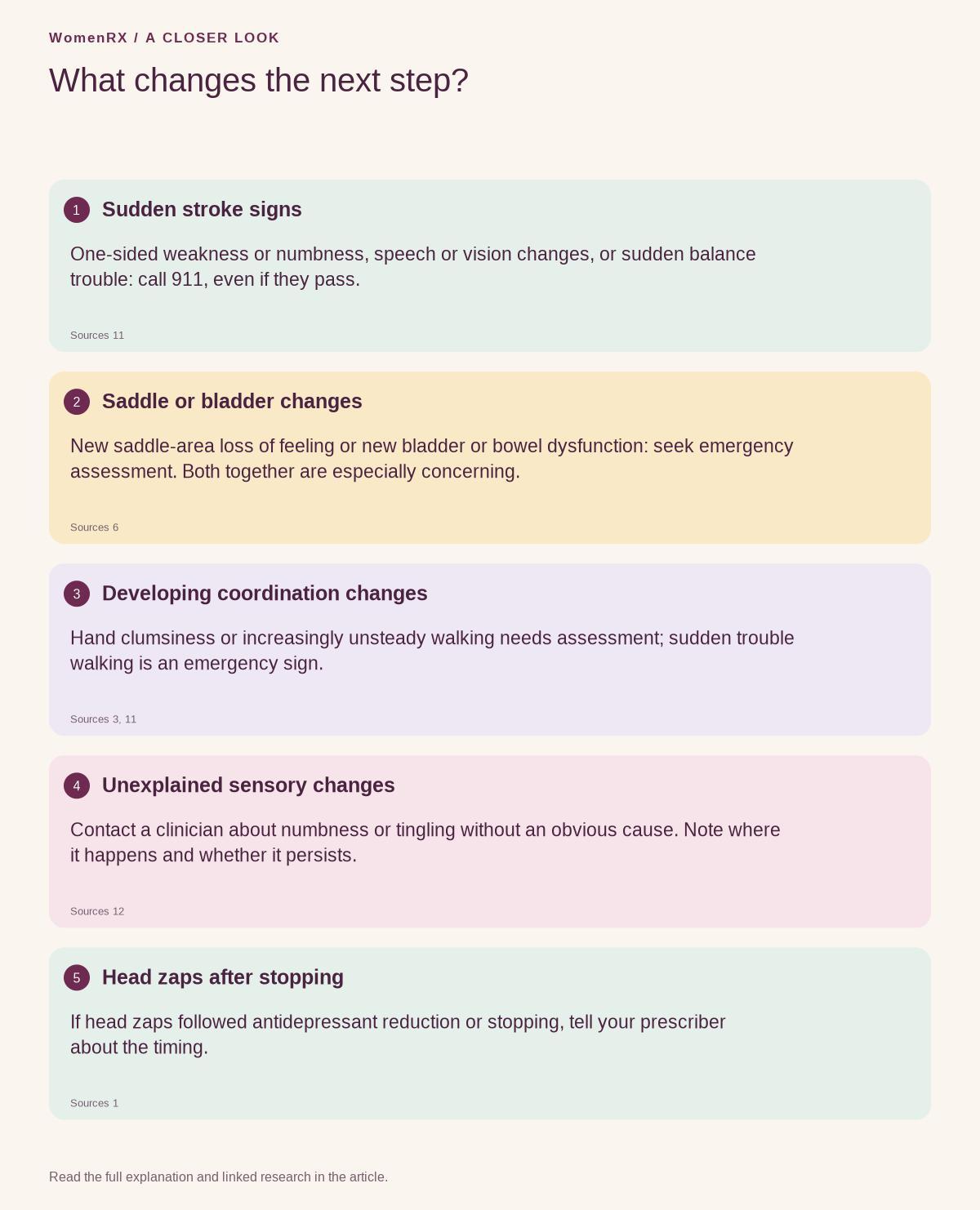
What changes the next step?
Sudden stroke signs: One-sided weakness or numbness, speech or vision changes, or sudden balance trouble: call 911, even if they pass.11
Saddle or bladder changes: New saddle-area loss of feeling or new bladder or bowel dysfunction: seek emergency assessment. Both together are especially concerning.6
Developing coordination changes: Hand clumsiness or increasingly unsteady walking needs assessment; sudden trouble walking is an emergency sign.311
Unexplained sensory changes: Contact a clinician about numbness or tingling without an obvious cause. Note where it happens and whether it persists.12
Head zaps after stopping: If head zaps followed antidepressant reduction or stopping, tell your prescriber about the timing.1
Read the figure as text
Start with accompanying symptoms, then consider whether the sensation has an obvious cause.- Sudden stroke signs: One-sided weakness or numbness, speech or vision changes, or sudden balance trouble: call 911, even if they pass.11
- Saddle or bladder changes: New saddle-area loss of feeling or new bladder or bowel dysfunction: seek emergency assessment. Both together are especially concerning.6
- Developing coordination changes: Hand clumsiness or increasingly unsteady walking needs assessment; sudden trouble walking is an emergency sign.311
- Unexplained sensory changes: Contact a clinician about numbness or tingling without an obvious cause. Note where it happens and whether it persists.12
- Head zaps after stopping: If head zaps followed antidepressant reduction or stopping, tell your prescriber about the timing.1
What if the shock lasted only seconds and I feel fine now?
Note where and when it happened and whether there was an obvious trigger. If you can’t identify a cause, contact a clinician rather than assuming the brief duration explains it.12 A brief episode with sudden one-sided numbness or weakness, trouble speaking, vision changes, or loss of balance is different: call 911 even if those signs have gone away.11
Sources you can check
- Antidepressants - NHSAccessed 2026-09-25Return to first citation
- Vitamin B12 - Health Professional Fact SheetAccessed 2026-09-25Return to first citation
- Degenerative Cervical Myelopathy: A Concept Review and Clinical Approach.Gallagher DO, Taghlabi KM, Bondar K, Saifi C. · Clinical spine surgery · 2024Return to first citation
- Assessment and early investigation of cauda equina syndrome- a systematic review of existing international guidelines and summary of the current evidence.Hennessy O, Devitt AT, Synnott K, Timlin M. · European spine journal : official publication of the European Spine Society, the European Spinal Deformity Society, and the European Section of the Cervical Spine Research Society · 2025Return to first citation
- Multiple sclerosis: diagnosis, differential diagnosis, and clinical presentation.Gelfand JM. · Handbook of clinical neurology · 2014Return to first citation
- Signs and Symptoms of Stroke | Stroke | CDCAccessed 2026-09-25Return to first citation
- Numbness and tingling: MedlinePlus Medical EncyclopediaAccessed 2026-09-25Return to first citation