Eating Well Through Menopause, Without a Strict Diet
A flexible, plant-rich eating pattern can support general health in midlife without promising to stop hot flashes or requiring one specific menopause diet.
There’s no single eating plan every woman needs during menopause. A useful starting point is a varied, mostly minimally processed pattern that makes room for plant foods and meets your nutritional needs. Research in postmenopausal women suggests healthy patterns may support cardiometabolic and bone health, but much of the evidence is observational, and no specific menu is established as a menopause treatment. 2 5
Start with a pattern, not a list of forbidden foods
A menopause eating plan doesn’t need its own rules or a strict menu. A practical starting point is a varied pattern built around minimally processed, plant-rich foods, with enough nutritional variety to meet your needs. This describes a broad approach, not a tested meal formula or a requirement to eat vegan. Reviews comparing vegan, vegetarian, and omnivorous diets emphasize overall food quality and nutrient adequacy over whether a pattern excludes animal foods. 2
For an everyday meal, you might combine vegetables or fruit, a grain or other filling staple, and a protein source that fits how you eat. That’s an example of how to put the broader pattern into practice, not a prescribed ratio or a meal plan proven to reduce menopause symptoms. The best fit is one you can maintain and adapt to your preferences, budget, culture, and health needs.
What the evidence says about midlife health
A review focused on postmenopausal women found that healthy patterns, including Mediterranean-style and DASH approaches, may support cardiometabolic health and may benefit body composition and bone health. The review also noted that much of the evidence was observational, so it doesn’t establish that a particular pattern will produce those outcomes for an individual woman. 5
A separate systematic review and meta-analysis in the general population found that greater adherence to a Mediterranean diet was associated with lower risk of type 2 diabetes. That finding supports the pattern as a reasonable option for general cardiometabolic health, but it isn’t menopause-specific evidence and doesn’t mean that eating this way guarantees prevention. 3
Bone health deserves attention, too. Calcium is a major mineral in bone, and a US clinical guideline describes it as a shortfall nutrient in the American diet. That’s a reason to consider whether your overall eating pattern meets your needs, not a reason to assume that every woman needs a supplement or the same foods. The guideline found no cardiovascular benefit or harm associated with calcium intake from food or supplements in generally healthy adults, within the stated upper intake limits. 1
Keep symptom claims separate from health goals
Eating well may be worthwhile for general health, but don’t count on a particular diet to treat hot flashes. The North American Menopause Society’s review did not recommend dietary modification as a treatment for vasomotor symptoms, and it also did not recommend soy foods or soy extracts for that purpose. That doesn’t mean you need to avoid soy as food; it means the evidence doesn’t support presenting it as a dependable hot-flash treatment. 4
This distinction can help you choose a goal that matches the evidence. You might want an eating pattern that supports overall health and feels satisfying, while considering other options separately if symptoms are disrupting your life.
A flexible way to build meals
Use the checklist below as a set of prompts, not a scorecard:
- Include plant foods regularly. Choose options you enjoy and can get consistently. A plant-rich pattern is a useful starting point, but it doesn’t require eliminating animal foods. 2
- Vary your choices. Across meals, aim for variety rather than relying on a narrow set of foods. The point is to support a nutrient-adequate pattern, not to follow a fixed menu. 2
- Consider bone-related nutrition. Ask whether your usual eating pattern provides enough calcium for your individual needs. Calcium matters for bone; supplements are a separate decision, not a substitute for figuring out what you need. 1
- Adapt to how you eat. Vegetarian and vegan patterns can be healthy when well planned, but the review identifies nutrients that may need particular attention, including vitamin B12, iodine, iron, zinc, calcium, vitamin D, omega-3 fats, and protein quality. 2
- Make it workable. Choose a pattern you can sustain and adjust it for preferences, access, and medical needs. A healthy pattern doesn’t have to match one named diet. 2 5
If you have a condition or dietary restriction that affects what you can eat, or you’re considering supplements, your individual needs may call for tailored advice. The useful question isn’t “Which menopause diet is best for everyone?” It’s “What eating pattern can I keep up, and does it meet my needs?”
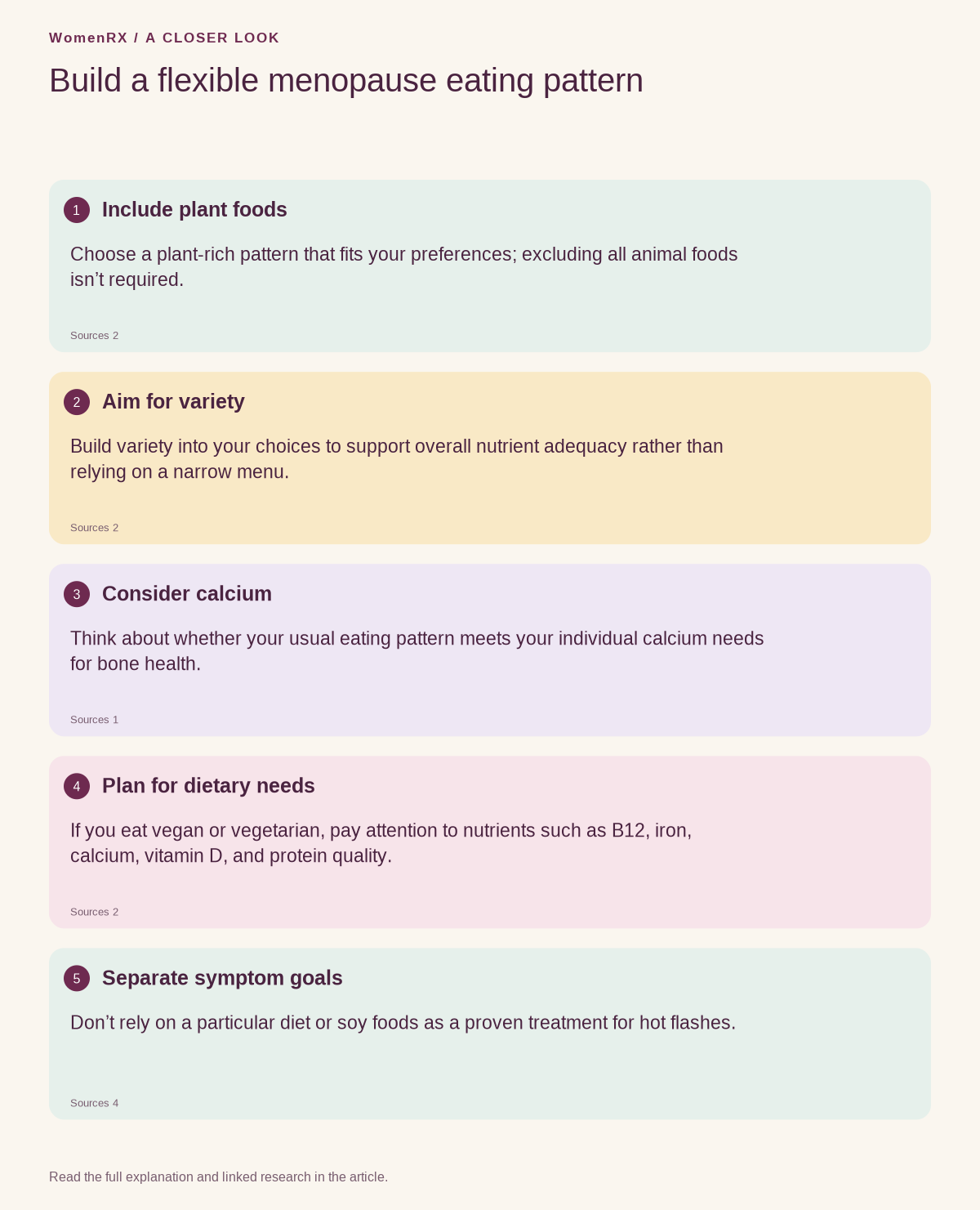
Build a flexible menopause eating pattern
Include plant foods: Choose a plant-rich pattern that fits your preferences; excluding all animal foods isn’t required.2
Aim for variety: Build variety into your choices to support overall nutrient adequacy rather than relying on a narrow menu.2
Consider calcium: Think about whether your usual eating pattern meets your individual calcium needs for bone health.1
Plan for dietary needs: If you eat vegan or vegetarian, pay attention to nutrients such as B12, iron, calcium, vitamin D, and protein quality.2
Separate symptom goals: Don’t rely on a particular diet or soy foods as a proven treatment for hot flashes.4
Read the figure as text
Use these prompts to make a varied eating pattern fit your preferences and nutritional needs. They are not a scored test or a prescribed menu.- Include plant foods: Choose a plant-rich pattern that fits your preferences; excluding all animal foods isn’t required.2
- Aim for variety: Build variety into your choices to support overall nutrient adequacy rather than relying on a narrow menu.2
- Consider calcium: Think about whether your usual eating pattern meets your individual calcium needs for bone health.1
- Plan for dietary needs: If you eat vegan or vegetarian, pay attention to nutrients such as B12, iron, calcium, vitamin D, and protein quality.2
- Separate symptom goals: Don’t rely on a particular diet or soy foods as a proven treatment for hot flashes.4
More questions, answered
Should I eat soy to prevent hot flashes?
Soy can be part of an eating pattern if you enjoy it, but current menopause guidance does not recommend soy foods or soy extracts as a treatment for hot flashes. 4
Sources you can check
- Lack of Evidence Linking Calcium With or Without Vitamin D Supplementation to Cardiovascular Disease in Generally Healthy Adults: A Clinical Guideline From the National Osteoporosis Foundation and the American Society for Preventive Cardiology.Kopecky SL, Bauer DC, Gulati M, Nieves JW, Singer AJ, Toth PP, Underberg JA, Wallace TC, Weaver CM. · Annals of internal medicine · 2016Return to first citation
- Diet Quality, Food Processing, and Nutrient Adequacy in Vegan, Vegetarian, and Omnivorous Dietary Patterns: A Critical Narrative Review.Clemente-Suárez VJ, Sancho-Haro ES, Yáñez-Sepúlveda R, Tornero-Aguilera JF, Martín-Rodríguez A. · Nutrients · 2026Return to first citation
- Mediterranean diet for the primary prevention of cardiometabolic diseases: evidence from a systematic review and meta-analysis featured in the Italian National Guidelines "La Dieta Mediterranea".Muscogiuri G, Maiorino MI, Paolini B, Aversano F, Buscemi C, Cappiello I, Caruso I, Ceriani E, Chimienti M, Cicero FAG, Cintoni M, Desideri G, D'Eusebio C, Medea G, Patti MC, Randa... · Nutrition (Burbank, Los Angeles County, Calif.) · 2026Return to first citation
- The 2023 nonhormone therapy position statement of The North American Menopause Society.Menopause (New York, N.Y.) · 2023Return to first citation
- Dietary patterns and their associations with body composition, cardiometabolic and bone health in postmenopausal women.Best N. · Post reproductive health · 2025Return to first citation