Can GLP-1 Medicines Help Without a Strict Diet?
A review found that nearly all studied weight-management drug interventions reduced weight more than placebo and/or lifestyle intervention, but it did not report what to expect with no lifestyle changes.
Possibly. A review that included several GLP-1 medicines found that nearly all studied weight-management drug interventions reduced weight more than placebo and/or lifestyle intervention. It did not report how much a particular medicine helps with no diet or activity changes. 3 The STEP results below are a semaglutide example, not an estimate for other GLP-1 medicines: in trials with lifestyle support, people taking semaglutide lost more weight than those taking placebo. 4 Support can still help you eat well and stay active in ways that fit your life. 14
What the trial results actually compare
A review that included several GLP-1 medicines found that nearly all studied weight-management drug interventions reduced weight more than placebo and/or lifestyle intervention. That finding is broader than the semaglutide trials below, but it does not establish what happens with no lifestyle changes for any particular medicine. 3
For semaglutide, the most useful question isn’t whether people in a medication trial changed their habits perfectly. It’s whether the semaglutide group lost more weight than the placebo group in a trial that included lifestyle support. That difference helps show semaglutide’s contribution within the conditions studied. These STEP results should not be treated as results for other GLP-1 medicines. 4
In STEP 1, a 68-week trial of adults with overweight or obesity without diabetes, participants receiving semaglutide lost an average of 14.9% of their starting body weight, compared with 2.4% for those receiving placebo. The trial included a lifestyle intervention. These are group averages, not a prediction of what you would lose. 4
STEP 3 asked a related question under more intensive conditions. For participants without diabetes, the study paired semaglutide with intensive behavioral therapy and an initial low-calorie diet. At 68 weeks, average weight loss was 16.0% with semaglutide and 5.7% with placebo. Here, too, the semaglutide group lost more weight in a study that included lifestyle support. 4
It’s tempting to subtract STEP 1’s result from STEP 3’s and call the difference the benefit of a stricter program. That wouldn’t be a fair comparison: they were separate trials, not a single trial that randomly assigned otherwise comparable people to different levels of lifestyle support. The higher placebo-group weight loss in STEP 3 shows that its whole treatment setting differed, but it doesn’t isolate how much each part contributed. 4
What “without lifestyle changes” leaves unanswered
If you mean, “I can’t follow an intensive program,” the trial results are encouraging in one specific way: semaglutide’s advantage over placebo appeared in studies with different approaches to lifestyle support, including one with intensive behavioral therapy. 4 They don’t establish that you need to meet a particular diet or exercise target before the medicine can help.
If you mean, “What percentage of weight would I lose while making no changes at all?”, there isn’t a sound number to take from those comparisons. The broader review included studies with and without lifestyle interventions and several GLP-1 medicines. Its reported findings don’t provide a no-lifestyle-change weight-loss estimate for semaglutide or another particular medicine. 3
Trial details can also make results less transferable to everyday life. In one liraglutide study, people entered the randomized treatment period only after losing at least 5% of their starting weight through a lifestyle intervention during a run-in period. The product information explicitly cautions that those results may not reflect what would be expected in the general population. 2
Support doesn’t have to mean an all-or-nothing plan
A useful distinction is between following a strict weight-loss program and looking after your nutrition and physical health while taking a medicine. You may not have the time, energy, or circumstances for intensive counseling or a prescribed meal plan. That doesn’t make a small, workable change pointless. For example, if long workouts aren’t realistic, activity can start slowly and be broken into shorter stretches; even small amounts can benefit health. 1
Gastrointestinal adverse reactions are another consideration. GLP-1 receptor agonists, including liraglutide, have been associated with gastrointestinal reactions, sometimes severe. In Saxenda (liraglutide) trials, severe gastrointestinal reactions were reported more often with liraglutide than with placebo. 2
These trial summaries don’t provide weight-loss comparisons by sex, reproductive stage, or menopause stage. What matters more for this question is being clear about which medicine and which trial conditions sit behind a number you hear. 34
What semaglutide trial comparisons can tell you
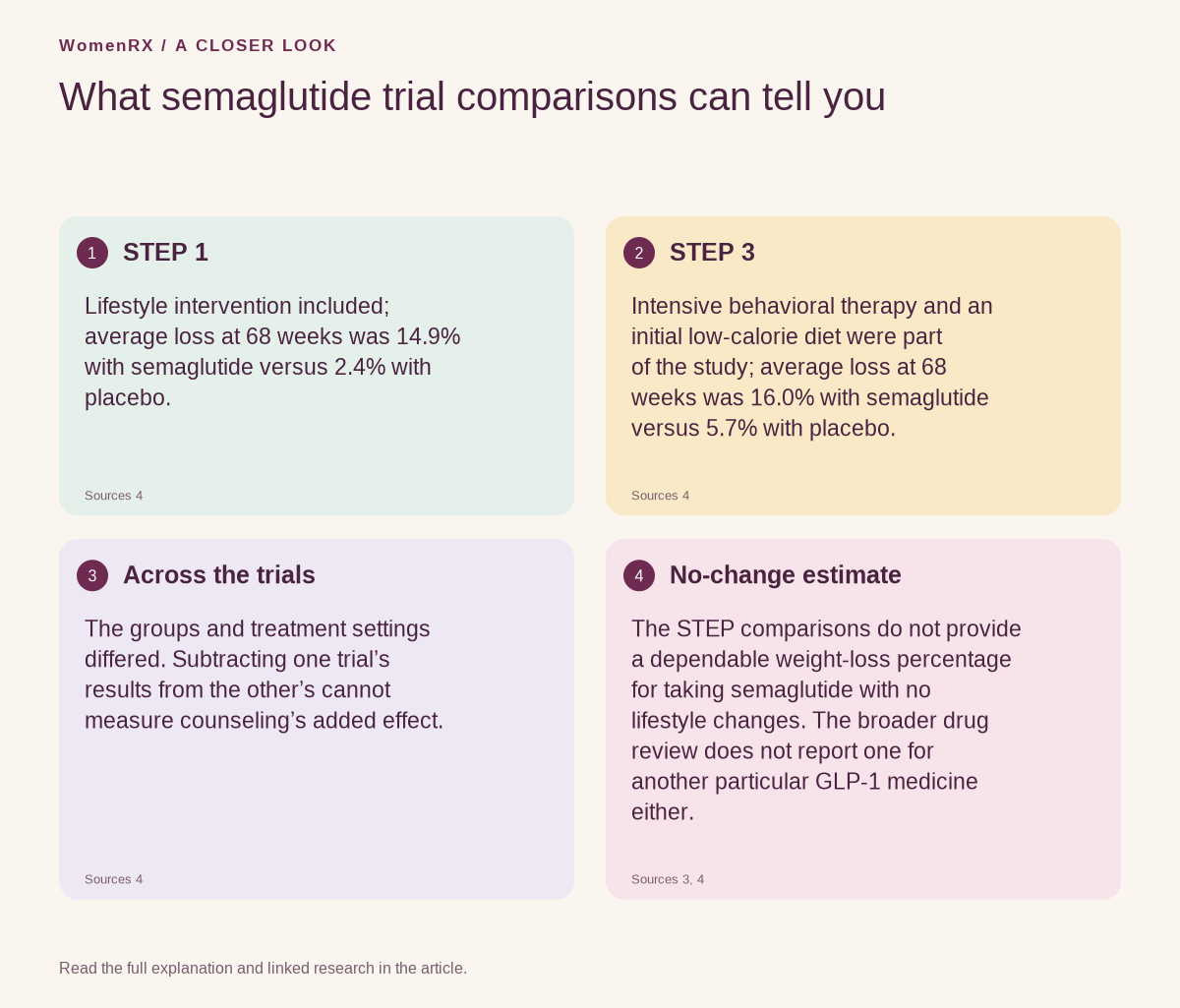
STEP 1: Lifestyle intervention included; average loss at 68 weeks was 14.9% with semaglutide versus 2.4% with placebo.4
STEP 3: Intensive behavioral therapy and an initial low-calorie diet were part of the study; average loss at 68 weeks was 16.0% with semaglutide versus 5.7% with placebo.4
Across the trials: The groups and treatment settings differed. Subtracting one trial’s results from the other’s cannot measure counseling’s added effect.4
No-change estimate: The STEP comparisons do not provide a dependable weight-loss percentage for taking semaglutide with no lifestyle changes. The broader drug review does not report one for another particular GLP-1 medicine either.34
Read the figure as text
These are semaglutide examples, not results for every GLP-1 medicine. Both comparisons come from trials that included lifestyle support; comparing across trials cannot measure the added value of a more intensive program.- STEP 1: Lifestyle intervention included; average loss at 68 weeks was 14.9% with semaglutide versus 2.4% with placebo.4
- STEP 3: Intensive behavioral therapy and an initial low-calorie diet were part of the study; average loss at 68 weeks was 16.0% with semaglutide versus 5.7% with placebo.4
- Across the trials: The groups and treatment settings differed. Subtracting one trial’s results from the other’s cannot measure counseling’s added effect.4
- No-change estimate: The STEP comparisons do not provide a dependable weight-loss percentage for taking semaglutide with no lifestyle changes. The broader drug review does not report one for another particular GLP-1 medicine either.34
More questions, answered
Does the STEP 3 result prove intensive counseling adds a specific amount of weight loss?
No. STEP 3 compared semaglutide with placebo in a study that included intensive behavioral therapy and an initial low-calorie diet. STEP 1 included a lifestyle intervention, but comparing the two separate trials can’t isolate the added effect of counseling. 4
Sources you can check
- How Much Exercise Do I Need?: MedlinePlusAccessed 2026-09-25Return to first citation
- SAXENDA (LIRAGLUTIDE) INJECTION, SOLUTION [NOVO NORDISK PHARMACEUTICAL INDUSTRIES, LP] | US prescribing information and patient instructionsAccessed 2026-09-25Return to first citation
- Benefits and Harms of Pharmacologic Treatments in Adults With Overweight or Obesity: A Living Systematic Review and Network Meta-analysis for the American College of Physicians.Damen JAA, Idema DL, Vernooij RWM, Huis In 't Veld LF, Kusters MPT, Lokerse ME, de Kanter E, Spijker R, van der Braak K, Jenniskens K, Oerbekke MS, Hooft L. · Annals of internal medicine · 2026Return to first citation
- Semaglutide in obesity and type 2 diabetes: A review of clinical trial evidence from 1 to 5 semaglutide treatment effect in people with obesity program.Khanna A, Kumar V, Gola S. · Indian journal of pharmacology · 2026Return to first citation