Does Your Father’s Family Predict Menopause Timing?
Menopause timing can run in families, but research hasn’t shown how much a relative on your father’s side predicts your own.
Family history can offer context, but it can’t give you a reliable personal menopause-age estimate. Studies have found associations among mothers, daughters, and sisters, and one found a correlation between aunts and nieces. The reported research doesn’t compare maternal and paternal relatives, so it can’t tell you how predictive your father’s family is for your timing. 23
If women on your father’s side had menopause early or late, it’s reasonable to include that history in a conversation about your health. But a relative’s age can’t be turned into a dependable date for your own menopause. Studies have found family patterns, but the reported comparisons don’t show whether a paternal relative’s timing predicts yours differently from a maternal relative’s. 23
Family patterns are clues, not personal forecasts
In a UK study of 2,060 relatives, women had higher odds of natural menopause at age 45 or younger if their mother or non-twin sister had also reached menopause by 45. The reported odds ratios were 6.2 for mothers and 5.5 for sisters. The study also found higher odds of menopause at age 54 or older when a mother or sister had experienced menopause at that age or later. 2
Those figures describe associations between groups in one study. They aren’t your personal odds, and they don’t mean you’ll reach menopause at the same age as a relative. The researchers estimated that both genetic factors and environmental factors shared by sisters contributed to similarities in menopause age. A family pattern, then, isn’t necessarily explained by inheritance alone. 2
A separate community-based study found correlations in age at natural menopause between mothers and daughters, sisters, and aunt-niece pairs. The adjusted correlations were 0.21, 0.22, and 0.12, respectively. These results show some relationship between relatives’ timing, but they don’t provide an individual prediction. 3
What the research says about your father’s side
The studies report comparisons involving mothers and sisters, and one reports an aunt-niece comparison. That study doesn’t say whether the aunts were on the mother’s or father’s side. The research therefore can’t establish how strongly a paternal grandmother’s or aunt’s experience predicts your timing, or compare that with the value of maternal family history. 23
It still makes sense to gather what you know from both sides. When possible, note which relative you mean and whether menopause happened naturally or followed surgery or medical treatment. The studies measured natural menopause, so those experiences aren’t directly comparable. If the age or circumstances are uncertain, say so rather than treating a family story as exact. 123
Menopause age and perimenopause onset are different questions
The family studies measured age at natural menopause. One study defined it as at least a year without menstrual periods. They do not report whether family history predicts when perimenopause begins, so their findings can’t answer that separate timing question. 23
If your periods are changing much earlier than you expected, or close relatives had early natural menopause, share both details with your clinician. You might ask, “Does this family history change how you’d interpret my menstrual changes?” and “Could surgery or treatment explain the age my relative stopped having periods?” That keeps the discussion focused on your own circumstances, not a relative’s age as a timetable.
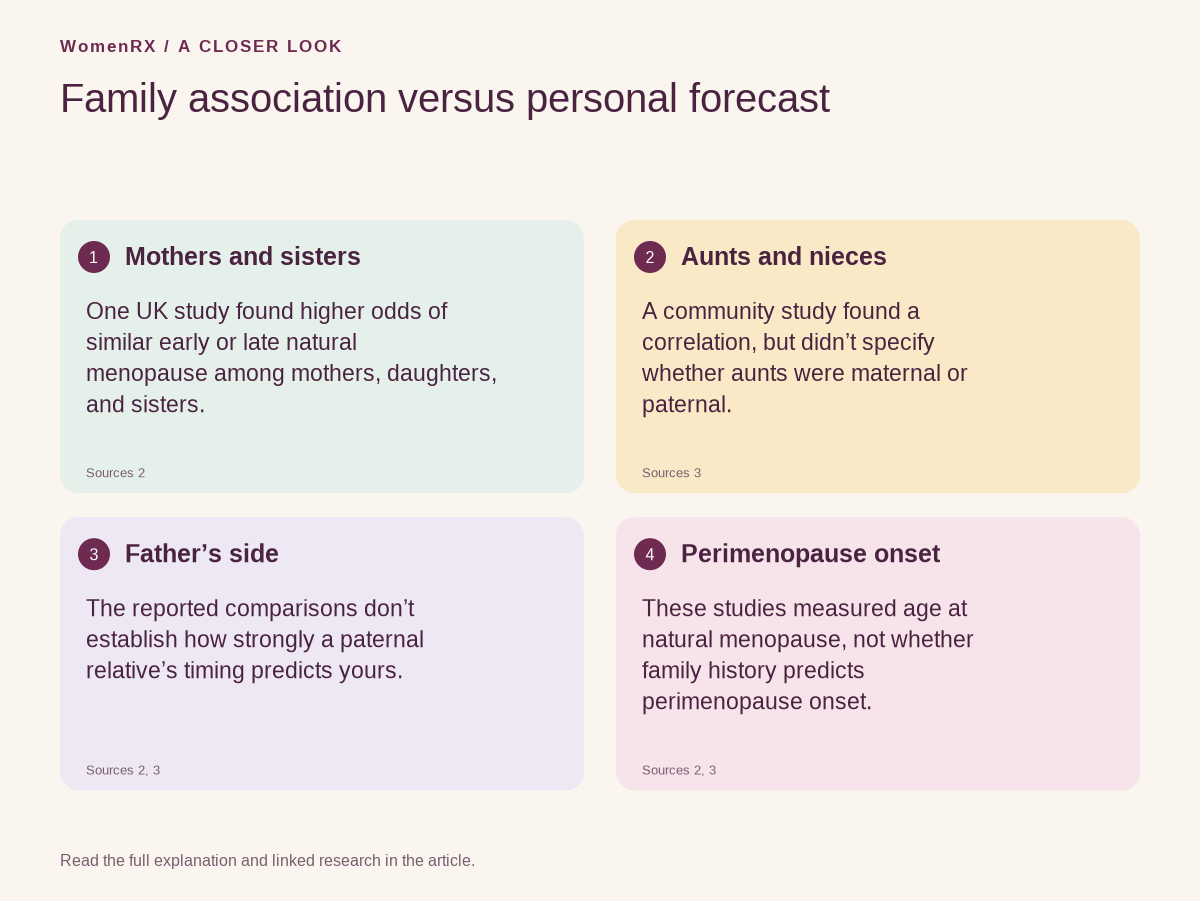
Family association versus personal forecast
Mothers and sisters: One UK study found higher odds of similar early or late natural menopause among mothers, daughters, and sisters.2
Aunts and nieces: A community study found a correlation, but didn’t specify whether aunts were maternal or paternal.3
Father’s side: The reported comparisons don’t establish how strongly a paternal relative’s timing predicts yours.23
Perimenopause onset: These studies measured age at natural menopause, not whether family history predicts perimenopause onset.23
Read the figure as text
Family studies show some similarities in natural menopause timing, but don’t establish a personal prediction or compare paternal with maternal relatives.- Mothers and sisters: One UK study found higher odds of similar early or late natural menopause among mothers, daughters, and sisters.2
- Aunts and nieces: A community study found a correlation, but didn’t specify whether aunts were maternal or paternal.3
- Father’s side: The reported comparisons don’t establish how strongly a paternal relative’s timing predicts yours.23
- Perimenopause onset: These studies measured age at natural menopause, not whether family history predicts perimenopause onset.23
Sources you can check
- Family History: MedlinePlusAccessed 2026-09-25Return to first citation
- Familial concordance for age at natural menopause: results from the Breakthrough Generations Study.Morris DH, Jones ME, Schoemaker MJ, Ashworth A, Swerdlow AJ. · Menopause (New York, N.Y.) · 2011Return to first citation
- Heritability of age at natural menopause in the Framingham Heart Study.Murabito JM, Yang Q, Fox C, Wilson PW, Cupples LA. · The Journal of clinical endocrinology and metabolism · 2005Return to first citation