Does Vitamin E Help Skin, Hair, or Nails?
A small eczema trial offers a limited reason to study oral vitamin E, not a reason to expect clearer skin, thicker hair, or stronger nails.
Getting enough vitamin E matters, but taking extra hasn’t been shown to improve skin, hair, or nails generally. A small trial reported improvement in people with atopic dermatitis who took oral vitamin E; it can’t answer questions about cosmetic results or vitamin E applied to skin. High-dose supplements also carry risks, especially if you take a blood thinner. 512
The skin result is about eczema, not appearance
If you’re considering vitamin E for a skin concern, the type of concern matters. In a randomized trial, 45 people with atopic dermatitis, a relapsing inflammatory condition also called eczema, were assigned to vitamin E, vitamin D, both vitamins, or placebo for 60 days. The 11 people in the vitamin E-only group took 600 IU of synthetic vitamin E. Their SCORAD score, a measure of eczema severity, fell by 35.7% during the study. 5
That’s an interesting result, but it’s a change within a very small group, not a clear measure of how much vitamin E helped compared with placebo. The trial doesn’t establish a dose for treating eczema, and eczema severity is not the same outcome as skin glow, texture, or aging. The published summary doesn’t report a women-specific result or outcomes by pregnancy, postpartum, or menopause status. 5
There’s a different kind of finding for seborrheic dermatitis, which can affect the scalp and skin. A systematic review describes a case-control study in which people with the condition had lower vitamin E levels than controls. Because those levels weren’t measured again after remission, the finding can’t show whether raising vitamin E levels would improve symptoms. The review called for studies that actually test supplementation. 3
Swallowing vitamin E isn’t the same as applying it
The eczema trial tested an oral supplement. It tells us nothing about whether vitamin E cream or oil helps eczema or improves ordinary skin appearance. Likewise, a topical result cannot establish that a capsule will work.
One nail-growth review illustrates the problem with crediting vitamin E for a combination product. It describes a formulation containing topical minoxidil plus vitamin E used in people with nail growth arrest. Because the ingredients weren’t isolated, that result cannot tell us whether vitamin E contributed. It’s not evidence that oral vitamin E strengthens brittle nails. 4
The skin studies also don’t test oral vitamin E as a treatment for hair thinning or nail breakage. Vitamin E has antioxidant functions, but a biological role isn’t proof that extra vitamin E will produce a visible change. 135
Enough vitamin E and extra vitamin E are different goals
The recommended dietary allowance for adult women is 15 mg of alpha-tocopherol a day, including during pregnancy, and 19 mg during lactation. Those are nutrient targets, not doses shown to improve appearance. Nuts, seeds, vegetable oils, and leafy greens provide vitamin E; most people get enough from food. Certain conditions that interfere with nutrition or absorption, including Crohn’s disease and cystic fibrosis, may create a separate need for extra vitamin E. 12
A vitamin-E-only supplement often contains substantially more than the daily allowance. High doses can interfere with blood clotting, and MedlinePlus cautions that vitamin E supplements may be harmful for people taking blood thinners. If that’s you, ask your prescriber or pharmacist about the specific product before adding it. The NIH fact sheet does not identify the same adverse effects from vitamin E in food. 12
So the useful distinction isn’t “natural versus synthetic” or “capsule versus cream.” It’s whether you’re meeting a nutritional need or trying to treat a particular concern. For a diagnosed skin condition, the small studies don’t make vitamin E a stand-alone treatment. For hair or nails, there’s no demonstrated benefit in these findings that justifies taking a high-dose supplement for appearance. 345
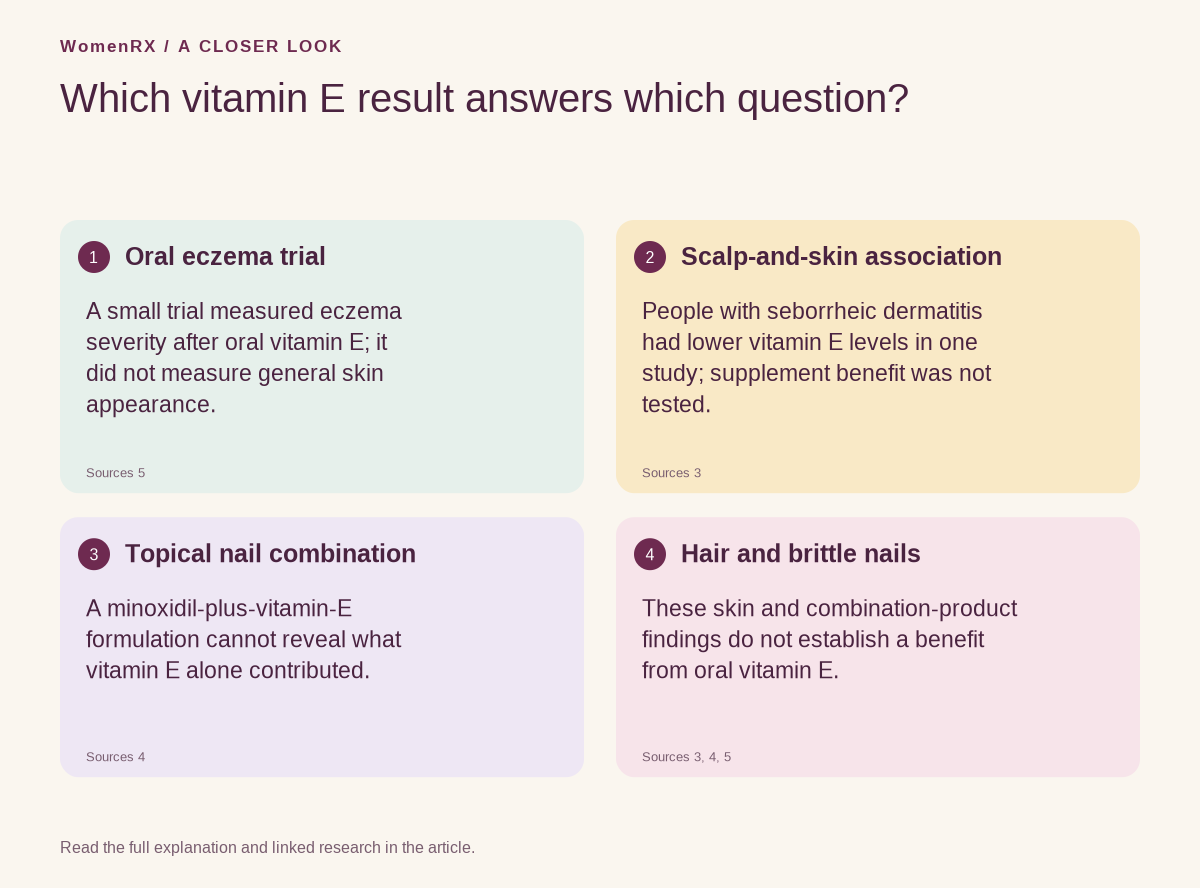
Which vitamin E result answers which question?
Oral eczema trial: A small trial measured eczema severity after oral vitamin E; it did not measure general skin appearance.5
Scalp-and-skin association: People with seborrheic dermatitis had lower vitamin E levels in one study; supplement benefit was not tested.3
Topical nail combination: A minoxidil-plus-vitamin-E formulation cannot reveal what vitamin E alone contributed.4
Hair and brittle nails: These skin and combination-product findings do not establish a benefit from oral vitamin E.345
Read the figure as text
The route, ingredients, and outcome determine what each finding can tell you.- Oral eczema trial: A small trial measured eczema severity after oral vitamin E; it did not measure general skin appearance.5
- Scalp-and-skin association: People with seborrheic dermatitis had lower vitamin E levels in one study; supplement benefit was not tested.3
- Topical nail combination: A minoxidil-plus-vitamin-E formulation cannot reveal what vitamin E alone contributed.4
- Hair and brittle nails: These skin and combination-product findings do not establish a benefit from oral vitamin E.345
More questions, answered
Should I use the amount from the eczema study?
The trial’s 600 IU synthetic vitamin E was a research intervention in a small group with atopic dermatitis, not a recommended amount for skin, hair, or nails. Vitamin-E-only supplements commonly exceed the adult dietary allowance, and higher amounts can raise safety concerns. 51
Sources you can check
- Vitamin E - Health Professional Fact SheetAccessed 2026-09-25Return to first citation
- Vitamin E: MedlinePlusAccessed 2026-09-25Return to first citation
- Nutrition, Obesity, and Seborrheic Dermatitis: Systematic Review.Woolhiser E, Keime N, Patel A, Weber I, Adelman M, Dellavalle RP. · JMIR dermatology · 2024Return to first citation
- Systematic Review Efficacy of Topical Minoxidil for Nail Growth: A Systematic Review.Alghmadi SM, Alahmadi M, Alharbi R, Alhussaini S, Albyali S, Zainab M, Alanazi D, Almuhanna N. · Skin appendage disorders · 2026Return to first citation
- Randomized controlled trial using vitamins E and D supplementation in atopic dermatitis.Javanbakht MH, Keshavarz SA, Djalali M, Siassi F, Eshraghian MR, Firooz A, Seirafi H, Ehsani AH, Chamari M, Mirshafiey A. · The Journal of dermatological treatment · 2011Return to first citation