Do Estradiol Levels Have a “Normal” Range at Every Age?
An estradiol result needs more context than your age: cycle timing, menopause stage, the test method, and any estrogen therapy can all affect what it means.
There isn’t one estradiol range that defines “normal” for every age. A result is most useful when you know why it was tested, whether you’re still cycling and when the sample was taken, what reference interval the lab uses, and whether you take estrogen. For menopause symptoms, estradiol testing generally doesn’t help guide care, and one result can’t settle the whole picture. 3
Start with the lab’s range, not an age chart
A number on its own can look definitive, but an estradiol result needs context. Reference intervals aren’t complete or consistent for women, and a range is useful only if it matches the population and test being considered. A broad chart that labels results by age alone may leave out details that affect interpretation. 3
Age-specific intervals can be useful in particular settings. For example, researchers established age- and sex-specific estradiol intervals for children and adolescents using a specific laboratory method and samples from 405 healthy children. That finding supports age-specific interpretation for that pediatric group. It does not establish a single set of adult ranges for reproductive years, perimenopause, and postmenopause. 4
If you still have periods, cycle timing matters
For someone who is still cycling, the phase of the menstrual cycle is part of the context for interpreting estradiol. A result without that information may be difficult to compare with an interval intended for a particular cycle phase. A review of hormone testing describes research on estradiol concentrations across the menstrual cycle, while also noting that reference intervals for women remain incomplete. 3
That means two results taken at different points in a cycle shouldn’t automatically be treated as a straightforward before-and-after comparison. Check whether the lab report gives a cycle-specific interval, and whether the timing of the test is known. If your cycles have become irregular, age alone still won’t tell you which interval best fits the result.
Perimenopause and postmenopause: a result isn’t a verdict
During the menopausal transition, an age label can’t tell you the circumstances around a particular blood draw. More broadly, a recent laboratory-medicine review says estradiol measurement does not facilitate care for women who may be experiencing menopausal symptoms. That is not the same as saying estradiol is never measured or never useful for another clinical question. It does mean that a number alone shouldn’t be treated as a menopause diagnosis or as a measure of how symptoms should be managed. 3
For postmenopausal women with moderate to severe hot flashes, US prescribing information for estradiol products says estradiol and FSH levels have not been shown useful for managing those symptoms. The test result is not a substitute for considering the symptoms and the reason treatment is being discussed. 12
The test and any estrogen treatment matter
The method used to measure estradiol can matter too. In a pediatric study, two laboratories using LC-MS/MS had a mean difference of 29.3 pmol/L, or 9.1%, in their measurements. That study involved children, so it does not tell us the size of differences in adult testing. It does illustrate why a reference interval and measurement method belong alongside the number, rather than assuming every lab result is directly interchangeable. 4
If you use estrogen therapy, mention the product and timing of the blood draw when discussing the result. For one transdermal estradiol product, prescribing information reports that blood concentrations change after application. This product-specific information does not establish a target level for other products or prove that routine level checks are needed. 1
A practical way to read your report
Before drawing a conclusion from a result, look for the lab’s own reference interval and units. Then ask what question the test was ordered to answer. The details that can change the interpretation include whether you still have periods, the cycle timing if you do, whether you’re postmenopausal, the assay or lab interval, and any estrogen treatment.
If the test was ordered because of menopause symptoms, ask how the result would change the next step. Current review evidence says estradiol testing does not facilitate care for women experiencing menopausal symptoms; that is different from saying every estradiol test is pointless. The useful question is whether this particular result answers a specific clinical question, rather than whether it falls inside an age-based chart. 3
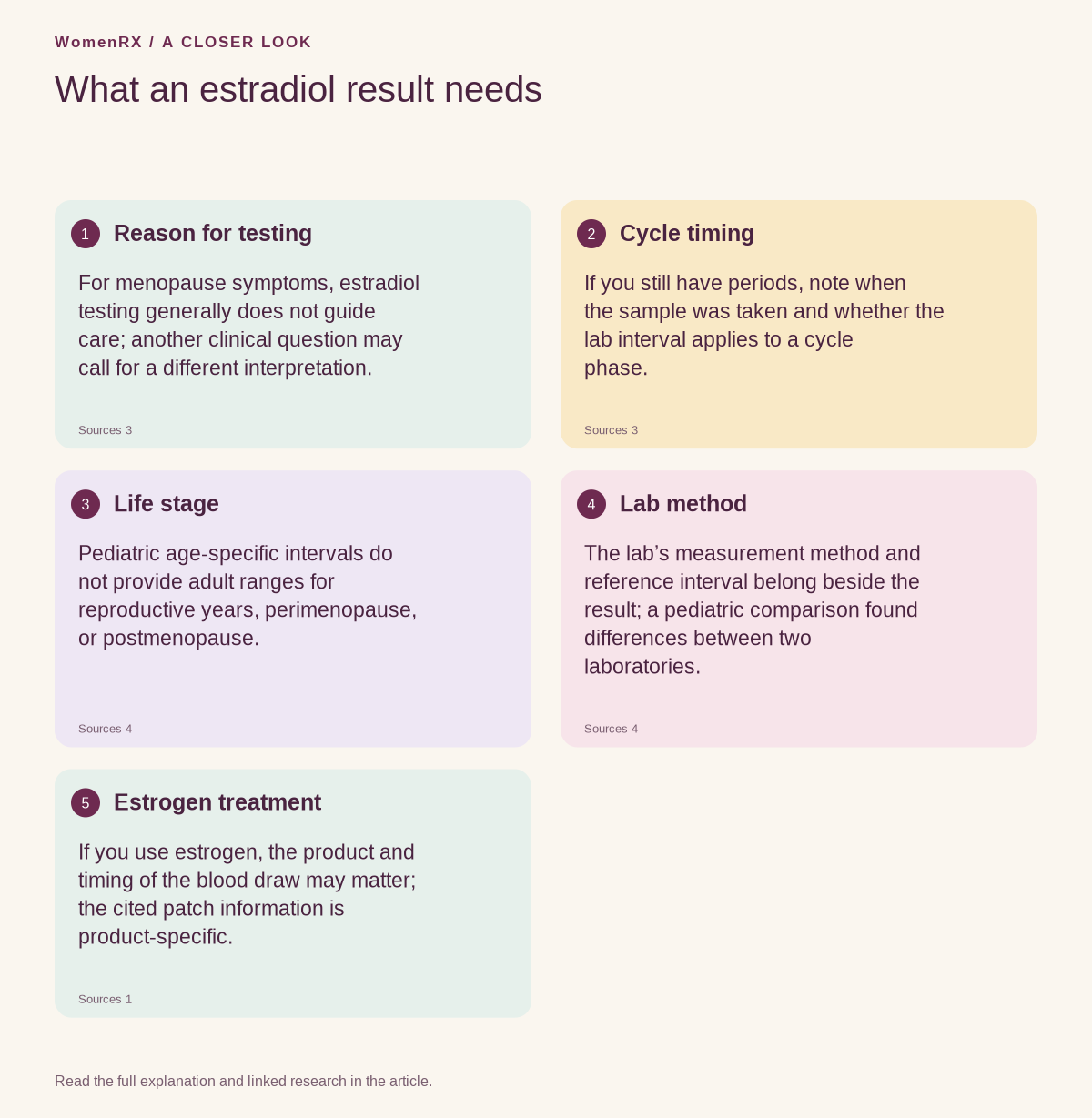
What an estradiol result needs
Reason for testing: For menopause symptoms, estradiol testing generally does not guide care; another clinical question may call for a different interpretation.3
Cycle timing: If you still have periods, note when the sample was taken and whether the lab interval applies to a cycle phase.3
Life stage: Pediatric age-specific intervals do not provide adult ranges for reproductive years, perimenopause, or postmenopause.4
Lab method: The lab’s measurement method and reference interval belong beside the result; a pediatric comparison found differences between two laboratories.4
Estrogen treatment: If you use estrogen, the product and timing of the blood draw may matter; the cited patch information is product-specific.1
Read the figure as text
Age is only one possible label. These are the other details that help show what a result can, and cannot, answer.- Reason for testing: For menopause symptoms, estradiol testing generally does not guide care; another clinical question may call for a different interpretation.3
- Cycle timing: If you still have periods, note when the sample was taken and whether the lab interval applies to a cycle phase.3
- Life stage: Pediatric age-specific intervals do not provide adult ranges for reproductive years, perimenopause, or postmenopause.4
- Lab method: The lab’s measurement method and reference interval belong beside the result; a pediatric comparison found differences between two laboratories.4
- Estrogen treatment: If you use estrogen, the product and timing of the blood draw may matter; the cited patch information is product-specific.1
More questions, answered
Does one estradiol result confirm menopause?
A single result shouldn’t be treated as a verdict. A review of laboratory medicine says estradiol testing does not facilitate care for women who may be experiencing menopausal symptoms, and reference intervals for women remain incomplete. The result needs to be interpreted in light of why it was ordered and the person’s broader context. 3
What if my result is flagged high or low?
A flag means the result is outside that lab’s stated interval; it doesn’t explain why or establish a diagnosis by itself. Check whether the interval fits your life stage and the test method, and whether cycle timing or estrogen treatment is relevant. 34
Sources you can check
- CLIMARA PRO (ESTRADIOL AND LEVONORGESTREL) PATCH [BAYER HEALTHCARE PHARMACEUTICALS INC.] | US prescribing information and patient instructionsAccessed 2026-09-25Return to first citation
- CLIMARA (ESTRADIOL) PATCH [BAYER HEALTHCARE PHARMACEUTICALS INC.] | US prescribing information and patient instructionsAccessed 2026-09-25Return to first citation
- A Comprehensive Review of Estradiol, Progesterone, Luteinizing Hormone, and Follicle-Stimulating Hormone in the Context of Laboratory Medicine to Support Women's Health.Greene DN, Ahmed SB, Daccarett S, Kling JM, Lorey TS, Rytz CL, Smock KJ, Winston-McPherson G. · Clinical chemistry · 2025Return to first citation
- Highly sensitive tandem mass spectrometric measurement of serum estradiol without derivatization and pediatric reference intervals in children and adolescents.Di Meo A, Yazdanpanah M, Higgins V, Nichols M, Bohn MK, Tan A, Zainab S, Sepiashvili L, Adeli K. · Clinical chemistry and laboratory medicine · 2023Return to first citation