Dizziness in Your 40s: Sorting Hormonal Context From Other Causes
Heavier periods can add context, but dizziness has several possible causes and isn’t proof of perimenopause.
Heavier periods can occur as menopause approaches, but dizziness alongside them doesn’t establish a hormonal cause. Notice whether you feel faint, off-balance, or as if the room is spinning, and whether episodes follow standing up, a new medicine, heavy bleeding, or migraine-like symptoms. Dizziness that keeps returning or doesn’t go away deserves medical assessment. 2 3
If your periods have become heavier in your 40s, approaching menopause may be part of the conversation. But dizziness, even alongside heavier bleeding, can’t tell you that hormones are the cause. The useful next step is to describe the sensation and look for patterns that point toward other explanations. 2 3
One connection worth separating from a direct “hormonal dizziness” explanation is heavy bleeding. Heavier periods can occur as menopause approaches, and blood loss is a common cause of iron deficiency. Anemia can cause dizziness, while lightheadedness may also occur with iron deficiency. That’s a possible chain of events, not a conclusion you can draw from symptoms alone. 1 2 4
Start with what “dizzy” feels like
People use “dizzy” for different sensations. Feeling faint or lightheaded is different from feeling that you or the room are spinning, and both differ from feeling unsteady or off-balance. These distinctions don’t diagnose the cause, but they make the pattern easier to discuss. 3
Notice what brings it on. Lightheadedness that starts when you stand up can fit a blood-pressure drop. Spinning or imbalance, especially with hearing changes or ringing in the ears, can point toward an inner-ear cause. Dizziness that begins after starting a prescription medicine may be a side effect. 3
Migraine is another possibility when repeated dizziness or vertigo occurs with migraine features such as headache, light sensitivity, or sound sensitivity. A headache doesn’t have to be the most noticeable part of every episode, so mention migraine history and sensory symptoms even if the dizziness stands out most. 5
When bleeding changes the picture
If your periods have become much heavier, mention that along with dizziness rather than assuming both are simply part of menopause. Heavy periods can happen approaching menopause, but they can also have other causes. Blood loss may lead to iron deficiency or anemia, which can cause symptoms including lightheadedness or dizziness. 1 2 4
A clinician can assess whether blood tests are appropriate. Iron deficiency is diagnosed with blood testing, not by dizziness alone, and treatment depends on what the tests show. 1 4
Keep a short record, not a theory
For a few episodes, jot down what the sensation was, when it started, how long it lasted, and what was happening just before it. Include whether you had stood up, started a medicine, noticed a change in your bleeding, or had headache, light sensitivity, hearing changes, or ringing in your ears. This record won’t identify the cause by itself; it can help distinguish patterns worth assessing.
Arrange medical evaluation if dizziness keeps returning or doesn’t go away. Trouble speaking, numbness or weakness, and fainting or collapse warrant assessment even if the dizziness has not persisted or recurred. Hearing or vision changes, pulse changes, headache, or nausea alongside dizziness also warrant assessment. 3
The key distinction is this: heavier periods may make approaching menopause relevant to the wider picture, while the timing and feel of the dizziness can point toward other causes. Heavy bleeding matters especially because it can connect menstrual changes to iron deficiency, without proving that hormones directly caused the dizziness. 1 2 3
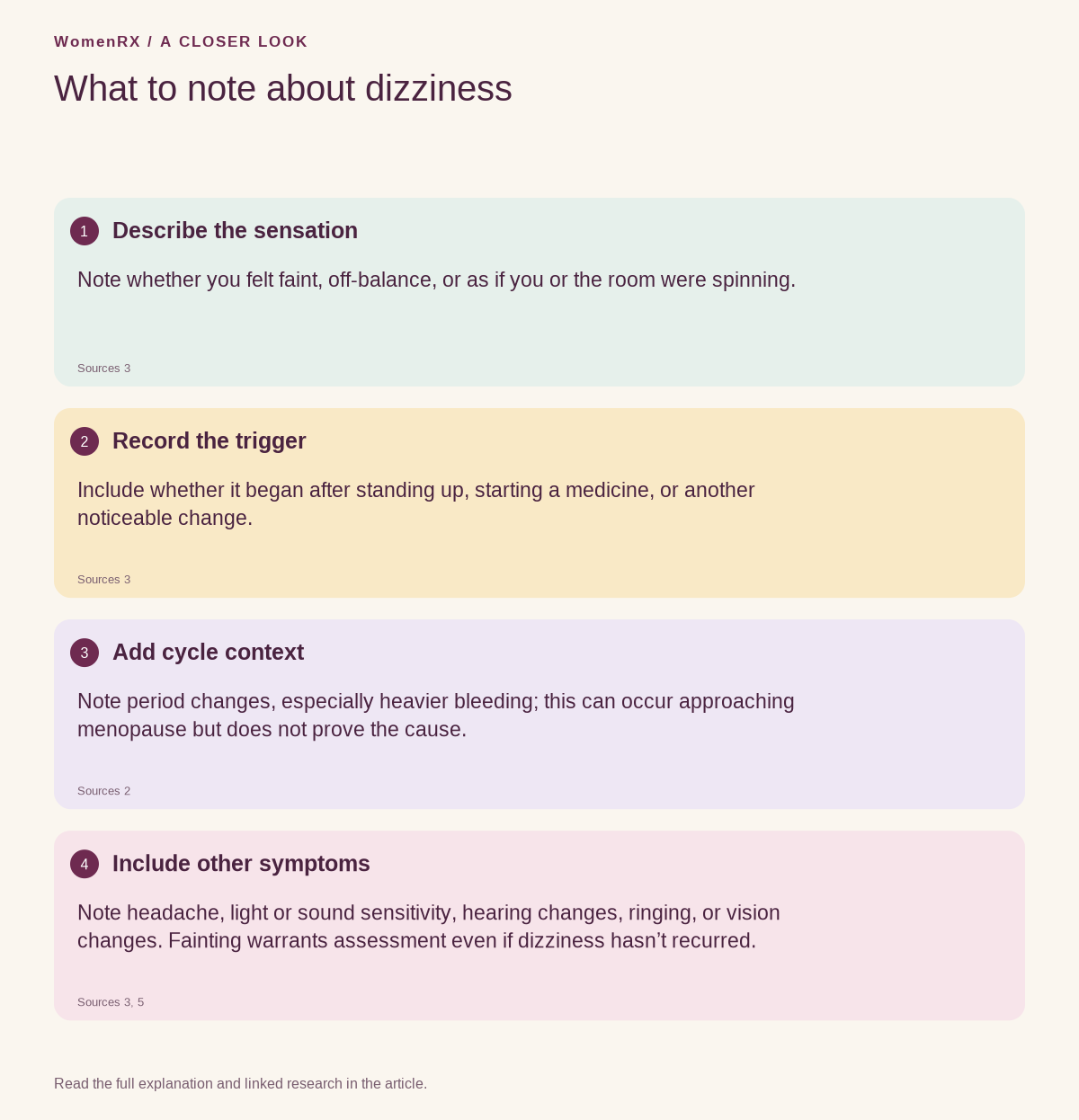
What to note about dizziness
Describe the sensation: Note whether you felt faint, off-balance, or as if you or the room were spinning.3
Record the trigger: Include whether it began after standing up, starting a medicine, or another noticeable change.3
Add cycle context: Note period changes, especially heavier bleeding; this can occur approaching menopause but does not prove the cause.2
Include other symptoms: Note headache, light or sound sensitivity, hearing changes, ringing, or vision changes. Fainting warrants assessment even if dizziness hasn’t recurred.35
Read the figure as text
Record the episode and its context without assuming that menstrual changes explain it.- Describe the sensation: Note whether you felt faint, off-balance, or as if you or the room were spinning.3
- Record the trigger: Include whether it began after standing up, starting a medicine, or another noticeable change.3
- Add cycle context: Note period changes, especially heavier bleeding; this can occur approaching menopause but does not prove the cause.2
- Include other symptoms: Note headache, light or sound sensitivity, hearing changes, ringing, or vision changes. Fainting warrants assessment even if dizziness hasn’t recurred.35
Sources you can check
- Anemia | MedlinePlusAccessed 2026-09-25Return to first citation
- Heavy periods - NHSAccessed 2026-09-25Return to first citation
- Dizziness - NHSAccessed 2026-09-25Return to first citation
- Iron Deficiency in Adults: A Review.Auerbach M, DeLoughery TG, Tirnauer JS. · JAMA · 2025Return to first citation
- Phenotype-guided selection of venlafaxine and topiramate for vestibular migraine: a narrative review.Wang T, Luo S, Han J, Li H, Wang Y, Zhang X, Li D, Yu X. · Frontiers in neuroscience · 2026Return to first citation