DIM and Hormone Medicines: What the Evidence Can Tell You
DIM has been linked to changes in estrogen metabolites in one group of women using an estradiol patch, but that study didn’t show whether symptoms, treatment effectiveness, or health outcomes changed.
DIM may affect how estrogen is processed, but a change in estrogen metabolites isn’t proof of a health benefit or a predictable change in hormone levels. One retrospective study found different urinary estrogen profiles among postmenopausal women using DIM with an estradiol patch. It did not establish what DIM does with birth control, fertility medicines, or cancer treatments, so check the specific combination before starting it. 3
A change in a lab marker isn’t the same as a treatment effect
DIM, short for diindolylmethane, is a compound formed from substances in cruciferous vegetables and is also sold as a supplement. It’s often discussed in connection with estrogen metabolism. But claims that it “detoxes” estrogen, balances hormones, or prevents hormone-related disease go beyond what research has established.
The most directly relevant human study was a retrospective analysis of lab results from 1,458 postmenopausal women using an estradiol patch. Of those, 108 reported taking DIM. Their urinary estrogen profiles differed from those of women using the patch without DIM, including differences in several estrogen metabolites. Because this was an observational study, it can show an association, not prove DIM caused the differences. 3
The study measured urinary hormones and metabolites. It did not test whether DIM improved symptoms, changed bone health, prevented cancer, or made hormone treatment less effective. The authors said the clinical meaning of the observed changes is uncertain. A shift in a metabolite ratio, by itself, does not establish that a pathway is healthier or safer. 3
What that means if you take hormone-related medicine
Menopausal hormone therapy: The study raises a reasonable question about using DIM with a transdermal estradiol patch: urinary estrogen profiles differed in women reporting both. It did not establish that DIM changes symptom relief or other treatment outcomes, or determine how a prescriber should adjust therapy. Don’t change a prescribed hormone dose based on a supplement or a urine test alone. 3
Hormonal contraception: The study did not examine birth control or measure contraceptive effectiveness. That means its findings can’t tell you whether DIM affects a particular pill, patch, ring, shot, implant, or hormonal IUD. Don’t assume a predictable interaction either way. Ask a pharmacist or prescriber about your specific method before adding DIM.
Fertility treatment: The study does not establish how DIM interacts with fertility medicines or treatment protocols. Since the relevant medicines and treatment goals differ, ask the fertility team or a pharmacist to review the exact DIM product before using it during treatment.
Hormone-sensitive disease care: The study does not show that DIM prevents or treats cancer, nor does it establish how DIM interacts with cancer medicines or other hormone-sensitive disease treatment. If you’re receiving that care, ask your oncology team or oncology pharmacist to check the specific product against your treatment plan. Don’t use a proposed estrogen-metabolism effect as a substitute for prescribed care. 3
Why drug-interaction questions are still reasonable
Some prescription estrogens are metabolized partly through an enzyme called CYP3A4. For example, US prescribing information for specific estradiol products warns that certain medicines or substances that affect CYP3A4 can change estrogen concentrations. That doesn’t tell us that DIM has the same effect in a particular person, or establish an interaction with every hormone medicine. The DIM study authors describe a possible interaction with transdermal estradiol, while emphasizing that the clinical significance remains unclear. 123
This research does not provide a dependable list of DIM side effects or establish its safety alongside hormonal contraception, fertility treatment, or cancer care. “It changes a lab marker” and “it is safe and effective to take with my medicine” are different claims.
Questions that make a medication review useful
Bring the product bottle or a clear photo of its label, and ask:
- Does this DIM product raise a concern with my exact medicine or treatment plan?
- Is there evidence it affects treatment effectiveness, or only a possible effect on hormone metabolism?
- Should I avoid it during a particular part of my treatment?
- If I already started it, what should I tell the people managing my care?
Include other supplements in that conversation too. For prescription estradiol products, the medication information may name interactions with specific CYP3A4-affecting substances, but those examples shouldn’t be treated as a complete interaction check for your full medication list. 12
For now, the clearest human finding is a difference in urinary estrogen profiles in one observational study of postmenopausal estradiol-patch users. Whether that difference matters to treatment outcomes, or applies to contraception, fertility medicines, or cancer treatment, remains unestablished by that study. 3
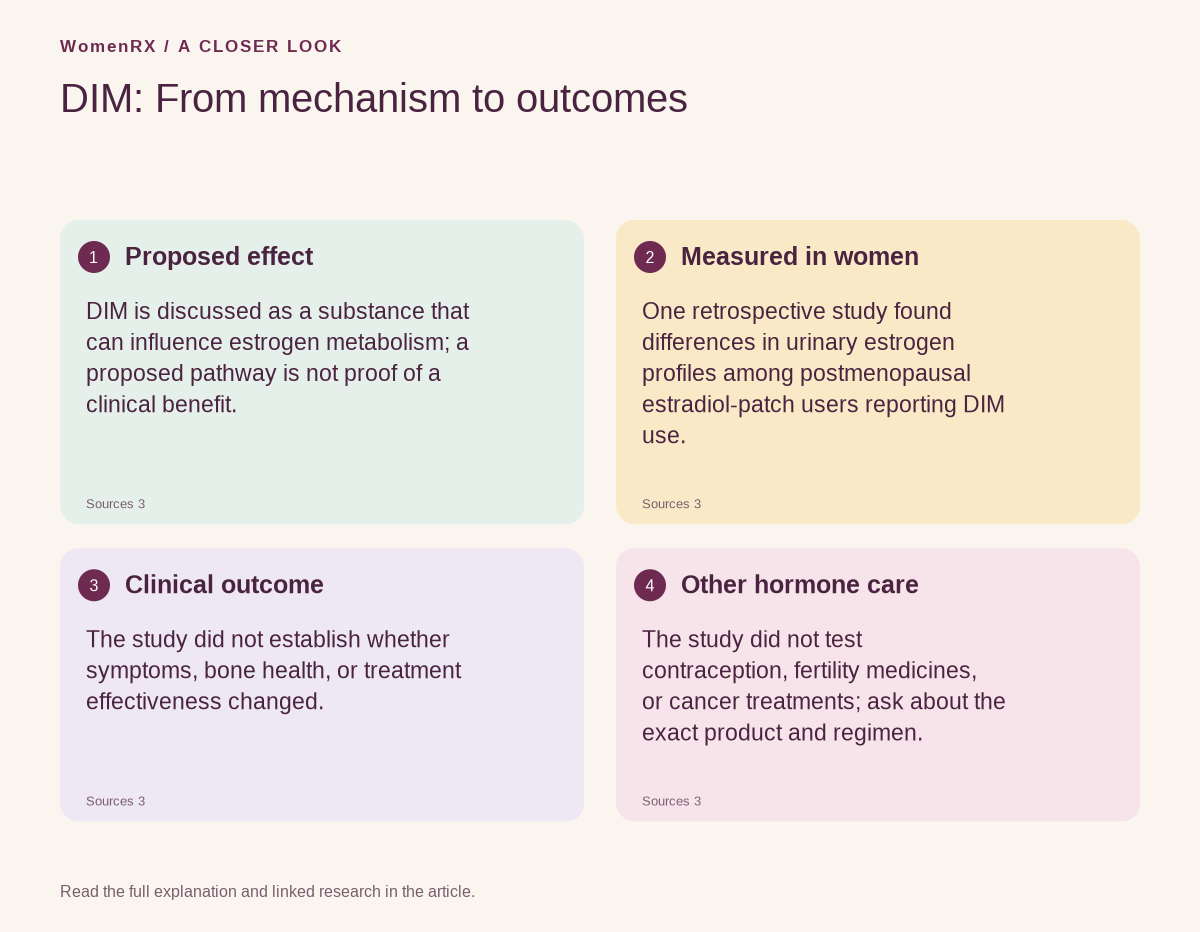
DIM: From mechanism to outcomes
Proposed effect: DIM is discussed as a substance that can influence estrogen metabolism; a proposed pathway is not proof of a clinical benefit.3
Measured in women: One retrospective study found differences in urinary estrogen profiles among postmenopausal estradiol-patch users reporting DIM use.3
Clinical outcome: The study did not establish whether symptoms, bone health, or treatment effectiveness changed.3
Other hormone care: The study did not test contraception, fertility medicines, or cancer treatments; ask about the exact product and regimen.3
Read the figure as text
Separate the proposed estrogen-metabolism effect from what a human study measured and what remains unanswered for common hormone-related care.- Proposed effect: DIM is discussed as a substance that can influence estrogen metabolism; a proposed pathway is not proof of a clinical benefit.3
- Measured in women: One retrospective study found differences in urinary estrogen profiles among postmenopausal estradiol-patch users reporting DIM use.3
- Clinical outcome: The study did not establish whether symptoms, bone health, or treatment effectiveness changed.3
- Other hormone care: The study did not test contraception, fertility medicines, or cancer treatments; ask about the exact product and regimen.3
More questions, answered
Does DIM lower estrogen?
That’s not established as a predictable effect in women. In a retrospective study of postmenopausal women using estradiol patches, DIM use was associated with differences in several urinary estrogen measures. The study did not show what those differences meant for symptoms or treatment outcomes. 3
Can I take DIM with hormonal birth control?
The study described here did not test hormonal birth control or contraceptive effectiveness, so it can’t answer whether DIM affects your specific method. Ask a pharmacist or prescriber to review the exact product and contraception you use before combining them.
Sources you can check
- CLIMARA PRO (ESTRADIOL AND LEVONORGESTREL) PATCH [BAYER HEALTHCARE PHARMACEUTICALS INC.] | US prescribing information and patient instructionsAccessed 2026-09-25Return to first citation
- CLIMARA (ESTRADIOL) PATCH [BAYER HEALTHCARE PHARMACEUTICALS INC.] | US prescribing information and patient instructionsAccessed 2026-09-25Return to first citation
- The impact of 3,3'-diindolylmethane on estradiol and estrogen metabolism in postmenopausal women using a transdermal estradiol patch.Newman MS, Smeaton J. · Menopause (New York, N.Y.) · 2025Return to first citation