D-Chiro-Inositol and Weight: Reading PCOS Studies Clearly
PCOS studies report weight changes with inositol combinations, but they don’t establish whether D-chiro-inositol alone affects weight.
The PCOS studies discussed here don’t establish whether D-chiro-inositol (DCI) alone reliably affects body weight: the human studies reporting weight outcomes tested it with myo-inositol, diet, or other ingredients. Weight, waist measurements, insulin-related lab results, and menstrual changes are separate outcomes. A change in one doesn’t prove DCI causes weight loss. 234
What the weight findings can, and can’t, tell you
If you’re considering D-chiro-inositol (DCI) for PCOS, the key question is not just whether a study recorded weight. It’s whether the study can show that DCI itself made a difference. The human studies discussed here used DCI in combinations, so their results don’t establish whether DCI alone reliably affects weight. They also don’t establish a weight effect for people considering DCI for another reason. 234
One six-month prospective study followed 70 women with PCOS taking a combination of myo-inositol and DCI. Researchers recorded body weight and BMI, and reported a significant reduction in weight. The abstract doesn’t describe a comparison group or give the size of the change. That makes it hard to tell how much the combination contributed. 2
A small, six-month randomized study compared diet alone with diet plus myo-inositol, or diet plus myo-inositol and DCI. It included 43 women with PCOS and overweight or obesity. Weight, BMI, and waist and hip measurements decreased in all three groups. Because every group followed a diet, those changes alone don’t show that adding DCI caused weight loss. The abstract doesn’t give the size of any between-group weight difference. 3
A retrospective review of records from 283 women with PCOS reported that 69.6% had reduced weight while taking myo-inositol and DCI. There was no control group described in the study summary, and some participants also received other treatments. The finding describes weight change during use; it can’t establish that DCI caused the change or how much weight participants lost. 4
Together, these studies show why “weight went down during treatment” and “DCI caused weight loss” are not the same conclusion. The first is an observation. To assess the second, you’d want a suitable comparison that isolates DCI’s contribution and reports how the treatment group’s weight changed relative to that comparison.
A scale, a tape measure, and a lab test answer different questions
Body weight is total body mass, which includes fat, muscle, bone, and water. Waist circumference is another measurement, and insulin or glucose tests measure metabolic markers. Each can be useful, but a change in one does not tell you that the others changed or explain why. 1234
That distinction matters in PCOS research. A study might report improved insulin or glucose measurements, or changes in periods or ovulation, alongside weight results. Those metabolic and reproductive findings may matter in their own right, but they are not proof that a treatment reduces weight. 24
Waist and hip measurements also shouldn’t be substituted for a scale result. In the randomized study, all three groups had decreases in weight and in circumference measures. Those are related observations, but the study’s abstract doesn’t report a between-group weight difference that would show an added effect from the DCI-containing combination. 3
The formula and study group matter
A result for a combination product isn’t automatically a result for DCI alone. In addition to the studies above, an observational study of a product combining myo-inositol, DCI, chromium, antioxidants, and vitamins reported lower weight and BMI in participants with obesity, while those measures remained unchanged in lean participants. Because the product contained several ingredients and the study was observational, it can’t identify DCI as the cause. 6
The studies also don’t provide a clear picture of weight outcomes by age or reproductive stage. The retrospective record review included women aged 12 to 45, but did not report its weight finding separately by age. The summaries of the other studies don’t provide age-specific or reproductive-stage weight results either. So these findings can’t tell you whether weight effects differ for adolescents, adults of different ages, or people at different reproductive stages. 234
How to read a weight claim on a product page
Check what the study actually measured and what it compared. Was weight reported, or only insulin, glucose, waist circumference, or a reproductive outcome? Was DCI tested on its own or in a blend? Did the comparison group receive the same diet or other treatment? And does the result show a difference between groups, rather than only a change from the start of the study?
Those questions help separate a promising-looking result from evidence that a specific ingredient caused weight loss. Based on the PCOS studies discussed here, a weight change during use of an inositol combination shouldn’t be presented as proof that DCI is a weight-loss supplement.
Four outcomes, four different questions
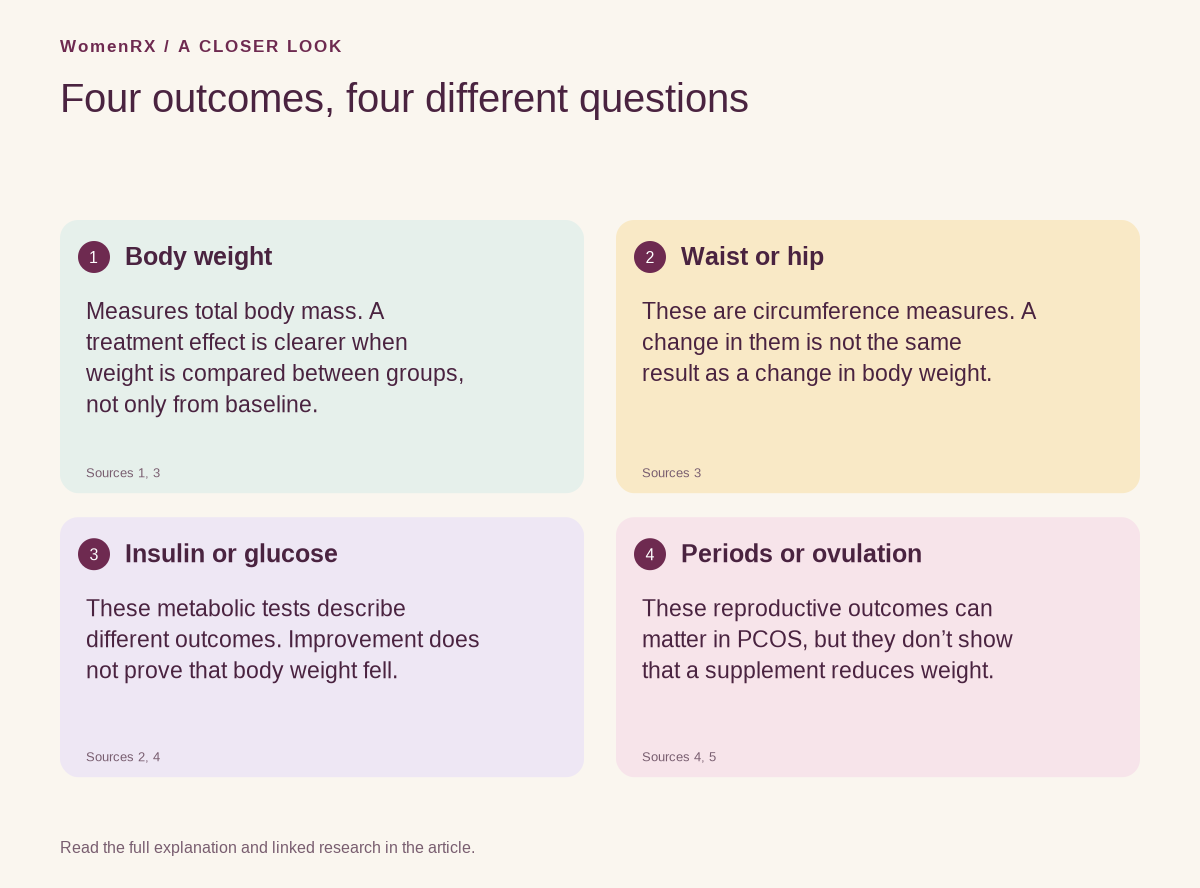
Body weight: Measures total body mass. A treatment effect is clearer when weight is compared between groups, not only from baseline.13
Waist or hip: These are circumference measures. A change in them is not the same result as a change in body weight.3
Insulin or glucose: These metabolic tests describe different outcomes. Improvement does not prove that body weight fell.24
Periods or ovulation: These reproductive outcomes can matter in PCOS, but they don’t show that a supplement reduces weight.45
Read the figure as text
PCOS studies may measure several outcomes at once. This comparison shows what each measure can tell you, and why it can’t stand in for a weight result.- Body weight: Measures total body mass. A treatment effect is clearer when weight is compared between groups, not only from baseline.13
- Waist or hip: These are circumference measures. A change in them is not the same result as a change in body weight.3
- Insulin or glucose: These metabolic tests describe different outcomes. Improvement does not prove that body weight fell.24
- Periods or ovulation: These reproductive outcomes can matter in PCOS, but they don’t show that a supplement reduces weight.45
More questions, answered
Does improved insulin or glucose mean DCI caused weight loss?
No. Insulin and glucose results are metabolic measures, not weight results. A change in those tests doesn’t establish that body weight decreased or that DCI caused a weight change. 24
Do these studies show different weight effects by age or reproductive stage?
The reported results don’t separate weight findings by age or reproductive stage. One retrospective study included women aged 12 to 45, but reported the weight result for the group overall. 4
Sources you can check
- Body Weight: MedlinePlusAccessed 2026-09-25Return to first citation
- Metabolic and hormonal effects of a combined Myo-inositol and d-chiro-inositol therapy on patients with polycystic ovary syndrome (PCOS).Januszewski M, Issat T, Jakimiuk AA, Santor-Zaczynska M, Jakimiuk AJ. · Ginekologia polska · 2019Return to first citation
- Effects of three treatment modalities (diet, myoinositol or myoinositol associated with D-chiro-inositol) on clinical and body composition outcomes in women with polycystic ovary syndrome.Le Donne M, Metro D, Alibrandi A, Papa M, Benvenga S. · European review for medical and pharmacological sciences · 2019Return to first citation
- Management of polycystic ovary syndrome among Indian women using myo-inositol and D-chiro-inositol.Vyas L, Raiturker AP, Sud S, Goyyal P, Abhyankar M, Revankar S, Walia S. · Bioinformation · 2022Return to first citation
- May myo-inositol and d-chiro-inositol (40:1) treatment be a good option on normal-weighted polycystic ovary syndrome patients without insulin resistance?Colak E, Ozcimen EE, Tohma YA, Ceran MU. · The journal of obstetrics and gynaecology research · 2020Return to first citation
- Efficacy of combination therapy of inositols, antioxidants and vitamins in obese and non-obese women with polycystic ovary syndrome: an observational study.Advani K, Batra M, Tajpuriya S, Gupta R, Saraswat A, Nagar HD, Makwana L, Kshirsagar S, Kaul P, Ghosh AK, Pradhan S, Mehta A, Jaiswal A, Nakhate KT, Kamdi S. · Journal of obstetrics and gynaecology : the journal of the Institute of Obstetrics and Gynaecology · 2020Return to first citation