D-Chiro-Inositol After 40: What the Evidence Actually Covers
Research on D-chiro-inositol mainly concerns PCOS, so it doesn’t establish a benefit for perimenopause, menopause, or midlife weight changes.
Being over 40 or going through menopause isn’t, by itself, a reason supported by this evidence to take D-chiro-inositol. The human studies discussed here involve people with PCOS, while menopause-related research includes a laboratory study of fat cells, not a clinical trial in women. If you have PCOS, those findings may be relevant to that condition, but they don’t establish a general midlife benefit. 1 2 3
D-chiro-inositol (DCI) is often discussed as a supplement for PCOS. But a study of people with PCOS doesn’t automatically tell you whether DCI helps with changes that come with perimenopause or menopause. The key question is not simply whether a study includes women. It’s whether it studied people with the same condition and the same concern you have.
PCOS research answers a different question
A 2026 systematic review and meta-analysis combined nine trials involving 440 women diagnosed with PCOS. It found that inositol supplementation was associated with changes in biochemical androgen measures, including testosterone and sex hormone-binding globulin. But the trials covered inositol supplementation broadly, including different forms and combinations. The findings don’t establish that DCI alone produces those effects, or that they apply to women without PCOS. The authors also reported substantial variation across some outcomes and described subgroup findings as exploratory. 2
A separate pilot study looked at 92 women with PCOS undergoing IVF. It was retrospective, and the supplement combined myo-inositol, DCI, and antioxidants. Because it studied a combination, it can’t show what DCI alone did. And IVF outcomes in people with PCOS aren’t evidence that DCI improves midlife weight, blood sugar, or menopausal symptoms. 1
These studies may matter if you have PCOS. They don’t make age over 40, perimenopause, or menopause an indication for DCI.
Why the menopause-related cell study isn’t a treatment trial
It’s easy to see how a laboratory finding might sound like a promise for women in midlife. In one study, researchers treated a human adipocyte cell line, a model of fat cells, with DCI and measured changes related to insulin signaling and fat storage. That can help researchers investigate possible mechanisms. It doesn’t show that taking a supplement changes weight, metabolism, or health in women during or after menopause. 3
The distinction is practical: a result in cells is a clue about what to study next, not proof of a benefit from a supplement in people. The study’s discussion mentions menopause-related fat accumulation as a reason to explore DCI, but its experiment was in cells, not women experiencing menopause. 3
A useful way to judge the claim
If you’re considering DCI for a midlife concern, check what the claim is actually based on. Does the study involve people with your condition? Does it test DCI by itself, or a blend? Does it measure an outcome you care about in people, rather than a lab marker or cell process?
For DCI, the human findings here are tied to PCOS and, in one study, a combination supplement used before IVF. They don’t establish a benefit for midlife concerns in women without PCOS. If you have a PCOS diagnosis as well as midlife changes, keep those questions separate: evidence about PCOS doesn’t resolve whether DCI helps with menopause-related concerns. 1 2 3
don’t choose DCI just because you’re over 40 or because a supplement is marketed for hormones or metabolism. This evidence doesn’t show that it treats perimenopause, menopause, or age-related metabolic changes. That’s different from proving it can never help; it means the PCOS findings and laboratory results aren’t enough to establish that benefit.
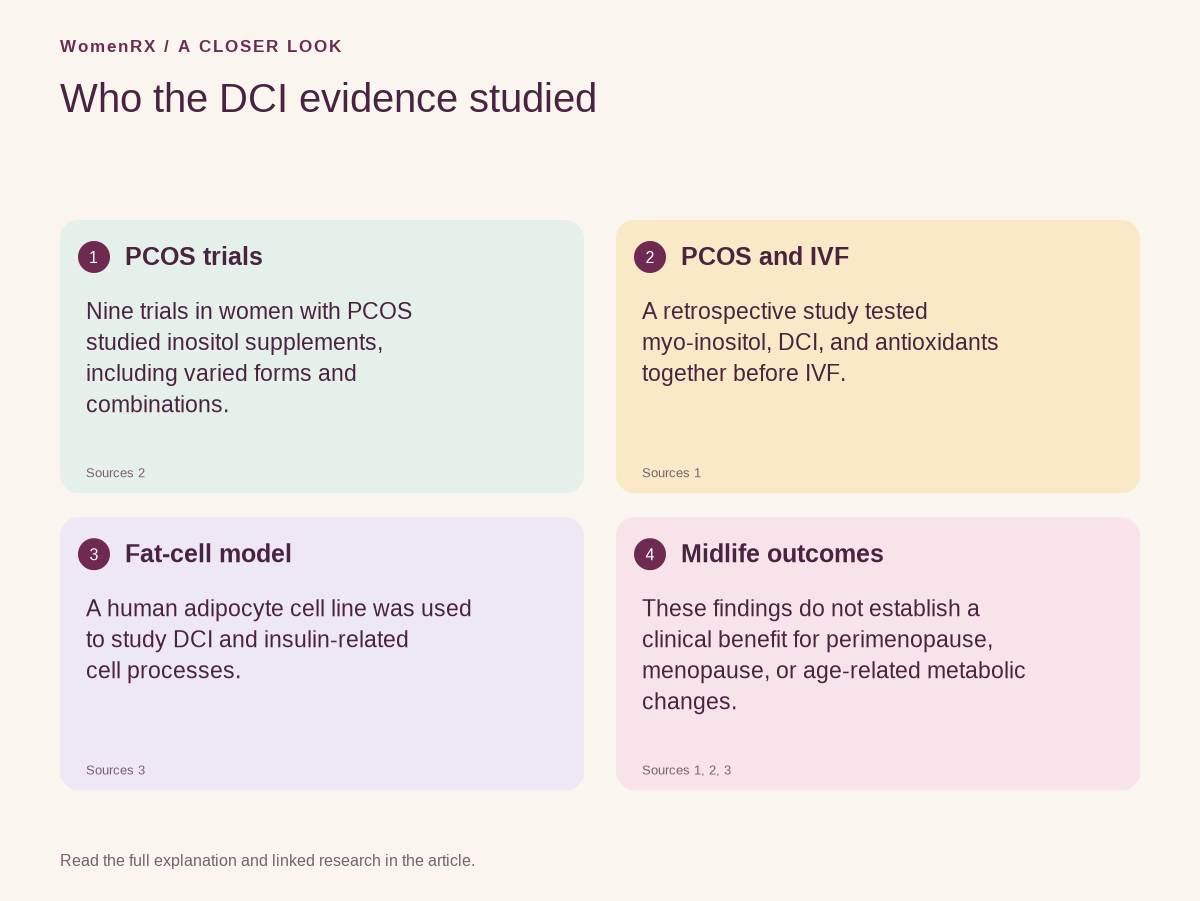
Who the DCI evidence studied
PCOS trials: Nine trials in women with PCOS studied inositol supplements, including varied forms and combinations.2
PCOS and IVF: A retrospective study tested myo-inositol, DCI, and antioxidants together before IVF.1
Fat-cell model: A human adipocyte cell line was used to study DCI and insulin-related cell processes.3
Midlife outcomes: These findings do not establish a clinical benefit for perimenopause, menopause, or age-related metabolic changes.123
Read the figure as text
These studies differ in both population and setting. Their results should not be treated as interchangeable evidence for midlife concerns.- PCOS trials: Nine trials in women with PCOS studied inositol supplements, including varied forms and combinations.2
- PCOS and IVF: A retrospective study tested myo-inositol, DCI, and antioxidants together before IVF.1
- Fat-cell model: A human adipocyte cell line was used to study DCI and insulin-related cell processes.3
- Midlife outcomes: These findings do not establish a clinical benefit for perimenopause, menopause, or age-related metabolic changes.123
More questions, answered
If I have PCOS and I’m over 40, does the research apply to me?
The studies of people with PCOS may be relevant to PCOS, regardless of whether you’re also in midlife. But they don’t establish that DCI treats menopause-related concerns, and the reviewed trials included different inositol forms and combinations rather than testing DCI alone throughout. 1 2
Sources you can check
- A 3.6:1 myo-inositol to D-chiro-inositol ratio and antioxidant-based food supplement before IVF improves fertility in women with PCOS: a pilot observational retrospective cohort study.Belchín Fernández P, Calvente V, Gómez Roso MJ, González Expósito E, Silván Bueno A, Aparicio Fluge M, Ordoñez Pérez D. · Journal of obstetrics and gynaecology : the journal of the Institute of Obstetrics and Gynaecology · 2026Return to first citation
- Metabolic Phenotype Predicts Biochemical Response to Inositol Supplementation in Polycystic Ovary Syndrome: A Systematic Review and Meta-Analysis.Tienforti D, Puocci G, Venditti C, Gizzi V, Pisanò C, Cocci E, Perfetto E, D'Alessandro F, Spagnolo L, Baroni MG, Barbonetti A. · Clinical endocrinology · 2026Return to first citation
- D-Chiro-Inositol Regulates Insulin Signaling in Human Adipocytes.Montt-Guevara MM, Finiguerra M, Marzi I, Fidecicchi T, Ferrari A, Genazzani AD, Simoncini T. · Frontiers in endocrinology · 2021Return to first citation