Creatine and Fatigue: What the Evidence Supports
Creatine has evidence for some intense exercise outcomes, but that doesn’t make it a proven fix for everyday tiredness.
Creatine supports a rapid energy system in muscles, so studies have focused largely on strength, power, and repeated intense efforts, not feeling more energetic all day. A small pilot in people with post-COVID condition found a change in fatigue scores in one creatine group alongside exercise. Most participants were women, but the overall result doesn’t establish a women-specific effect or a general fatigue benefit. 2 3 5
“Energy” can mean muscle output or everyday well-being
Creatine helps support phosphocreatine in muscle, which contributes to quickly supplying energy during short, intense efforts. That’s one reason researchers study creatine for strength, power, and repeated bursts of activity. But a mechanism that matters during exercise doesn’t, by itself, show that a supplement will make you feel more energetic in daily life. 2
Everyday fatigue is a broader experience: feeling worn out or short on energy in a way that can affect usual activities. It can follow poor sleep, stress, or physical activity, but it can also be related to pregnancy, anemia, thyroid disease, depression, sleep disorders, some medicines, and other health conditions. Exercise results can’t identify which, if any, of these is behind your fatigue. 1
What the exercise research actually measured
A review of 19 studies in combat-sport athletes found improvements in measures of muscular strength and power, but not in sport-specific endurance, recovery, or fatigue measures. Those findings concern athletic performance, not whether creatine eases everyday tiredness. They also don’t establish the same effects for people who aren’t combat-sport athletes. 3
A small crossover trial offers a closer look at how different exercise outcomes can diverge. Fourteen physically active men took creatine or placebo and completed a shuttle-run test. Some performance measures, including total and best distance, improved with creatine. The trial did not find significant changes in fatigue index, performance decrement, or perceived exertion. Those are exercise-test measures; they don’t tell us whether participants felt less fatigue in daily life. The trial included men, so it doesn’t establish the same result in women. 4
A limited finding in post-COVID fatigue
A four-week pilot study looked specifically at people with post-COVID condition and fatigue, with physical activity three times a week alongside supplementation. Sixty-seven people were randomized and 58 completed the study; 76.6% of participants were female. In the 6-g-per-day creatine group, the study reported a difference-in-differences change of −2.05 on its fatigue scale, with a 95% confidence interval from −3.47 to −0.63. 5
This is a relevant signal, but it answers a narrower question than whether creatine helps with fatigue generally. The participants had post-COVID condition, the study was a pilot, and physical activity was part of the intervention. The reported result is for the overall group; the fact that most participants were women doesn’t establish a women-specific effect. These findings also don’t establish how results might differ across life stages. 5
Match the evidence to the concern
If your question is about performance during short, demanding exercise, creatine research on strength, power, or repeated efforts is the relevant evidence. It shouldn’t be treated as proof of a general energy boost, improved endurance in every setting, or relief from persistent fatigue. 3 4
If you’re tired during ordinary activities or outside exercise, consider that separately from workout performance. Fatigue can have many causes, including sleep problems, stress, pregnancy, health conditions, and some medicines. If it hasn’t improved after several weeks, MedlinePlus recommends contacting a care provider to help look for the cause. 1
The useful distinction is that creatine’s role in muscle energy and some exercise outcomes have been studied; everyday fatigue is a broader symptom. The post-COVID pilot offers a preliminary finding for that particular setting, not a general answer for low energy. 2 5
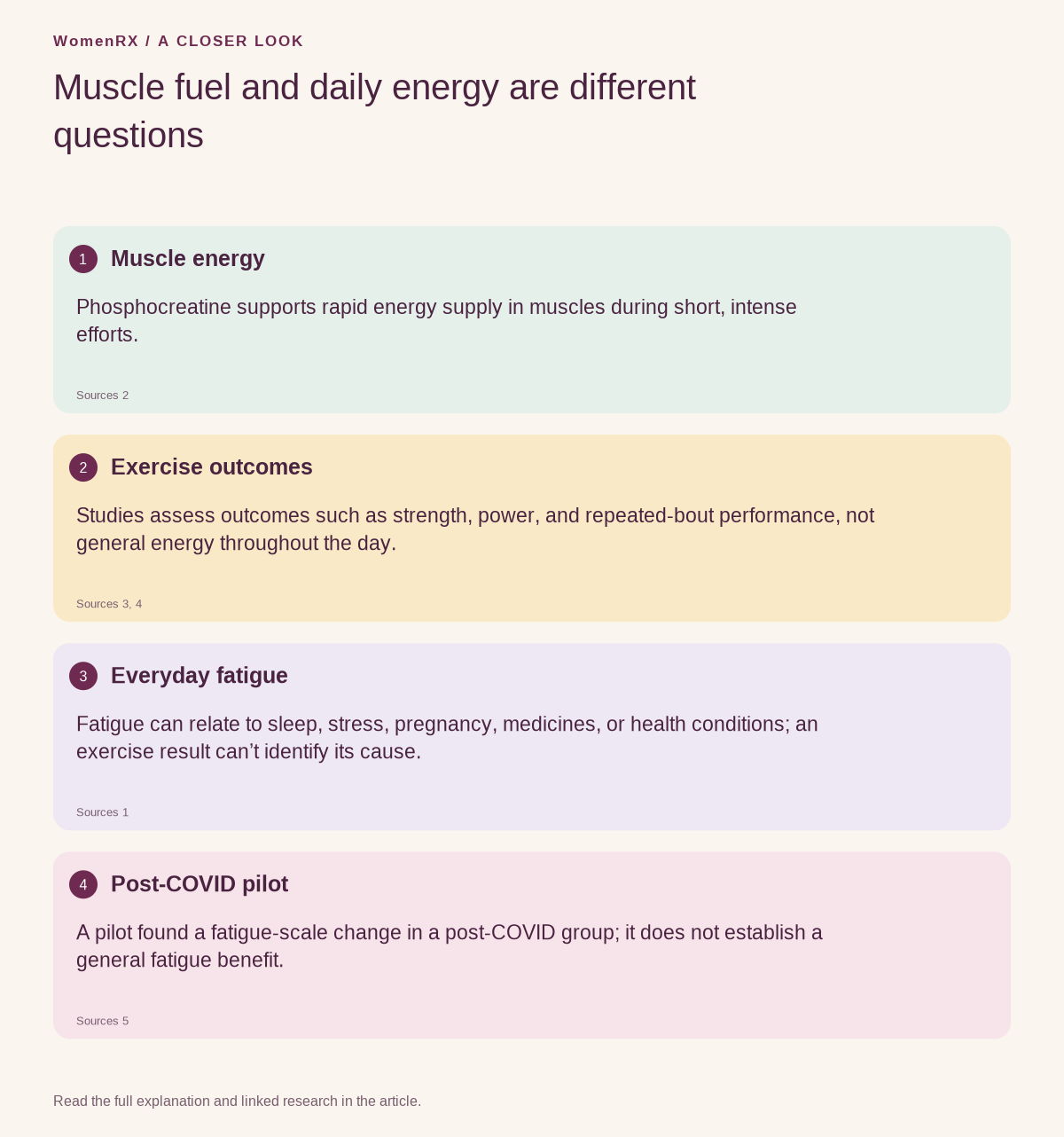
Muscle fuel and daily energy are different questions
Muscle energy: Phosphocreatine supports rapid energy supply in muscles during short, intense efforts.2
Exercise outcomes: Studies assess outcomes such as strength, power, and repeated-bout performance, not general energy throughout the day.34
Everyday fatigue: Fatigue can relate to sleep, stress, pregnancy, medicines, or health conditions; an exercise result can’t identify its cause.1
Post-COVID pilot: A pilot found a fatigue-scale change in a post-COVID group; it does not establish a general fatigue benefit.5
Read the figure as text
This comparison separates creatine’s role in intense muscle work from exercise-test outcomes and the broader symptom of everyday fatigue.- Muscle energy: Phosphocreatine supports rapid energy supply in muscles during short, intense efforts.2
- Exercise outcomes: Studies assess outcomes such as strength, power, and repeated-bout performance, not general energy throughout the day.34
- Everyday fatigue: Fatigue can relate to sleep, stress, pregnancy, medicines, or health conditions; an exercise result can’t identify its cause.1
- Post-COVID pilot: A pilot found a fatigue-scale change in a post-COVID group; it does not establish a general fatigue benefit.5
More questions, answered
Does creatine have evidence for everyday tiredness?
Not as a general benefit. A pilot study found a change in fatigue scores among people with post-COVID condition, but that result doesn’t establish that creatine helps fatigue from other causes or day-to-day low energy generally. 5
Do these findings establish a benefit for women?
No. The post-COVID pilot included mostly women, but its reported fatigue result is for the overall group and doesn’t establish a women-specific effect. The shuttle-run trial was in men, and the combat-sport review focused on athletes. 3 4 5
Sources you can check
- Fatigue: MedlinePlusAccessed 2026-09-25Return to first citation
- Synergistic effects of creatine, carbs, protein on repeated sprint performance.Wang Y, Wei H, Cheng X, Chen Z. · Scientific reports · 2026Return to first citation
- Creatine Supplementation in Combat Sport Athletes: A Narrative Systematic Review.Ashtary-Larky D, Candow DG, Forbes SC, Hajizadeh L, Peacock CA, Kalman D, Ricci T, Antonio J. · Journal of dietary supplements · 2025Return to first citation
- Effects of Creatine Monohydrate Loading on Sleep Metrics, Physical Performance, Cognitive Function, and Recovery in Physically Active Men: A Randomized, Double-Blind, Placebo-Controlled, Crossover Trial.Ben Maaoui K, Delleli S, Mahdi N, Jebabli A, Del Coso J, Chtourou H, Ardigò LP, Ouergui I. · Nutrients · 2025Return to first citation
- Creatine supplementation on fatigue related to post-COVID-19 condition-fatigue study: a randomized controlled trial.Dos Santos MSC, Dorna MS, Costa AF, Franco EAT, Bassani I, Geronutti J, Antunes LCO, Brizola LFP, Breda CC, Marin CS, Suetake FS, Barros YO, Azevedo PS, de Paiva SAR, Tanni SE, Pru... · Frontiers in nutrition · 2026Return to first citation