Considering Quercetin? Check the Goal, Form, and Dose
A quercetin label can tell you what’s in a serving, but not whether that product will help with your goal.
Start with the reason you’d take quercetin, then check the amount per serving and the form named on the label. Human studies show that different forms can produce different levels in blood or urine, but greater absorption doesn’t establish a health benefit.6 Doses used in studies of nonpregnant adults aren’t a recommended dose for everyone, particularly during pregnancy.3
First, name the outcome you’re hoping for
“Antioxidant support” can sound appealing, but it’s not the same as a measurable outcome you care about. Are you considering quercetin for a specific symptom, or because someone suggested it while you’re trying to conceive? That distinction changes which research is relevant.
For example, researchers have studied quercetin in human placental cells exposed to oxidative stress. A separate study found effects against Toxoplasma gondii in laboratory-grown cells and placental tissue studied outside the body. Neither study shows that taking a quercetin supplement prevents miscarriage, treats an infection, or improves pregnancy outcomes.24 A review focused on recurrent pregnancy loss describes promising laboratory work but says clinical trials directly addressing that outcome remain limited.5
If a product’s pitch relies on a cell experiment, ask whether people were studied for the outcome you want. A plausible mechanism is a reason to investigate, not a reason to assume a capsule will work.
Read the amount and the form together
Find the amount of quercetin per serving, then check how many capsules or scoops make up that serving. Look for the form named on the label, not just a large number on the front of the bottle. This gives you a clearer description of the product you’re considering; it still doesn’t tell you whether it’s effective.
Form matters because quercetin doesn’t enter the body equally from every preparation. A systematic review of 31 human intervention studies found differences in quercetin measured in blood or urine across chemical forms, formulations, and food matrices.6 That’s a finding about absorption, not proof that a more absorbable product improves symptoms or is safer. It also means a dose from a study using one preparation shouldn’t be treated as interchangeable with the same number of milligrams in another.
A studied dose is not your dose
A review of quercetin research describes nonpregnant human studies using 500 mg daily for several weeks and studies using 500 mg or 1,000 mg daily for 12 weeks without reported serious adverse events in those studies. The review also says that dose optimization is unresolved and that a safe, effective range during pregnancy needs further research.3 Those regimens describe what researchers studied. They don’t establish that either amount is useful for your goal, safe with your medicines, or appropriate for long-term use.
Before buying, compare the product’s serving amount and form with the specific research behind the claim. If the claim concerns a different condition or a different preparation, the comparison has limited value.
Make the safety question specific to you
Pregnancy deserves a separate decision, not an extrapolation from studies in nonpregnant adults. Research on quercetin for pregnancy-related outcomes is still largely preliminary, and its efficacy and safety in human pregnancy need better study.35 If you’re pregnant, or trying to conceive and considering quercetin for a reproductive outcome, bring the exact product and your goal to the clinician involved in your care before using it.
If you’re breastfeeding, don’t assume a pregnancy study or an adult tolerability study answers what happens during nursing. MedlinePlus notes that some medicines can pass into breast milk, but that general fact does not establish whether quercetin does or what a supplement would mean for a nursing infant.1 Ask about the specific product rather than treating that uncertainty as either proof of harm or reassurance.
Taking a prescription medicine or managing a health condition? Bring a photo of the full label, including its other ingredients, to a pharmacist or your treating clinician. Ask, “Is there a known concern with this product and my medicines or condition?” The research discussed above does not establish a specific quercetin-medicine interaction, so a generic warning can’t replace a check of what you actually take.
The useful pre-purchase test is simple: Can you name the outcome, identify the serving amount and form, and explain why the research applies to your situation? If not, you have a better next move than guessing at a dose.
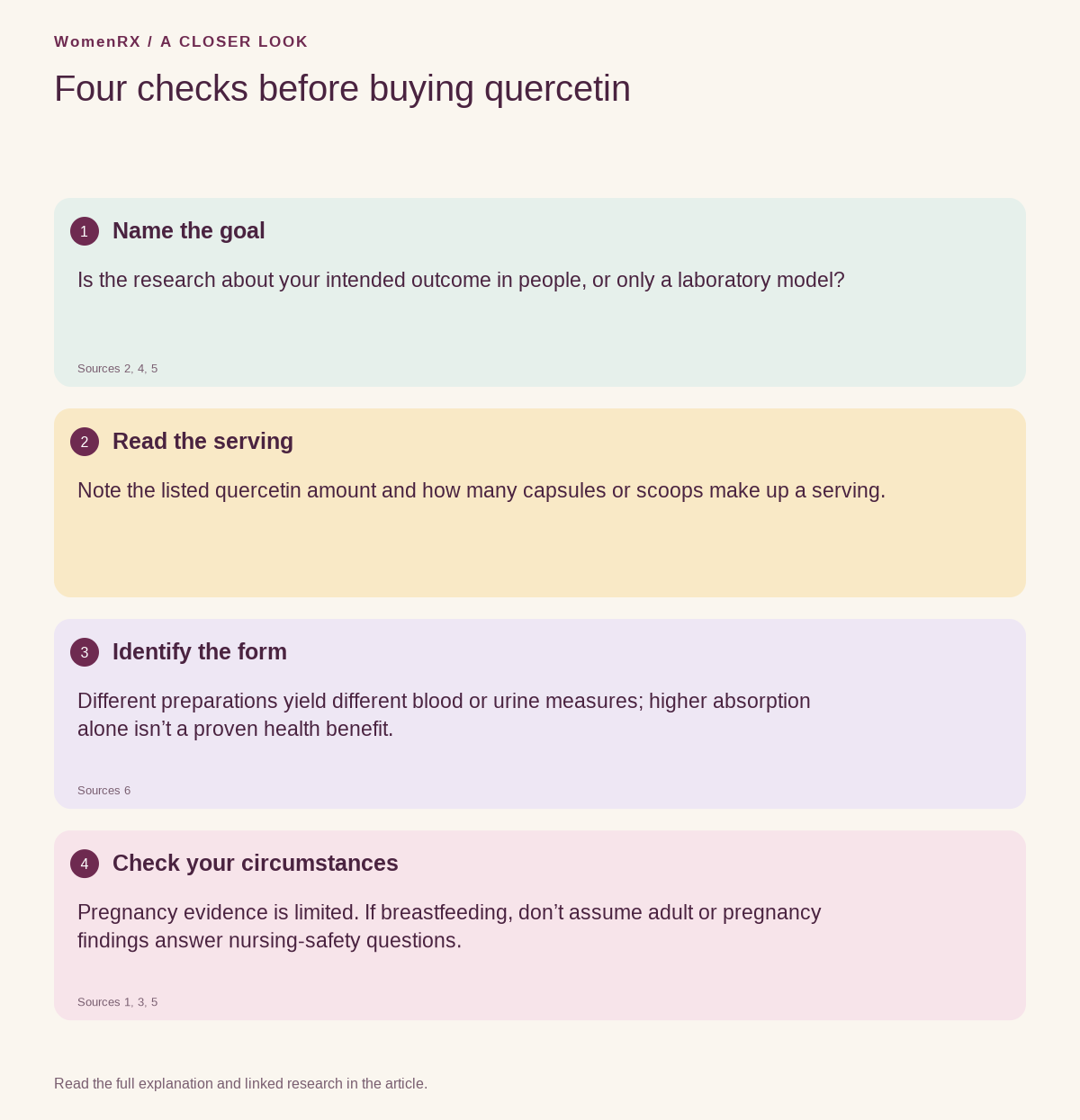
Four checks before buying quercetin
Name the goal: Is the research about your intended outcome in people, or only a laboratory model?245
Read the serving: Note the listed quercetin amount and how many capsules or scoops make up a serving.
Identify the form: Different preparations yield different blood or urine measures; higher absorption alone isn’t a proven health benefit.6
Check your circumstances: Pregnancy evidence is limited. If breastfeeding, don’t assume adult or pregnancy findings answer nursing-safety questions.135
Read the figure as text
Use these questions to separate what the label says from what research can tell you.- Name the goal: Is the research about your intended outcome in people, or only a laboratory model?245
- Read the serving: Note the listed quercetin amount and how many capsules or scoops make up a serving.
- Identify the form: Different preparations yield different blood or urine measures; higher absorption alone isn’t a proven health benefit.6
- Check your circumstances: Pregnancy evidence is limited. If breastfeeding, don’t assume adult or pregnancy findings answer nursing-safety questions.135
More questions, answered
Does a higher-absorption form mean a better quercetin supplement?
Not necessarily. Human studies found differences in blood or urine measures of quercetin across preparations, but those measures don’t establish that a higher-absorption product delivers a better health outcome.6
Sources you can check
- Breastfeeding | Benefits of Breastfeeding | MedlinePlusAccessed 2026-09-25Return to first citation
- Quercetin protects HTR-8/SVneo human trophoblast cells against oxidative stress injury via activating EGFR/PI3K/AKT-NRF2/HO-1 signaling axis.Liu L, Ding Z, Wu Y, Xiao J, Tao C, Zhou X, Tang H. · Frontiers in pharmacology · 2026Return to first citation
- Research progress of quercetin in infection at the maternal-fetal interface.Shi J, Zhang J, Gong W, Shen L. · Frontiers in immunology · 2026Return to first citation
- Quercetin Reduces Toxoplasma gondii Infection in In Vitro and Ex Vivo Placental Models.Souto MP, de Faria GV, de Souza G, Lima Júnior JP, Damasceno IS, Almeida MPO, Dos Santos NCL, de Oliveira RM, Ferreira EL, Luz LC, Mendonça TP, Pereira CS, Espindola FS, Justino AB... · International journal of molecular sciences · 2026Return to first citation
- Quercetin as a multifaceted therapeutic agent in recurrent pregnancy loss: Mechanisms and clinical perspectives.Qi Q, Zhou J, Wang J, Zhou Y, Sun H, Wang L. · Drug discoveries & therapeutics · 2025Return to first citation
- Improving quercetin bioavailability: A systematic review and meta-analysis of human intervention studies.Liu L, Barber E, Kellow NJ, Williamson G. · Food chemistry · 2025Return to first citation