Can You Drink Coffee While Taking a GLP-1 Medication?
If coffee has started to feel different on a GLP-1 medication, the useful question is what changes when you change your cup.
You may be able to keep drinking coffee, but let your tolerance guide you. GLP-1 medications can cause nausea and other digestive symptoms, and the caffeine in coffee varies.13 Feeling worse after a cup doesn’t, by itself, show a drug interaction. If coffee seems to affect your stomach, sleep, or appetite, change one part of the habit and see what happens.
Start with what happens after your cup
Coffee doesn’t have to be an all-or-nothing decision. If you enjoy a cup and feel fine afterward, there’s no symptom to solve. If you feel queasy, overly full, or uncomfortable after drinking it, changing your coffee habit is a reasonable way to learn what you tolerate.
The distinction matters because the medication itself may be part of what you’re feeling. In a systematic review of randomized trials, nausea, vomiting, diarrhea, constipation, and decreased appetite were all more common with GLP-1 receptor agonists than with placebo.3 Semaglutide can slow stomach emptying and reduce appetite, so your usual morning routine may feel different even if the coffee hasn’t changed.4 Those findings describe medication effects, not the effects of drinking coffee with the medication.
Change the drink before blaming the medication
For example, if nausea seems to follow your morning coffee, you could try a smaller cup or skip coffee on another morning and notice whether the discomfort still appears. If it does, coffee may not be the whole explanation. If it settles when you skip the drink, you’ve found a useful clue about your own tolerance, not proof of a drug interaction.
Pay attention to what’s in the cup, too. Plain coffee is different from a drink with syrup, cream, or whipped topping: those additions can make it a more calorie-rich drink without changing the question of whether you tolerate coffee itself. If the drink with additions bothers you, comparing it with plain coffee may help you identify what you tolerate. If your appetite is lower, notice whether a substantial coffee drink is taking the place of food you’d otherwise have. Reduced appetite is a recognized effect of these medications.34
Caffeine amount can vary: MedlinePlus lists roughly 95-200 mg in an 8-ounce coffee.1 If sleep seems worse after coffee, compare your usual routine with a day when you have less coffee or drink it earlier. If reflux is the issue, notice whether discomfort follows the coffee, its additions, or both. These comparisons can help you decide what suits you; they won’t establish what caused a symptom.
Coffee also isn’t a substitute for checking whether you’re getting enough to drink throughout the day. If nausea or vomiting is making it hard to drink, or stomach problems won’t go away, bring that up in a medication review rather than trying to solve it by changing coffee alone.36
Pregnancy is a separate question
If you’re pregnant or planning pregnancy, don’t use how well you tolerate coffee on a GLP-1 medication as a guide to caffeine during pregnancy. Ask your prenatal care team about caffeine separately from the medication plan. Medication guidance depends on the specific product: for example, the U.S. information for Wegovy (semaglutide) says to discontinue it at least two months before a planned pregnancy.5 That timing is about semaglutide, not coffee, and shouldn’t be assumed to apply to every GLP-1 medication.
Know when it’s more than a coffee question
Don’t keep experimenting with coffee if stomach symptoms are severe or won’t go away. The U.S. information for tirzepatide advises reporting severe or persistent stomach problems.6 Persistent or severe abdominal pain, sometimes spreading to the back and with or without vomiting, needs prompt medical assessment because it can be a sign of pancreatitis during GLP-1 receptor agonist treatment.2
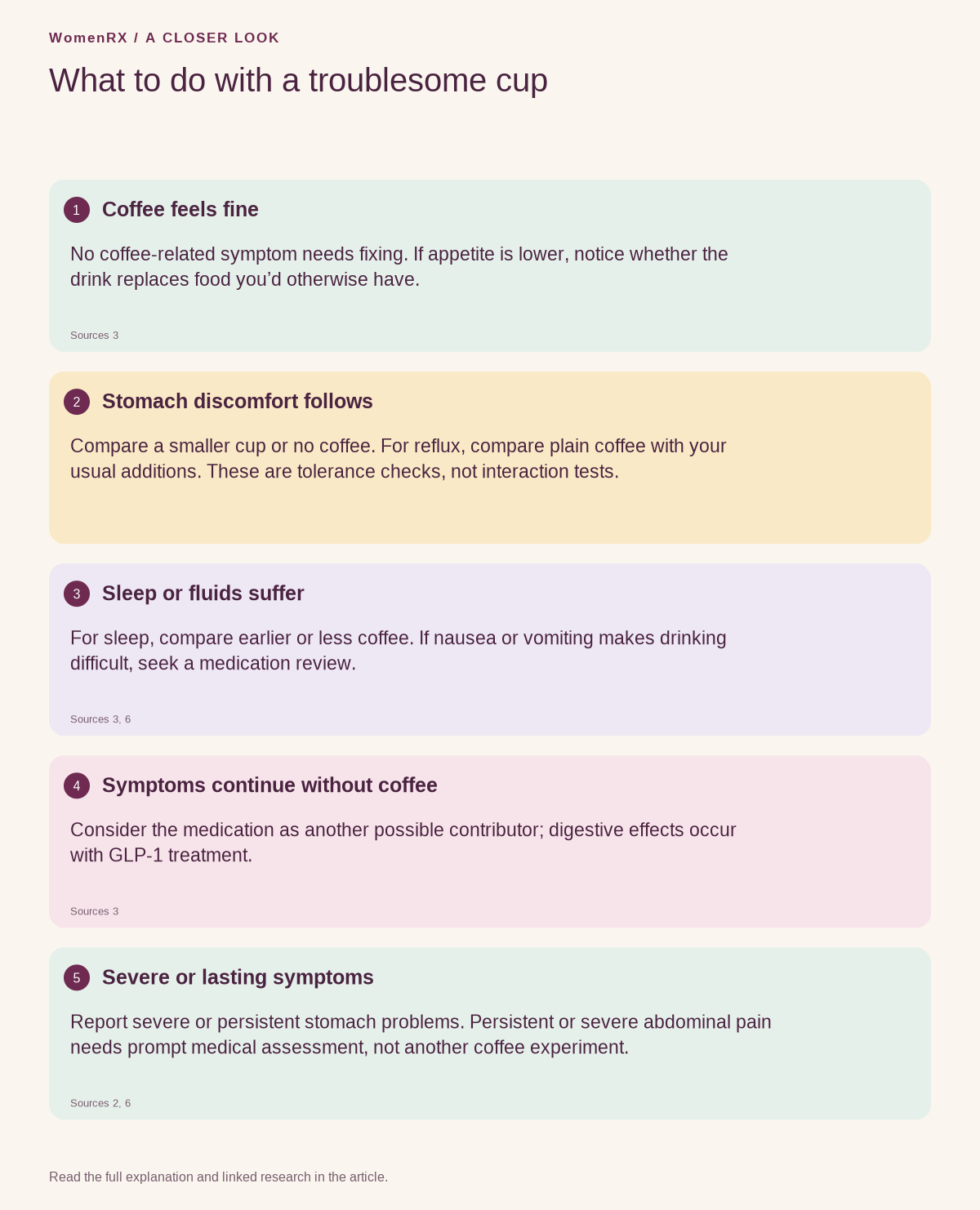
What to do with a troublesome cup
Coffee feels fine: No coffee-related symptom needs fixing. If appetite is lower, notice whether the drink replaces food you’d otherwise have.3
Stomach discomfort follows: Compare a smaller cup or no coffee. For reflux, compare plain coffee with your usual additions. These are tolerance checks, not interaction tests.
Sleep or fluids suffer: For sleep, compare earlier or less coffee. If nausea or vomiting makes drinking difficult, seek a medication review.36
Symptoms continue without coffee: Consider the medication as another possible contributor; digestive effects occur with GLP-1 treatment.3
Severe or lasting symptoms: Report severe or persistent stomach problems. Persistent or severe abdominal pain needs prompt medical assessment, not another coffee experiment.26
Read the figure as text
Follow the symptom you notice, then choose a comparison or a care step without assuming coffee and medication interact.- Coffee feels fine: No coffee-related symptom needs fixing. If appetite is lower, notice whether the drink replaces food you’d otherwise have.3
- Stomach discomfort follows: Compare a smaller cup or no coffee. For reflux, compare plain coffee with your usual additions. These are tolerance checks, not interaction tests.
- Sleep or fluids suffer: For sleep, compare earlier or less coffee. If nausea or vomiting makes drinking difficult, seek a medication review.36
- Symptoms continue without coffee: Consider the medication as another possible contributor; digestive effects occur with GLP-1 treatment.3
- Severe or lasting symptoms: Report severe or persistent stomach problems. Persistent or severe abdominal pain needs prompt medical assessment, not another coffee experiment.26
Sources you can check
- Caffeine: MedlinePlusAccessed 2026-09-25Return to first citation
- VICTOZA (LIRAGLUTIDE) INJECTION [NOVO NORDISK] | US prescribing information and patient instructionsAccessed 2026-09-25Return to first citation
- Exploring the rates of Gastrointestinal adverse effects among five GLP-1 receptor agonists: A systematic review and Meta-Analysis of randomized controlled trials.Joy B, Ramsamooj A, Ibrahim S, Wen J, Hsu N, Frezza E. · Endocrine · 2026Return to first citation
- Effectiveness & safety of semaglutide in weight reduction in obese nondiabetic patients: A systematic review and meta-analysis.Naz F, Qaiser F, Mumtaz A, Din SU, Mustafa A, Ullah A, Perveen A, Malik J. · Medicine · 2026Return to first citation
- WEGOVY (SEMAGLUTIDE) INJECTION, SOLUTION WEGOVY (SEMAGLUTIDE) TABLET [NOVO NORDISK PHARMACEUTICAL INDUSTRIES, LP] | US prescribing information and patient instructionsAccessed 2026-09-25Return to first citation
- ZEPBOUND (TIRZEPATIDE) INJECTION, SOLUTION ZEPBOUND (TIRZEPATIDE) INJECTION, SOLUTION ZEPBOUND KWIKPEN (TIRZEPATIDE) INJECTION, SOLUTION [ELI LILLY AND COMPANY] | US prescribing information and patient instructionsAccessed 2026-09-25Return to first citation