Can Short Bouts of Movement Add Up in a Busy Day?
Brief movement breaks can help you move more and interrupt long stretches of sitting, but they haven’t been shown to replace every benefit of a longer workout.
Yes. Short walks, stair climbs, or a few bodyweight movements can make it easier to add activity when a long workout won’t fit. Research on these “exercise snacks” suggests possible benefits for fitness and physical function, but the studies use varied routines and don’t establish that brief bouts are equivalent to longer sessions for every outcome. 2 3
Think of short bouts as useful building blocks
An exercise snack is a brief bout of planned movement, repeated at different points in the day. Studies use different definitions and activities, ranging from a few seconds to several minutes. The practical idea is simple: you don’t have to wait for an uninterrupted block of free time to move. Short bouts can help break up sitting and add activity to an otherwise busy day. 3
That can be a real advantage if work, caregiving, or other responsibilities make a scheduled workout hard to manage. It’s a way to get moving, not a test of whether you’re exercising “properly.”
A menu of ways to fit movement in
Choose an option that suits the moment and your surroundings. These are examples of activities used in research or discussed in reviews, not a required routine:
- Between tasks: walk around the home or office, or take a short walk outside.
- After a meal: try a brief walk. Short walks were among the activities included in research on movement breaks and blood-sugar responses. 4
- During a work break: try stair climbing, sit-to-stands, or simple bodyweight movements such as squats or calf raises. These kinds of activities have been used in exercise-snack interventions. 2 4
- When you’re already on your feet: use a transition, such as putting something away or moving between tasks, as a chance to add a little more walking.
You can attach movement to something that already happens, such as finishing a meal or taking a break from a screen. There’s no one schedule established by this evidence, and you don’t need to copy a research protocol for these everyday examples to be useful.
What short bouts have been studied for
A systematic review and meta-analysis of 11 randomized trials, involving 472 healthy or “sub-healthy” adults, found improvements in pooled measures that included cardiorespiratory fitness and performance on a sit-to-stand test. The interventions varied, and often involved supervised sessions over several weeks. These findings suggest that brief bouts can contribute to measurable changes, but they don’t tell us that every brief activity will produce the same result. 2
Researchers have also examined breaking up sitting in relation to blood sugar after meals. A meta-analysis of eight acute trials involving 159 sedentary adults with metabolic risk found lower post-meal glucose responses with exercise snacks than with uninterrupted sitting. The studies were conducted under controlled conditions, and results varied; the finding doesn’t establish a long-term health effect or a specific routine for everyone. 4
How they compare with longer workouts
The clearest difference is flexibility: short bouts can be fitted into gaps, while a longer session gives you sustained time for activity. Current research on exercise snacks doesn’t settle whether breaking activity into brief bouts is equivalent to longer sessions across fitness, strength, blood sugar, and other outcomes. Studies use different activities, schedules, and comparison groups, so it’s best to treat exercise snacks as a way to add movement rather than a guaranteed substitute for structured exercise. 2 3
If you already enjoy a longer walk, class, or workout, brief movement breaks can complement it. If you’re starting with little activity, a few manageable bouts can be a reasonable place to begin. MedlinePlus notes that even five minutes of physical activity has health benefits, and that some activity is better than none. 1
Short bouts also shouldn’t be treated as a weight-loss promise. A review of exercise-snack trials found mixed results across outcomes, including no statistically significant improvement in BMI. Movement can support health and be part of weight management, but these studies don’t show that exercise snacks alone guarantee weight loss. 1 2
What the research says about women
The studies summarized here involve adults, but the findings don’t establish whether exercise snacks work differently for women, or whether effects vary across the menstrual cycle, pregnancy, postpartum, perimenopause, or postmenopause. There’s no need to assume a special benefit or limitation for women from these results. For now, the practical case is about fitting movement into daily life, not a proven sex-specific effect.
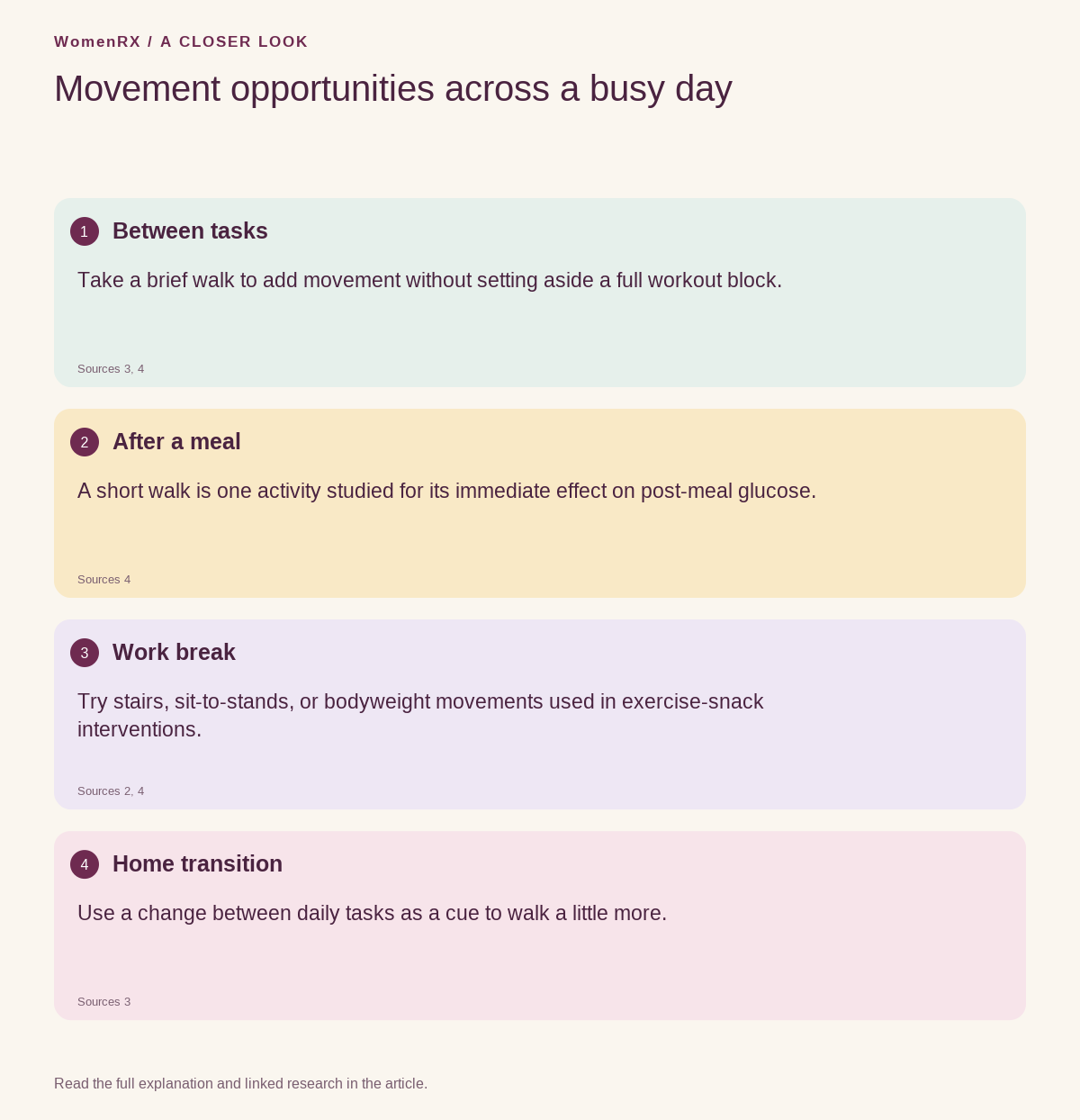
Movement opportunities across a busy day
Between tasks: Take a brief walk to add movement without setting aside a full workout block.34
After a meal: A short walk is one activity studied for its immediate effect on post-meal glucose.4
Work break: Try stairs, sit-to-stands, or bodyweight movements used in exercise-snack interventions.24
Home transition: Use a change between daily tasks as a cue to walk a little more.3
Read the figure as text
An illustrative sequence of moments when brief movement may fit. It is a menu, not a tested schedule or required daily plan.- Between tasks: Take a brief walk to add movement without setting aside a full workout block.34
- After a meal: A short walk is one activity studied for its immediate effect on post-meal glucose.4
- Work break: Try stairs, sit-to-stands, or bodyweight movements used in exercise-snack interventions.24
- Home transition: Use a change between daily tasks as a cue to walk a little more.3
More questions, answered
Do exercise snacks have to be intense?
No single intensity or format has been established as best. Research includes different activities, from walking and dynamic movement to stair climbing and bodyweight exercises, so choose a form that suits the moment rather than assuming every bout needs to be vigorous. 2 3 4
Can short movement breaks help with weight loss?
They can add activity, but the evidence doesn’t show that exercise snacks alone guarantee weight loss. A meta-analysis found no statistically significant improvement in BMI, and weight management involves more than one factor. 1 2
Sources you can check
- Benefits of Exercise: MedlinePlusAccessed 2026-09-25Return to first citation
- Effectiveness of exercise snacks on physical function: a systematic reviews with meta-analysis of randomized controlled trials.Zhang D, Sun S, Ding Y, Chen L, Zhang X, Yin J, Zhang H. · The journal of nutrition, health & aging · 2026Return to first citation
- Advances in exercise snacks for interrupting sedentary behavior and promoting physical activity: a narrative review.Ye S, Ding Y, Hu B, Zhou N, Huang R, Zhuang Y. · Frontiers in public health · 2026Return to first citation
- Acute effects of "exercise snacks" on postprandial glucose and insulin responses in populations at metabolic risk: a meta-analysis with exploratory meta-regression and vascular outcomes.Hu X, Sang X, Xu J, Chen P. · Frontiers in endocrinology · 2026Return to first citation