Can Perimenopause Change Your Sense of Smell?
A small study found a difference after menopause, but it can’t tell you whether a new smell change is caused by perimenopause.
Possibly, but there’s no established pattern of smell becoming stronger or weaker during perimenopause. One small study found lower measured smell ability in postmenopausal women than in similarly aged premenopausal women; it didn’t follow women through the transition or prove hormones caused the difference. Congestion, sinus symptoms and a recent head injury offer different clues worth considering. 421
What the menopause research can tell us
If coffee suddenly smells faint, or a familiar scent seems different, it’s understandable to wonder about hormones, especially if your periods are changing too. The evidence doesn’t give perimenopause a recognizable smell pattern, though.
In one study, researchers tested 20 premenopausal women and 20 women who were at least three years past menopause. Both groups were ages 41 to 50. The postmenopausal group performed worse on the study’s smell measures. That’s a finding about two groups at one point in time, not a record of what happened to each woman’s sense of smell as she moved through perimenopause. It also can’t establish that changing hormone levels caused the difference. 4
A review exploring estrogen and smell describes possible biological links, but calls for studies focused on women in perimenopause. Neither that review nor the small comparison study shows that perimenopause reliably sharpens smell, dulls it or makes certain odors unpleasant. 34
Look at the pattern, not just your age
Gradual change with ongoing nasal symptoms: If you’ve also had persistent stuffiness or other sinus symptoms, your nose may be a more useful starting point than your hormone levels. Nasal and sinus inflammation can interfere with odors reaching the smell-sensing area and can affect the tissue involved in sensing them. Allergy-related and chronic sinus conditions are among the conditions considered when assessing smell loss. If the smell change or nasal symptoms are continuing, bring up both when seeking an assessment. 2
A change around an illness: Notice whether congestion began around the same time as the smell change and whether it’s still there. That sequence doesn’t establish what caused the change, but it helps distinguish a change accompanied by nasal symptoms from one with no obvious nasal explanation. 2
A change after a head injury: Bring the smell change up when you’re getting care for the injury, even if your nose feels clear. Head trauma is a recognized cause of smell dysfunction, so that timing matters. 1
Sudden change without an obvious nasal explanation: Suddenness alone doesn’t identify a cause, and the menopause studies don’t establish sudden smell loss as a feature of the transition. 43 Rather than writing it off as perimenopause, tell a clinician when it began and what changed. If you’ve also noticed new memory or movement problems, mention those too. Smell dysfunction can occur in conditions that also involve cognitive or motor symptoms, although that association doesn’t identify the cause of your symptoms. 1
A medication change may also be close enough in time to catch your attention. Make a note of the sequence. It’s useful context to share, not proof that the medicine or menopause caused the smell change. This research doesn’t identify a particular medication as the cause of a smell symptom.
What an evaluation might sort out
For suspected nasal or sinus disease, an assessment can distinguish problems that block odors from inflammation affecting the smell-sensing tissue. A targeted history and nasal examination are part of that work; smell testing or imaging may be used selectively. That’s more informative than assuming every smell change at midlife has the same explanation. 2
You don’t have to decide on the cause before speaking up. The useful distinction is whether the change came on suddenly or gradually, whether your nose has felt congested, and whether it followed an illness, an injury or another noticeable change. Those details help make the smell change itself the focus of the conversation, rather than treating your menopause stage as the answer. 21
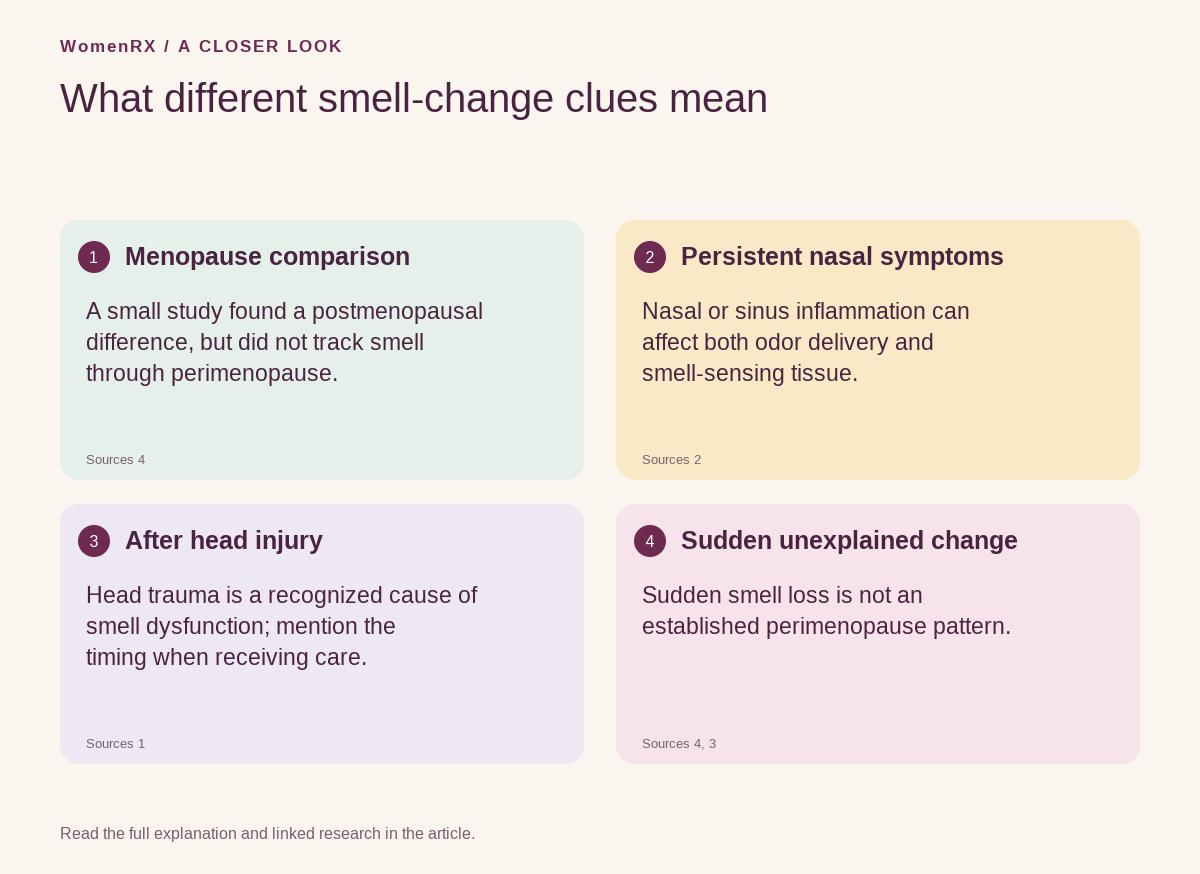
What different smell-change clues mean
Menopause comparison: A small study found a postmenopausal difference, but did not track smell through perimenopause.4
Persistent nasal symptoms: Nasal or sinus inflammation can affect both odor delivery and smell-sensing tissue.2
After head injury: Head trauma is a recognized cause of smell dysfunction; mention the timing when receiving care.1
Sudden unexplained change: Sudden smell loss is not an established perimenopause pattern.43
Read the figure as text
These clues don’t diagnose a cause. They show why a change in smell deserves more than a menopause-only explanation.- Menopause comparison: A small study found a postmenopausal difference, but did not track smell through perimenopause.4
- Persistent nasal symptoms: Nasal or sinus inflammation can affect both odor delivery and smell-sensing tissue.2
- After head injury: Head trauma is a recognized cause of smell dysfunction; mention the timing when receiving care.1
- Sudden unexplained change: Sudden smell loss is not an established perimenopause pattern.43
More questions, answered
Can a smell change tell me whether I’m in perimenopause?
No. The study comparing premenopausal and postmenopausal women did not establish a smell pattern that identifies the menopausal transition in an individual woman. 4
Sources you can check
- The olfactory-glymphatic syndrome: linking smell dysfunction, cognitive impairment and sleep disturbances in neuropathological disorders.Phillips WT, Schwartz JG. · Frontiers in neuroscience · 2026Return to first citation
- Smell and the sinuses.Pierre Z, Mattos JL. · Annals of allergy, asthma & immunology : official publication of the American College of Allergy, Asthma, & Immunology · 2026Return to first citation
- A Review of the Role of Estrogens in Olfaction, Sleep and Glymphatic Functionality in Relation to Sex Disparity in Alzheimer's Disease.Ekanayake A, Peiris S, Ahmed B, Kanekar S, Grove C, Kalra D, Eslinger P, Yang Q, Karunanayaka P. · American journal of Alzheimer's disease and other dementias · 2024Return to first citation
- [Olfactory perception in women with physiologically altered hormonal status (during pregnancy and menopause].Savović S, Nincić D, Lemajić S, Pilija V, Mandić A, Rajović J, Ivetić V. · Medicinski pregled · 2002Return to first citation