Can Menopause Change Your Sense of Smell?
A smell change in midlife is worth noticing, but timing alone can’t tell you whether menopause is the cause.
A change in smell around menopause does not mean menopause caused it. The study that included menopause in its analysis examined leptin and odor identification, not whether smell changes across menopausal stages. 1 A smell change in midlife may have another explanation, especially if it follows an illness or comes on suddenly.
A familiar scent suddenly seeming faint, strange, or different can be unsettling. Menopause may be part of what’s happening in your life, but the timing of a smell change doesn’t identify its cause. It helps to separate what people mean by “smell changed,” because different kinds of change have been studied differently.
Sensitivity, recognition, and distortion aren’t the same
Smell sensitivity is about how faint an odor can be before you detect it. Odor identification is recognizing or naming an odor once you’ve smelled it. A person might notice that a scent seems weaker yet still recognize it, or have trouble identifying an odor without feeling that smells are weaker overall.
Smells can also seem distorted. In parosmia, an odor seems different when its source is present; in phantosmia, a smell seems present when there isn’t an obvious source. These are distinct from simply having a less sensitive sense of smell. Both have been described during recovery from COVID-19. 3
What the leptin study found
A 2002 study assessed smell in two Swedish samples: a randomly selected group of 60 men and 61 women, and a group of 31 men and 27 women with obesity. In the population sample, researchers found an association between blood leptin levels and odor-identification scores in women. After they adjusted the analysis for menopause and estrogen treatment, that association became stronger. The similar pattern in the smaller obesity sample was not statistically significant. 1
Adjusting for menopause and estrogen treatment did not test whether smell changes from perimenopause to postmenopause. The finding therefore cannot explain an individual’s new smell change or establish a menopause-specific pattern. 1
Age and other explanations belong in the picture
Age matters too, but a study of adults aged 71 to 82 cannot tell us what happens to smell during the menopausal transition. It measured odor identification only once, so it could not track smell changes with age or across midlife. 4
Smell changes can also occur in connection with other circumstances. For example, COVID-19 can be followed by reduced smell or distortions such as parosmia and phantosmia. 3 The older-adult study also noted nasal surgery and chronic rhinosinusitis as possible influences on smell, although its design could not distinguish these causes from age-related decline. 4
So timing alone isn’t enough to identify a cause. If a smell change begins around the same time as menopause, that coincidence is worth mentioning, but it doesn’t confirm a hormonal explanation.
Make the change easier to describe
If your sense of smell changes suddenly or for no clear reason, don’t write it off as menopause. A clinician can assess a smell problem; guidance on olfactory dysfunction covers its diagnosis and management. 2
It may help to describe what changed: whether odors seem weaker, are harder to identify, or smell distorted, and whether you can link the change to an illness or another event. Those details are more useful than the timing of menopause alone when you’re trying to understand what happened.
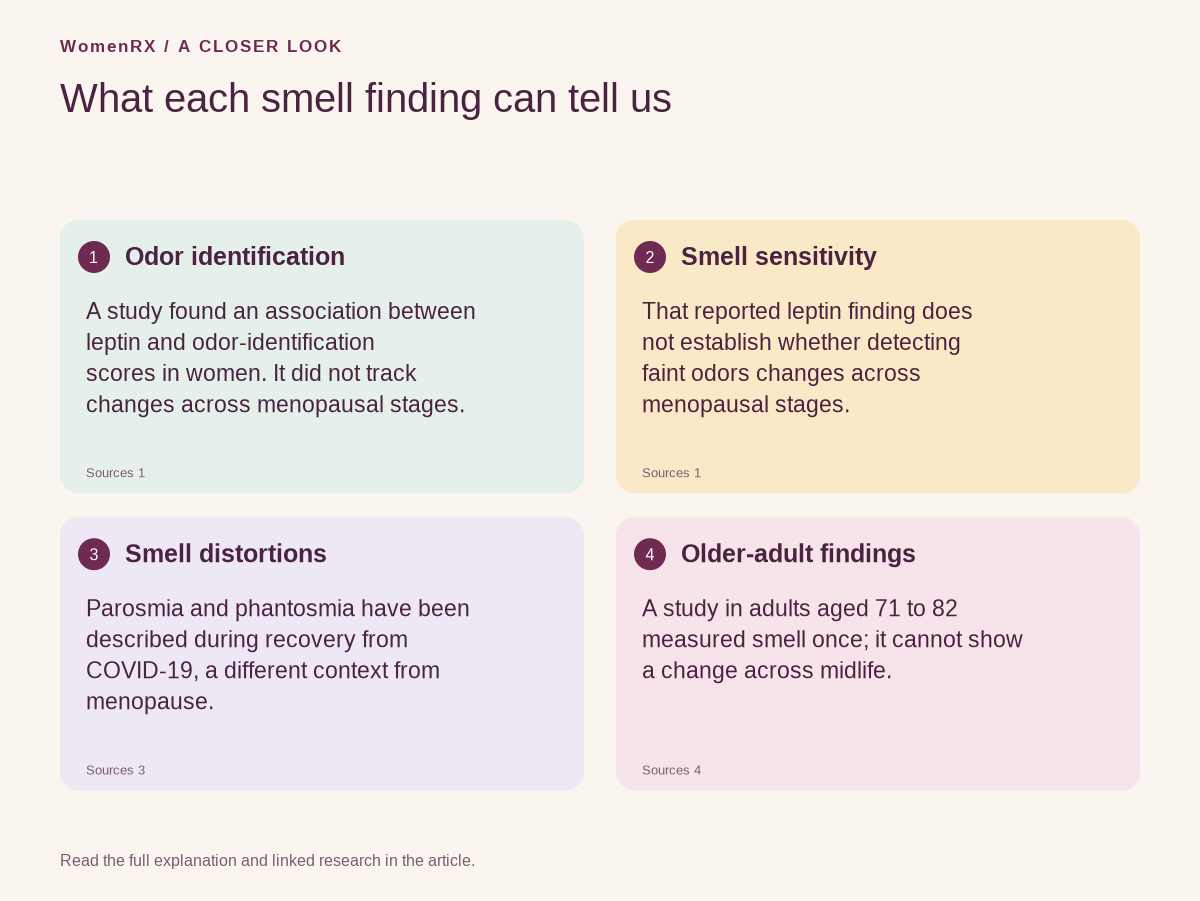
What each smell finding can tell us
Odor identification: A study found an association between leptin and odor-identification scores in women. It did not track changes across menopausal stages.1
Smell sensitivity: That reported leptin finding does not establish whether detecting faint odors changes across menopausal stages.1
Smell distortions: Parosmia and phantosmia have been described during recovery from COVID-19, a different context from menopause.3
Older-adult findings: A study in adults aged 71 to 82 measured smell once; it cannot show a change across midlife.4
Read the figure as text
Smell studies can measure different experiences in different populations. These findings shouldn’t be treated as interchangeable.- Odor identification: A study found an association between leptin and odor-identification scores in women. It did not track changes across menopausal stages.1
- Smell sensitivity: That reported leptin finding does not establish whether detecting faint odors changes across menopausal stages.1
- Smell distortions: Parosmia and phantosmia have been described during recovery from COVID-19, a different context from menopause.3
- Older-adult findings: A study in adults aged 71 to 82 measured smell once; it cannot show a change across midlife.4
More questions, answered
Does the leptin study show that menopause makes smells stronger?
No. The study measured odor identification, which means recognizing or naming an odor, rather than whether faint smells became easier to detect. 1
Sources you can check
- Evidence for gender-specific associations between leptin and olfaction.Karlsson AC, Lindroos AK, Lissner L, Torgerson JS, Carlsson B, Carlsson LM, Sjöström L. · The journal of gender-specific medicine : JGSM : the official journal of the Partnership for Women's Health at Columbia · 2002Return to first citation
- Summary of Japanese clinical practice guidelines 2025 for the management of olfactory dysfunction.Tsuzuki K, Hamamoto M, Iijima M, Kobayashi M, Kondo K, Mori E, Motoo Y, Nakamura K, Okutani F, Shibata M, Shiga H, Suzuki K, Suzuki M, Horii S, Inoshita A, Kawai Y, Kikuta S, Miyaz... · Auris, nasus, larynx · 2026Return to first citation
- Long-Term Olfactory Dysfunction in COVID-19 Patients: A Systematic Review.Zarkadi A, Katotomichelakis M, Chaidas K. · Cureus · 2026Return to first citation
- Olfaction and muscle strength in older adults: a longitudinal study.Liu R, Chen H, Li C, Kucharska-Newton A, Simonsick EM, Yuan Y. · The journals of gerontology. Series A, Biological sciences and medical sciences · 2026Return to first citation