Can Libido Increase During Perimenopause or Menopause?
A rise in sexual desire can be welcome, but its timing alone won’t tell you what caused it.
You may notice more sexual desire during perimenopause or after menopause, but the change alone doesn’t identify a hormone imbalance. Medicines and health conditions can affect sexual health, while vaginal comfort can change independently of desire. 134 The most useful clues are what else changed around the same time and whether your new level of desire feels good or troubling to you.
An increase doesn’t have one menopause explanation
Maybe you expected your interest in sex to fade, and instead it’s grown. You don’t need to treat a welcome change as a problem. You also don’t need to explain it by assuming your estrogen or testosterone is high or low.
Research on treating low desire doesn’t answer why someone’s desire might rise on its own. For example, a review found that testosterone treatment can improve sexual desire in some postmenopausal women with sexual dysfunction. That doesn’t mean a spontaneous increase in desire signals high testosterone. A menopause-symptom questionnaire study included low libido, but it didn’t follow increases in desire or compare causes across menopause stages. 56
The practical question is less “Which menopause hormone caused this?” and more “What else changed, and does this change feel good, neutral, or troubling to me?”
What the timing can and can’t suggest
During perimenopause, a change in desire may happen alongside changes in your circumstances, health, or medicines. Timing can help you notice a connection, but it can’t single out menopause as the cause. For example, if your feelings about the possibility of pregnancy have changed, that may be relevant to your sexual experience; fear of unplanned pregnancy is one factor that can affect sexual health. 1
After menopause, it can help to separate desire from physical comfort. Postmenopausal changes can affect vaginal tissues, and menopause guidance addresses treatment for bothersome vaginal symptoms. In a trial involving 80 postmenopausal women with vaginal atrophy symptoms, researchers measured desire, lubrication, pain, and other aspects of sexual function separately while testing vaginal treatments. The trial can’t explain a spontaneous rise in libido, but it shows why “I want sex more” and “sex feels more comfortable” are different observations. 34
After surgical menopause, the date of an operation gives you a clear point before and after which to describe a change. It doesn’t, by itself, show that surgery raised your desire. The postmenopausal treatment research above doesn’t establish whether an increase in desire differs between surgical and nonsurgical menopause. If your interest changed after surgery, it’s worth considering whether your medicines, health, or sexual comfort changed too. 14
Look at desire and sexual comfort separately
Desire is your interest in sex. Sexual comfort is part of the experience, but it isn’t the same thing. You could want sex more often and still have dryness or pain, or you could feel more comfortable with sex without a major change in desire. If discomfort is part of your picture, describe it directly rather than folding everything into the word libido. Menopause guidance identifies options for bothersome vaginal symptoms that aren’t relieved by over-the-counter approaches. 3
Check medicines and other changes without jumping to a cause
Medicines and chronic health conditions can affect sexual health. SSRIs and SNRIs, two types of antidepressants, can cause reduced sex drive. That side effect doesn’t explain every increase in desire, but it makes the timing of a medication change useful information, especially if your desire changed after you started, stopped, or changed a medicine. Bring a possible medication connection to the person who prescribes it rather than changing treatment based on a hunch. 12
Mood is worth noting separately from desire. The NHS lists agitation, shakiness, and anxiety as possible SSRI/SNRI side effects. A menopause symptom questionnaire measured mood and energy, but did not test whether mood changes cause higher desire. 26
Life circumstances matter as context, too. For example, a relationship change or a different sense of privacy might be worth noting if it happened around the same time. Those examples aren’t diagnoses or proven menopause effects. They’re ways to avoid overlooking your actual experience while searching for a single biological answer.
A quick way to sort out what changed
If you’d like to understand the shift or talk it through, try making a short timeline:
- Desire: When did you first notice the increase? Was it gradual or sudden?
- Medicines and health: What started, stopped, or changed around then? Include prescription medicines and any relevant health changes. 12
- Sexual experience: Has comfort changed? Is there dryness or pain as well as a change in interest? 3
- Mood and energy: Have you also felt agitated, shaky, or anxious, or noticed a change in energy? Did it begin around a medicine change? 26
- Your reaction: Is the increase welcome, neutral, distracting, or distressing? Has it affected choices or relationships in a way you want help with?
You don’t have to prove a cause before raising the subject in a care visit. If the increase in desire is distressing, or you’ve also noticed agitation, shakiness, anxiety, or a change in energy that concerns you, bring those changes to a care visit. A possible connection to a medicine is worth discussing too. If it’s welcome and nothing else is bothering you, you can simply notice it without assigning it a menopause diagnosis.
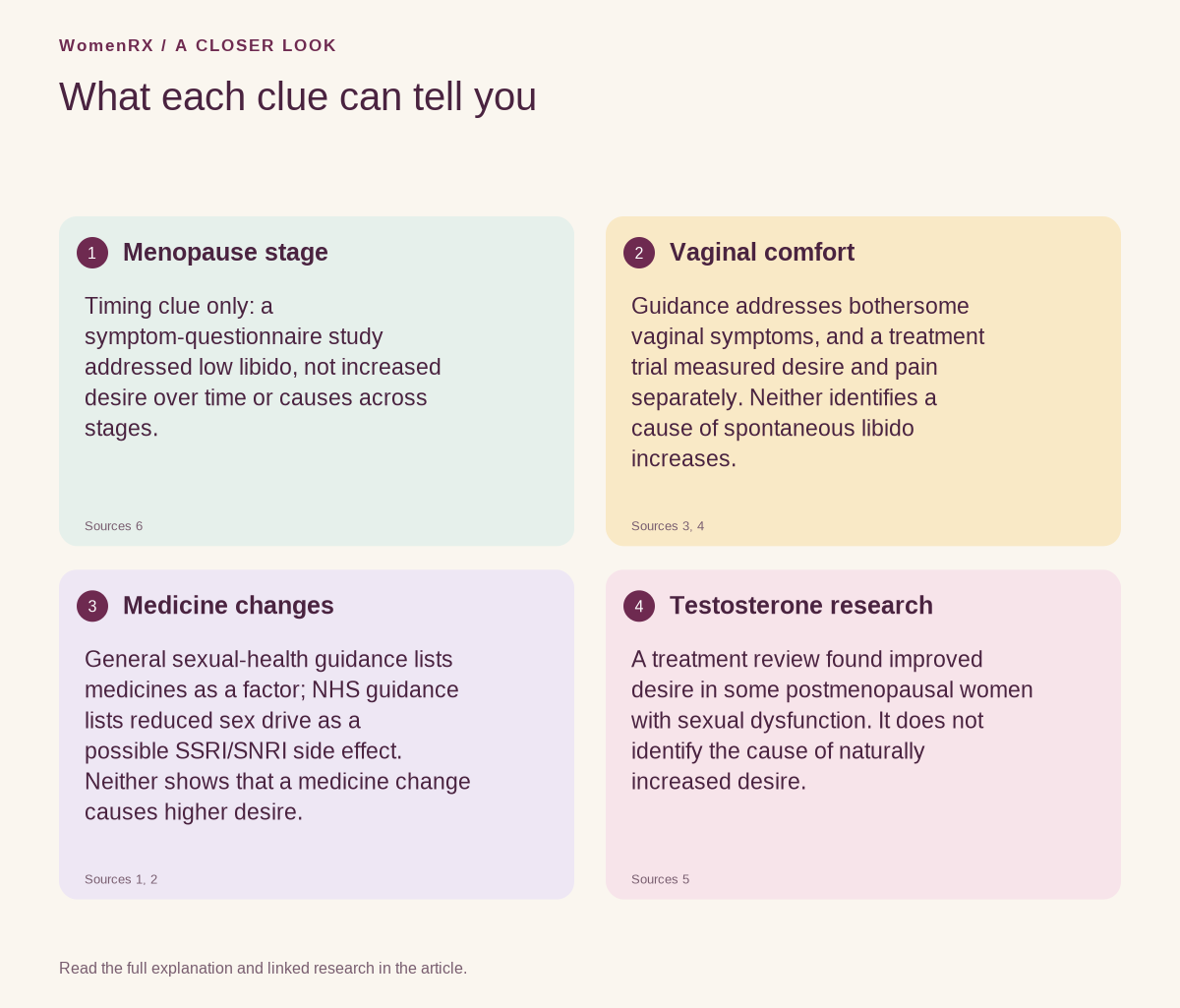
What each clue can tell you
Menopause stage: Timing clue only: a symptom-questionnaire study addressed low libido, not increased desire over time or causes across stages.6
Vaginal comfort: Guidance addresses bothersome vaginal symptoms, and a treatment trial measured desire and pain separately. Neither identifies a cause of spontaneous libido increases.34
Medicine changes: General sexual-health guidance lists medicines as a factor; NHS guidance lists reduced sex drive as a possible SSRI/SNRI side effect. Neither shows that a medicine change causes higher desire.12
Testosterone research: A treatment review found improved desire in some postmenopausal women with sexual dysfunction. It does not identify the cause of naturally increased desire.5
Read the figure as text
These sources offer timing clues, factors affecting sexual health, and studies of low desire or vaginal symptoms. None establishes a cause of naturally increased desire.- Menopause stage: Timing clue only: a symptom-questionnaire study addressed low libido, not increased desire over time or causes across stages.6
- Vaginal comfort: Guidance addresses bothersome vaginal symptoms, and a treatment trial measured desire and pain separately. Neither identifies a cause of spontaneous libido increases.34
- Medicine changes: General sexual-health guidance lists medicines as a factor; NHS guidance lists reduced sex drive as a possible SSRI/SNRI side effect. Neither shows that a medicine change causes higher desire.12
- Testosterone research: A treatment review found improved desire in some postmenopausal women with sexual dysfunction. It does not identify the cause of naturally increased desire.5
More questions, answered
Does a higher libido mean my hormones are out of balance?
No. Desire alone isn’t a hormone test. Research showing that testosterone treatment can improve low desire in some postmenopausal women doesn’t show that naturally higher desire means higher testosterone. 5
Sources you can check
- Sexual Health | MedlinePlusAccessed 2026-09-25Return to first citation
- Other medicines for menopause symptoms - NHSAccessed 2026-09-25Return to first citation
- The 2022 hormone therapy position statement of The North American Menopause Society.“The 2022 Hormone Therapy Position Statement of The North American Menopause Society” Advisory Panel. · Menopause (New York, N.Y.) · 2022Return to first citation
- Efficacy of vaginally applied estrogen, testosterone, or polyacrylic acid on sexual function in postmenopausal women: a randomized controlled trial.Fernandes T, Costa-Paiva LH, Pinto-Neto AM. · The journal of sexual medicine · 2014Return to first citation
- [The Role of Testosterone in The Improvement of Sexual Desire in Postmenopausal Women: An Evidence-Based Clinical Review].Gouveia M, Sanches R, Andrade S, Carmona S, Ferreira C. · Acta medica portuguesa · 2018Return to first citation
- Validation of the Menopause Transition Scale (MTS).Andersen NJ, Parker JL, Pettigrew S, Bitner D. · Menopause (New York, N.Y.) · 2022Return to first citation