Can Inositol Help With Anxiety? What Studies Show
A few small trials tested inositol for anxiety-related conditions, but they haven’t shown a clear benefit, and the findings don’t establish that it works for women.
Inositol has been tested in a small number of randomized trials involving conditions such as panic disorder, obsessive-compulsive disorder, and post-traumatic stress disorder. A meta-analysis found no statistically significant benefit for anxiety symptoms. The research doesn’t establish an effective form or dose for anxiety, and a pregnancy study of myo-inositol combined with other ingredients can’t show whether inositol itself affects anxiety. 3 4 5
What the anxiety trials found
Inositol has been studied directly in a small set of trials for anxiety-related diagnoses, not just discussed as a possible brain mechanism. A 2014 meta-analysis identified four randomized, placebo-controlled trials with 70 participants: two for obsessive-compulsive disorder (OCD), one for panic disorder, and one for post-traumatic stress disorder. Across the studies, inositol did not significantly improve anxiety, obsessive-compulsive, or depressive symptoms compared with placebo. The authors also emphasized that the evidence came from few studies. 4
A later systematic review looked at several supplements and other substances in randomized trials for OCD and related disorders. Three of the included studies tested inositol. Although results pooled across all the different substances showed a borderline difference on anxiety-related scales, no individual substance, including inositol, outperformed placebo on those scales. A result pooled across different treatments can’t be treated as proof that inositol works. 3
Taken together, these findings don’t show that inositol is an effective anxiety treatment. They also don’t prove it can never help anyone; the trials were too limited to answer that confidently.
What the research says about women and forms
The anxiety-trial summaries don’t report enough about participants’ sex to tell whether women were well represented or whether results differed for women. They also don’t specify the inositol form or dose used in those anxiety trials. So this evidence can’t tell you whether myo-inositol or D-chiro-inositol is more useful for anxiety, or what amount might work.
There is one relevant trial in a specifically female context. In the NiPPeR randomized trial, women planning pregnancy took a combination containing myo-inositol, probiotics, and micronutrients, or a standard micronutrient supplement. The researchers found no robust differences in anxiety symptoms during pregnancy or after delivery. Because myo-inositol was combined with other ingredients, and anxiety was a secondary outcome, this trial can’t isolate myo-inositol’s effect or answer whether it treats anxiety on its own. 5
That distinction matters when considering research in PCOS or another hormonal or metabolic condition. A result for a condition-specific outcome doesn’t establish that a supplement treats anxiety. To answer the anxiety question, a study needs to measure anxiety directly and be designed to test the relevant treatment effect.
Don’t confuse a brain measurement with a supplement trial
In a small study of people with depression who hadn’t responded adequately to antidepressants, researchers tested ebselen, a synthetic compound, not an inositol supplement. Ebselen lowered measured inositol in one brain region, but the study found no significant change in anxiety rating scales over seven days. That experiment doesn’t test whether taking inositol helps anxiety; changing a brain measurement with a different substance is not the same as showing a supplement improves symptoms. 2
What to do with this evidence
If you’re considering inositol specifically for anxiety, the most accurate expectation is that benefit hasn’t been established. The available trial summaries also don’t give a reliable anxiety-specific dose or show which form to choose. One older meta-analysis noted a nonsignificant trend toward more gastrointestinal upset with inositol than placebo, but that small evidence base isn’t enough to describe its overall safety confidently. 4
Anxiety that keeps getting in the way of work, sleep, relationships, or everyday activities is worth addressing directly. Established approaches include psychotherapy, such as cognitive behavioral therapy, and medication; the right option depends on the type of anxiety and your circumstances. 1 A supplement shouldn’t be treated as a replacement for care that’s helping, or as a reason to put off getting support.
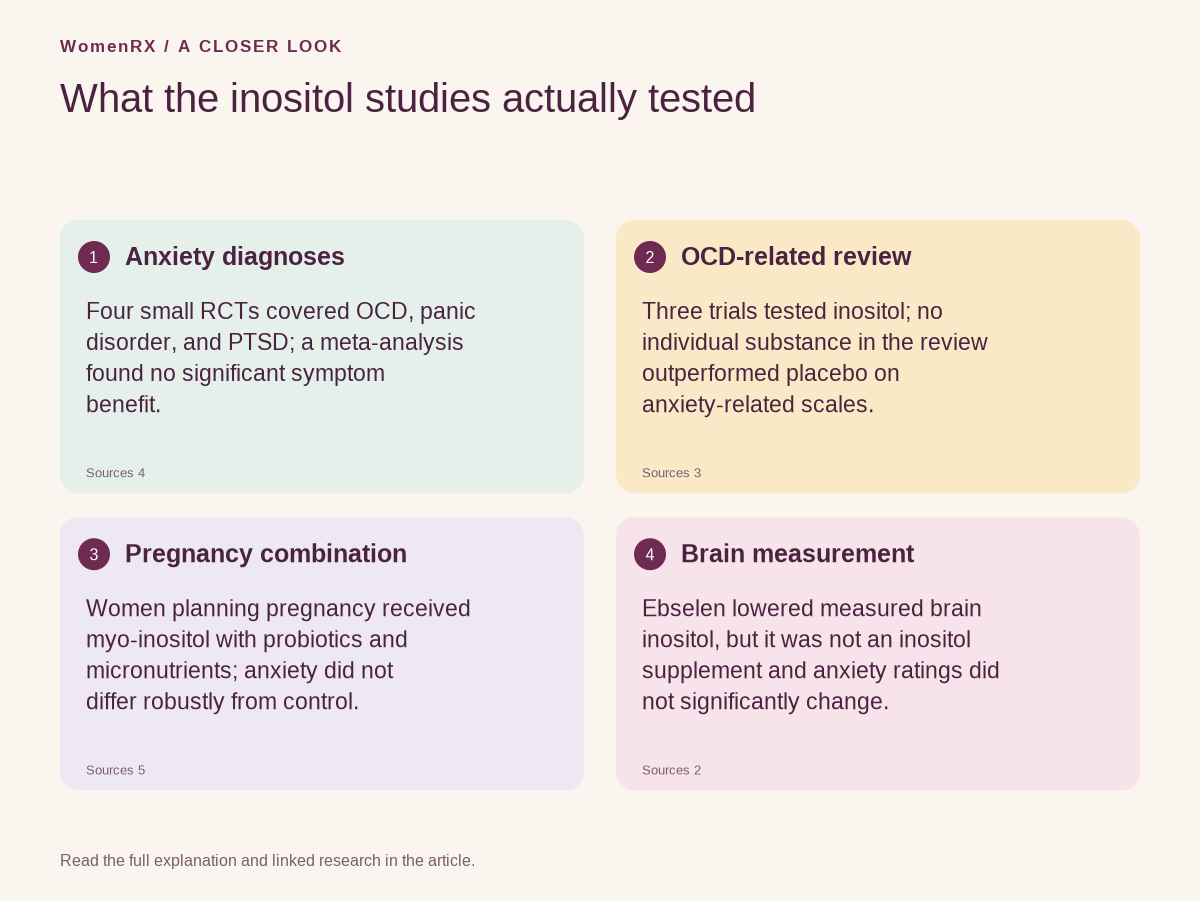
What the inositol studies actually tested
Anxiety diagnoses: Four small RCTs covered OCD, panic disorder, and PTSD; a meta-analysis found no significant symptom benefit.4
OCD-related review: Three trials tested inositol; no individual substance in the review outperformed placebo on anxiety-related scales.3
Pregnancy combination: Women planning pregnancy received myo-inositol with probiotics and micronutrients; anxiety did not differ robustly from control.5
Brain measurement: Ebselen lowered measured brain inositol, but it was not an inositol supplement and anxiety ratings did not significantly change.2
Read the figure as text
These study types answer different questions: some measured anxiety in anxiety-related conditions, while others tested a combination during pregnancy or measured a brain change after a different compound.- Anxiety diagnoses: Four small RCTs covered OCD, panic disorder, and PTSD; a meta-analysis found no significant symptom benefit.4
- OCD-related review: Three trials tested inositol; no individual substance in the review outperformed placebo on anxiety-related scales.3
- Pregnancy combination: Women planning pregnancy received myo-inositol with probiotics and micronutrients; anxiety did not differ robustly from control.5
- Brain measurement: Ebselen lowered measured brain inositol, but it was not an inositol supplement and anxiety ratings did not significantly change.2
More questions, answered
Does research on inositol for PCOS show it helps anxiety?
Not by itself. A study of PCOS or another condition only answers the anxiety question if it measures anxiety in a way that can test whether the treatment changes it. The pregnancy trial that measured anxiety tested a combination containing myo-inositol, not myo-inositol alone. 5
Is myo-inositol or D-chiro-inositol better for anxiety?
The anxiety-trial summaries don’t identify the forms well enough to compare them, and they don’t establish an effective form for anxiety. The pregnancy study used myo-inositol in a multi-ingredient supplement, which doesn’t settle that comparison. 4 5
Sources you can check
- Anxiety: MedlinePlusAccessed 2026-09-25Return to first citation
- Effects of ebselen addition on emotional processing and brain neurochemistry in depressed patients unresponsive to antidepressant medication.Ramli FF, Singh N, Emir UE, Villa LM, Waters S, Harmer CJ, Cowen PJ, Godlewska BR. · Translational psychiatry · 2024Return to first citation
- Mitochondrial modulators for obsessive-compulsive and related disorders: a systematic review and meta-analysis.Kishi T, Sakuma K, Iwata N. · Translational psychiatry · 2022Return to first citation
- A meta-analysis of inositol for depression and anxiety disorders.Mukai T, Kishi T, Matsuda Y, Iwata N. · Human psychopharmacology · 2014Return to first citation
- Maternal mood, anxiety and mental health functioning after combined myo-inositol, probiotics, micronutrient supplementation from preconception: Findings from the NiPPeR RCT.El-Heis S, Barton SJ, Chang HF, Nield H, Cox V, Galani S, Cutfield W, Chan SY, Godfrey KM, NiPPeR Study Group. · Psychiatry research · 2024Return to first citation