Bright Light Therapy for Seasonal Depression: What to Know
Bright light therapy can help seasonal depression, but the device, morning routine, and your mood history all matter.
Bright light therapy is an established treatment for seasonal affective disorder, usually done with a light box in the morning. A commonly described routine uses 10,000 lux for about 30 minutes daily, with the device placed at the specified distance. It doesn’t help everyone. If you have a history of bipolar disorder or are pregnant or postpartum, discuss a plan with your care team before starting. 135
Seasonal affective disorder (SAD) is depression that comes and goes with the seasons, most often starting in late fall or winter and easing in spring or summer. Bright light therapy is a well-supported treatment for that pattern. If low mood or loss of interest is making sleep, work, or other daily activities difficult, it’s worth getting help rather than assuming a light box will answer the whole problem. 123
Why the morning setup matters
Bright light therapy exposes your eyes to bright visible light on a regular schedule. Light helps set the body’s daily sleep-wake rhythm, one reason timing matters to the treatment. A commonly described SAD routine involves sitting near a light box in the morning, with 10,000 lux for about 30 minutes of daily exposure. You don’t need to stare directly at it. 1356
The number on the box doesn’t tell you the whole setup. Light intensity at your position depends on distance, and treatment protocols also differ in duration and timing. Before buying or using a device, check whether its instructions state the distance at which it delivers its advertised lux rating and how it should be positioned. The common routine is a reference point, not a reason to assume that any distance or time of day will have the same effect. 35
A SAD light box is not just a bright lamp
Look for a device intended to provide bright visible light for SAD, with clear intensity and positioning information. Red-light treatments aimed at tissues and ultraviolet treatments used for skin conditions are different kinds of light therapy; their evidence cannot be substituted for the evidence on SAD light boxes. 4
What about lighting up the whole room instead? In a small proof-of-concept randomized trial, people with SAD used either a very brightly illuminated room at home for at least six hours a day or a standard 10,000-lux light box for 30 minutes. Symptoms improved similarly in the two groups over four weeks. That finding makes room-based treatment worth studying, but it doesn’t show that ordinary household lighting is equivalent to a treatment device. 7
Know which changes deserve a conversation first
Headache, nausea, dizziness, tired eyes, insomnia, and waking earlier than intended are reported side effects of bright light therapy. If your sleep or comfort worsens, tell the clinician helping with your depression rather than treating the change as something you must push through. 6
A history of bipolar disorder calls for a plan before starting. Bright light therapy has been studied for bipolar depression, but treatment protocols include monitoring for a switch toward an elevated mood. New irritability, a markedly reduced need for sleep, or unusually rapid speech are warning signs to raise promptly with your treating clinician. The morning routine commonly described for SAD should not be assumed to be the right bipolar-depression protocol. 5
Pregnancy or postpartum depression also merits an individual treatment discussion. Small trials of bright light therapy in pregnant or postpartum women have had mixed findings, with possible symptom improvement. That doesn’t establish it as a replacement for other depression care during either period. 3
Fit it into the care you already have
Some people with SAD don’t improve with light therapy alone. Antidepressant medication and talk therapy can help on their own or alongside light therapy, so starting a light box needn’t mean abandoning a treatment that’s helping. If you take an antidepressant, discuss how to add light therapy without stopping or changing your medication on your own. 12
Give the plan a clear goal: improvement in the seasonal symptoms and daily activities that brought you to treatment. If those symptoms persist or worsen, revisit the diagnosis and treatment approach. Bright light therapy has also been studied for nonseasonal depression, but SAD has the strongest evidence; a winter pattern and depression that continues across seasons may call for different decisions. 123
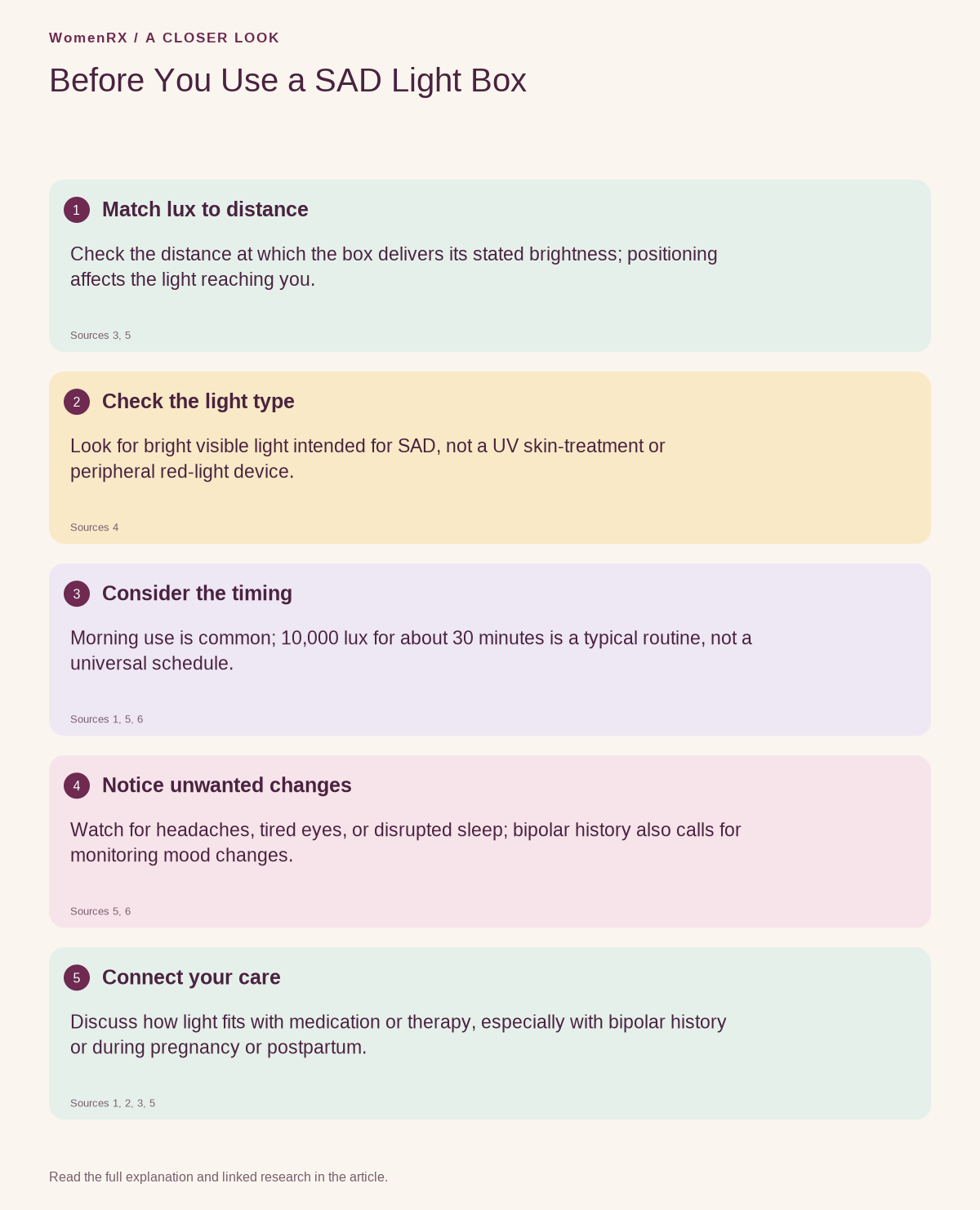
Before You Use a SAD Light Box
Match lux to distance: Check the distance at which the box delivers its stated brightness; positioning affects the light reaching you.35
Check the light type: Look for bright visible light intended for SAD, not a UV skin-treatment or peripheral red-light device.4
Consider the timing: Morning use is common; 10,000 lux for about 30 minutes is a typical routine, not a universal schedule.156
Notice unwanted changes: Watch for headaches, tired eyes, or disrupted sleep; bipolar history also calls for monitoring mood changes.56
Connect your care: Discuss how light fits with medication or therapy, especially with bipolar history or during pregnancy or postpartum.1235
Read the figure as text
Five checks that connect the device and routine to your treatment plan.- Match lux to distance: Check the distance at which the box delivers its stated brightness; positioning affects the light reaching you.35
- Check the light type: Look for bright visible light intended for SAD, not a UV skin-treatment or peripheral red-light device.4
- Consider the timing: Morning use is common; 10,000 lux for about 30 minutes is a typical routine, not a universal schedule.156
- Notice unwanted changes: Watch for headaches, tired eyes, or disrupted sleep; bipolar history also calls for monitoring mood changes.56
- Connect your care: Discuss how light fits with medication or therapy, especially with bipolar history or during pregnancy or postpartum.1235
Sources you can check
- Seasonal Affective Disorder: MedlinePlusAccessed 2026-09-25Return to first citation
- Depression: MedlinePlusAccessed 2026-09-25Return to first citation
- Bright Light Therapy in Psychiatric Disorders: Mechanisms, Clinical Procedures and Evidence.Pardossi S, Bossini L, Milani V, Rescalli MB, Cuomo A. · Life (Basel, Switzerland) · 2026Return to first citation
- Light therapy in medicine: where do we stand?Oyama Y, Witowski A, Adamzik M, Bartels K, de la Garza Eckle T. · Annals of translational medicine · 2026Return to first citation
- Therapeutic prospects of bright light therapy in addictive disorders: a scoping review.Rolland B, Salihi I, Mauries S, Medigue I, Catoire S, Peter-Derex L, Geoffroy PA. · Journal of neural transmission (Vienna, Austria : 1996) · 2026Return to first citation
- Role of Sleep in Depressive Disorders and the Potential Therapeutic Role of Short-Term Sleep Deprivation and Light Therapy: A Review.Bojarska W, Bury K, Januszczak R, Burda B, Pawęzka J. · Medical science monitor : international medical journal of experimental and clinical research · 2024Return to first citation
- 100,000 lumens to treat seasonal affective disorder: A proof of concept RCT of Bright, whole-ROom, All-Day (BROAD) light therapy.Sandkühler JF, Brochhagen S, Rohde P, Muscheidt RC, Grömer TW, Müller H, Brauner JM. · Depression and anxiety · 2022Return to first citation