Bloating After Meals: Which Food Changes Are Worth Testing?
A brief food-and-symptom record can help you test one likely trigger without cutting out whole food groups or overlooking other causes.
Start by looking for repeatable patterns, not by removing lots of foods. Record what and roughly how much you ate, when bloating began, bowel changes, and whether it clustered around your period. Try one modest change at a time, such as reducing fizzy drinks or very large meals. If symptoms persist, or you have concerning symptoms, get assessed rather than extending food restrictions. A guided low-FODMAP trial may be an option for some people with IBS. 1 4
Look for a pattern before changing your diet
Bloating can follow a meal for more than one reason. Gas may build up from certain foods or drinks, and swallowing air while eating can contribute too. Some people also notice bloating around their period. A single uncomfortable meal doesn’t tell you which explanation applies. 1
For a short, manageable stretch, jot down the meal and approximate portion, when bloating started, any bowel changes, and whether you were near your period. Keep the record simple: you’re looking for a pattern that repeats, not trying to monitor every bite. For example, if bloating often follows fizzy drinks but not other meals, testing fewer fizzy drinks is more informative than avoiding several food groups at once.
Change one thing at a time. You might try smaller meals if large ones seem to be a pattern, or slow down and chew with your mouth closed if you tend to eat quickly. These are practical starting points, not proof that a particular food is the cause. 1
When a low-FODMAP trial might fit
FODMAPs are types of short-chain carbohydrates that can be poorly absorbed and fermented in the gut. That process can contribute to gas and symptoms for some people with irritable bowel syndrome (IBS), but the diet is not a general-purpose bloating cure. 2
A low-FODMAP approach may be worth discussing when bloating occurs as part of ongoing IBS symptoms, particularly abdominal pain and changes in bowel habits. In a randomized trial of 65 adults with diarrhea-predominant IBS, both the low-FODMAP diet and rifaximin were associated with improvements in abdominal pain and bloating over five weeks. The trial did not show that the diet works for everyone or that it treats unexplained bloating. 4
The approach is usually structured rather than a permanent list of forbidden foods: a limited restriction phase is followed by reintroducing foods to see what you tolerate and making the plan more individual. A study of people who had previously tried the diet found that fewer than half completed it, and the researchers described it as difficult for many participants to follow. That’s one reason to seek guidance from a registered dietitian or clinician familiar with the approach, rather than continuing broad restrictions on your own. 3
If you try it, agree on what improvement you’re looking for and when you’ll review the result. If symptoms don’t improve, that’s a reason to reconsider the approach, not to keep narrowing your diet. The goal is to find the least restrictive way to eat comfortably, not to avoid as many foods as possible.
Period-related bloating is one clue, not a diagnosis
Bloating can vary around menstruation, so noting the timing may help you see whether symptoms follow a cycle-related pattern. It doesn’t establish that food is responsible. Persistent or recurring bloating can have causes beyond diet. Endometriosis, for example, can involve gastrointestinal symptoms such as bloating and changes in bowel habits, but evidence for low-FODMAP treatment specifically in women with endometriosis remains limited. 1 5
If bloating keeps returning or does not go away, arrange a medical assessment instead of repeatedly adding foods to your avoid list. Seek assessment especially if it comes with unintentional weight loss or blood in your stool. Sudden severe abdominal pain or vomiting blood calls for urgent medical care. 1
A useful next step
Bring your short record to a medical visit if symptoms persist. The most useful details are often the pattern: whether bloating follows particular meals, comes with abdominal pain or bowel changes, or clusters around your period. That gives you a better starting point for deciding whether a focused food test makes sense or whether to look beyond diet.
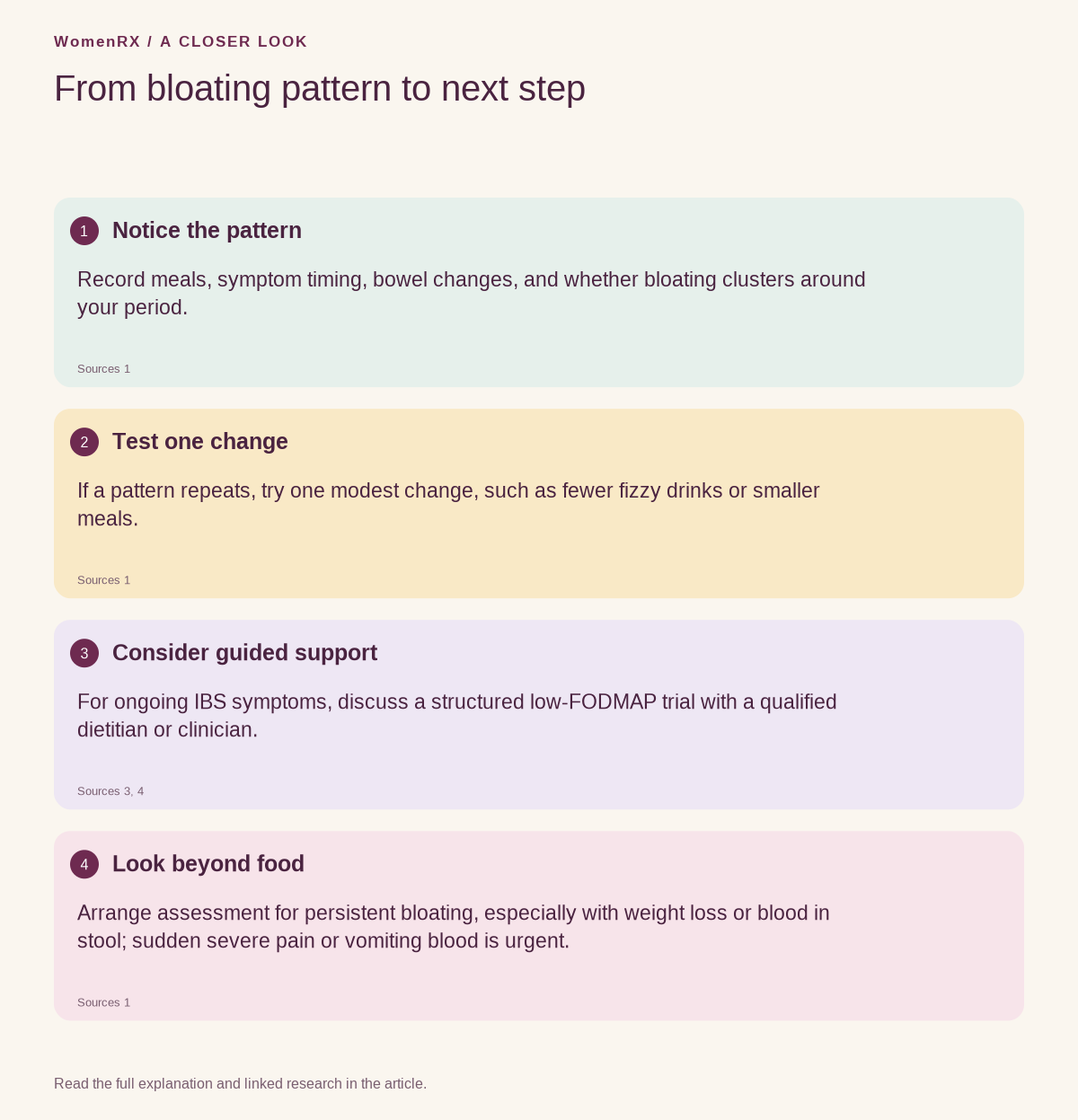
From bloating pattern to next step
Notice the pattern: Record meals, symptom timing, bowel changes, and whether bloating clusters around your period.1
Test one change: If a pattern repeats, try one modest change, such as fewer fizzy drinks or smaller meals.1
Consider guided support: For ongoing IBS symptoms, discuss a structured low-FODMAP trial with a qualified dietitian or clinician.34
Look beyond food: Arrange assessment for persistent bloating, especially with weight loss or blood in stool; sudden severe pain or vomiting blood is urgent.1
Read the figure as text
Use the pattern and accompanying symptoms to choose a proportionate next step, rather than starting with a long avoid-food list.- Notice the pattern: Record meals, symptom timing, bowel changes, and whether bloating clusters around your period.1
- Test one change: If a pattern repeats, try one modest change, such as fewer fizzy drinks or smaller meals.1
- Consider guided support: For ongoing IBS symptoms, discuss a structured low-FODMAP trial with a qualified dietitian or clinician.34
- Look beyond food: Arrange assessment for persistent bloating, especially with weight loss or blood in stool; sudden severe pain or vomiting blood is urgent.1
More questions, answered
Does bloating by itself mean I have IBS?
No. Bloating can happen for several reasons. IBS involves a broader pattern that can include abdominal pain and changes in bowel habits, so bloating alone cannot establish the cause. 1 2
Sources you can check
- Bloating - NHSAccessed 2026-09-25Return to first citation
- Effect of combined continuity care guided by Orem's self-care model and low FODMAP diet on gut microbiota composition and symptoms in patients with irritable bowel syndrome.Zhao Y, Zhang Y, Gao Z, Yuan X, Li X. · BMC gastroenterology · 2026Return to first citation
- Effectiveness of the low FODMAP diet in patients with irritable bowel syndrome and small intestine bacterial overgrowth syndrome.Bogdanowska-Charkiewicz D, Górski P, Jurkowska G, Środa R, Świdnicka-Siergiejko A, Dąbrowski A, Daniluk J. · Frontiers in nutrition · 2026Return to first citation
- A Randomized Trial of Rifaximin vs Low Fermentable Oligosaccharides, Disaccharides, Monosaccharides, and Polyols Diet for Symptom Outcomes and Microbiome Changes in Irritable Bowel Syndrome.Lee AA, Rao K, Singh P, Fehlman J, Gao J, Takakura W, Lynett A, Haller E, Ball S, Marand A, Liu A, Shah E, Menees S, Punglia R, Nojkov B, Eswaran S, Baker J, Chey WD, Owyang C, You... · Clinical gastroenterology and hepatology : the official clinical practice journal of the American Gastroenterological Association · 2026Return to first citation
- Low-FODMAP Diet for Gastrointestinal Symptoms in Endometriosis: A Systematic Review.Watrowski R, Kostov S, Schäfer SD, Juhasz-Böss I, Palumbo M, Sparić R, Mereu L, Vitale SG, Alkatout I. · Nutrients · 2026Return to first citation