Black Cohosh for Menopause: Does Timing Matter?
Black cohosh has been studied for hot flashes over weeks, but research hasn’t established a best time of day to take it.
There’s no established morning-versus-evening advantage for black cohosh. A trial assessed hot flashes after four and eight weeks of daily use, not at different times of day. Some research reports benefit, especially with a particular extract, but a North American Menopause Society statement recommends against herbal remedies for hot flashes. The preparation and your safety questions matter more than the hour on the clock. 7 6 5
Timing: what the studies actually tested
If hot flashes wake you at night, taking black cohosh at bedtime might sound more targeted than taking it in the morning. But studies of black cohosh haven’t established that one time of day works better. In a placebo-controlled trial of 84 postmenopausal women, participants took one black cohosh tablet or placebo tablet daily for eight weeks. Researchers assessed hot-flash number and symptom severity at four and eight weeks. They did not compare morning with evening use. 7
That trial shows the difference between a daily study schedule and a best time of day. It also doesn’t tell you whether taking black cohosh only when a hot flash starts would help. If you’re comparing products, the preparation and the symptom you hope to relieve are more useful questions than whether the label says morning or night.
Hot flashes have the clearest research focus
Black cohosh research has focused largely on vasomotor symptoms, including hot flashes. The eight-week trial found differences between the black cohosh and placebo groups in hot-flash number and severity at its four- and eight-week assessments. A Spanish Menopause Society statement also reported reductions in hot flashes, particularly among women with intense symptoms, in studies largely involving an isopropanolic extract of black cohosh. It reported mood improvement as well, but a finding about mood does not establish that black cohosh alone will reliably treat every menopause symptom. 7 6
The broader assessments differ. A 2023 North American Menopause Society position statement does not recommend supplements or herbal remedies for vasomotor symptoms. A 2026 systematic review, meanwhile, rated the evidence for black cohosh on vasomotor or menopausal symptoms as moderate certainty, while concluding that evidence for complementary therapies overall remains limited. These conclusions shouldn’t be flattened into either “it works” or “it never works.” They do mean you shouldn’t count on a predictable result from any product labeled black cohosh. 5 8
The extract matters more than the clock
“Black cohosh” on a package isn’t a guarantee that it matches a product used in a study. Much of the research highlighted by the Spanish Menopause Society involved an isopropanolic extract. Supplements can differ in their ingredients and amounts, so results for one preparation may not apply to another. Independent quality verification can help check a product’s contents, but it does not establish that the product is effective or safe. 6 1
The distinction is even sharper with a blend. In one 12-week placebo-controlled trial, a product containing black cohosh alongside soy isoflavone, chasteberry, and evening primrose oil improved several reported symptoms in postmenopausal women. Because the ingredients were given together, the trial cannot show which ingredient accounted for the difference. If you’re weighing a specific product, check whether it names the extract and whether it contains other active ingredients before applying a study result to it. 3
Put liver safety and other options in the same conversation
Side effects reported with black cohosh include nausea, dizziness, headache, and rash; rare hepatitis and allergic reactions have also been reported. A report does not establish that black cohosh caused every individual case. Conversely, a review that found no liver toxicity in studies of a particular extract cannot prove every black cohosh product is liver-safe. If you have liver disease or take other medicines or supplements, raise those details before deciding whether to use it. 1 2
If hot flashes are disrupting sleep or daily life, you have options with stronger treatment guidance than changing the time you take a supplement. Menopause hormone therapy is the most effective treatment for vasomotor symptoms, though its benefits and risks depend on factors including age, time since menopause, health history, and the treatment used. The North American Menopause Society also recommends several nonhormonal approaches, including cognitive-behavioral therapy and certain prescription medicines. A conversation about which options fit you can be more productive than trying to find a perfect hour for black cohosh. 4 5
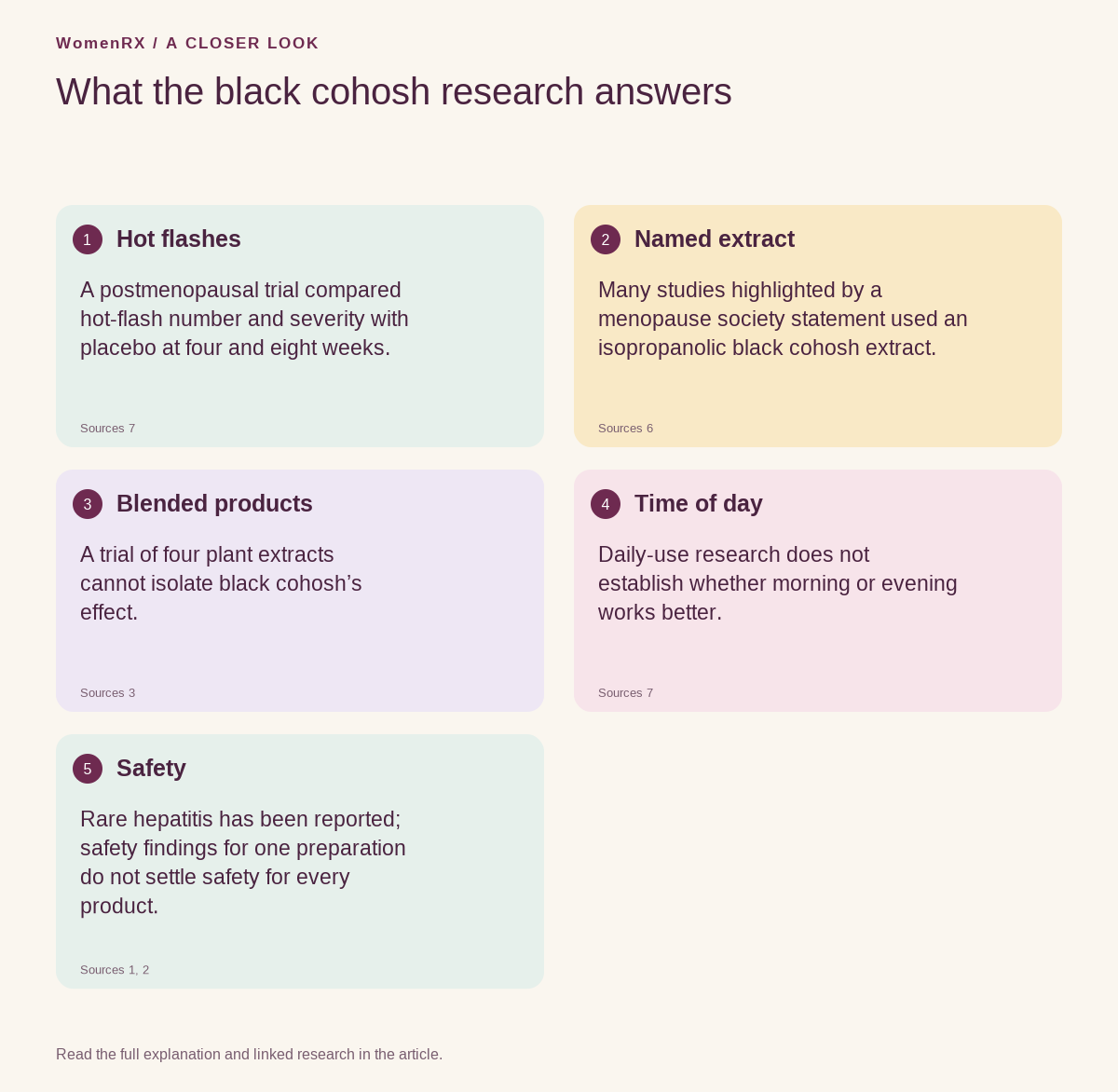
What the black cohosh research answers
Hot flashes: A postmenopausal trial compared hot-flash number and severity with placebo at four and eight weeks.7
Named extract: Many studies highlighted by a menopause society statement used an isopropanolic black cohosh extract.6
Blended products: A trial of four plant extracts cannot isolate black cohosh’s effect.3
Time of day: Daily-use research does not establish whether morning or evening works better.7
Safety: Rare hepatitis has been reported; safety findings for one preparation do not settle safety for every product.12
Read the figure as text
A quick guide to the questions studies have examined, and the timing question they leave open.- Hot flashes: A postmenopausal trial compared hot-flash number and severity with placebo at four and eight weeks.7
- Named extract: Many studies highlighted by a menopause society statement used an isopropanolic black cohosh extract.6
- Blended products: A trial of four plant extracts cannot isolate black cohosh’s effect.3
- Time of day: Daily-use research does not establish whether morning or evening works better.7
- Safety: Rare hepatitis has been reported; safety findings for one preparation do not settle safety for every product.12
More questions, answered
How soon have studies checked for a change in hot flashes?
One placebo-controlled trial in postmenopausal women assessed hot flashes after four and eight weeks of daily use. Those are research assessment points, not a promise that a different product will work within that period. 7 1
Does a study of a black cohosh blend show that black cohosh works?
Not on its own. A trial of a product containing black cohosh plus three other plant extracts found symptom improvements compared with placebo, but it cannot separate black cohosh’s contribution from the other ingredients. 3
Sources you can check
- Black Cohosh2006Return to first citation
- Herbal Products Used in Menopause and for Gynecological Disorders.Kenda M, Glavač NK, Nagy M, Sollner Dolenc M, On Behalf Of The Oemonom. · Molecules (Basel, Switzerland) · 2021Return to first citation
- Efficacy and Safety of Nutraceutical on Menopausal Symptoms in Post-Menopausal Women: A Randomized, Double-Blind, Placebo-Controlled Clinical Trial.Rattanatantikul T, Maiprasert M, Sugkraroek P, Bumrungpert A. · Journal of dietary supplements · 2022Return to first citation
- The 2022 hormone therapy position statement of The North American Menopause Society.“The 2022 Hormone Therapy Position Statement of The North American Menopause Society” Advisory Panel. · Menopause (New York, N.Y.) · 2022Return to first citation
- The 2023 nonhormone therapy position statement of The North American Menopause Society.Menopause (New York, N.Y.) · 2023Return to first citation
- Black cohosh efficacy and safety for menopausal symptoms. The Spanish Menopause Society statement.Castelo-Branco C, Navarro C, Beltrán E, Losa F, Camacho M, on the behalf of the Natural Products Study Group of the Spanish Menopause Society. · Gynecological endocrinology : the official journal of the International Society of Gynecological Endocrinology · 2022Return to first citation
- Effect of black cohosh (cimicifuga racemosa) on vasomotor symptoms in postmenopausal women: a randomized clinical trial.Shahnazi M, Nahaee J, Mohammad-Alizadeh-Charandabi S, Bayatipayan S. · Journal of caring sciences · 2013Return to first citation
- Complementary therapies for management of menopausal symptoms: a systematic review to inform the update of the International Menopause Society recommendations on women's midlife health.Maunder A, Mardon AK, Rao V, Torkel S, Metri NJ, Liu J, Yang G, Giese N, Mantzioris E, Abdul Jafar NK, Rodrigues de Souza GE, Al-Kanini I, Romero L, Panay N, Pedder H, Ee C. · Climacteric : the journal of the International Menopause Society · 2026Return to first citation