Bipolar Disorder: Recognizing Episodes and Finding Support
The useful clue is a distinct change in mood, energy, and activity that lasts and stands apart from your usual pattern.
Bipolar disorder involves episodes of mania or hypomania, which may occur alongside depression. A shift in mood alone isn’t enough to identify it: duration, changes in energy and activity, and effects on daily life all matter. Notes about those changes can help you describe the pattern during an assessment, but a mood chart cannot make the diagnosis. 1
What makes a change worth a closer look?
Everyone has moods that shift with a hard week, good news, or too little rest. Bipolar disorder involves distinct mood episodes that also change energy, behavior, and activity. An elevated episode may not feel like a problem from the inside. During hypomania, for example, someone may feel unusually good and productive while people close to them notice that their activity is unlike their usual pattern. 1
Time and severity help distinguish the types of episodes. In bipolar I, a manic episode lasts at least seven days, unless symptoms are severe enough to require immediate hospital care. Depressive episodes are also common and often last at least two weeks. Bipolar II involves depressive episodes and hypomania rather than full mania. Those descriptions explain why a brief mood swing, by itself, cannot tell you whether you have bipolar disorder. 1
Think about the whole stretch of time, not just its strongest moment. For example, if you’re trying to describe a period when you felt unusually energetic, it helps to know when it began, how your sleep and activity compared with normal, whether anyone else noticed a change, and what happened afterward. These are details to discuss, not boxes that add up to a diagnosis.
Write down observations, not labels
A short record can make a complicated pattern easier to explain. Note when a distinct change starts and ends; what happens to your mood, energy, sleep, and activity; and whether work, relationships, or daily responsibilities change. Include low periods as well as high-energy ones. If someone you trust noticed something you missed, you can ask what they observed. MedlinePlus includes mood journaling among tools that may help people manage symptoms, but a journal is not a diagnostic test. 1
Specific observations are more useful than a guess about what an episode was. For example: “For several days, I took on far more projects than usual, and my partner noticed I was acting differently” gives an assessor more to work with than “I was manic.” You don’t need a perfect record before seeking help.
What an assessment and treatment discussion can cover
Bring up both elevated and depressed periods, even if depression is what first prompted you to seek care. The distinction matters because bipolar I and bipolar II are described by different kinds of elevated episodes, while depression may occur in either. An assessment can look at the timing and effects of your symptoms and consider other possible explanations. For depression-like symptoms, medical conditions and some medicines can also be relevant. 1 2
Treatment for bipolar disorder may involve medication, psychotherapy, or both. Medication choices sometimes take adjustment, while psychotherapy can offer skills and support for you and your family. If you already take a prescribed medicine, raise side effects or concerns with your prescriber rather than stopping it on your own. 1
It’s reasonable to say what you most want treatment to improve. In a small Norwegian study of 22 outpatients with bipolar disorder, participants differed in how they valued outcomes such as avoiding severe depression or mania, quality of life, and work or social functioning. That study cannot set anyone else’s priorities, but it makes a useful point: fewer episodes and a life that works for you are both worth discussing. 5
Where menstrual cycles, pregnancy, and postpartum fit
If changes seem to occur around your period, record both the timing and what actually changes. Cycle timing is context, not a defining feature of bipolar disorder; the question remains whether there have been characteristic mood episodes. 1
Pregnancy and the months after birth deserve a more deliberate treatment conversation. A review of reports on medication to prevent bipolar episodes during pregnancy and postpartum included 256 patients taking several different medicines. Those limited, varied reports do not establish which treatment is safest or most effective for an individual pregnancy. If you’re planning a pregnancy, pregnant, or recently gave birth, discuss your episode history and current treatment before making medication changes. 6 1
Postpartum changes also deserve timely attention. In a population-based Danish study, first bipolar diagnoses were less frequent across the entire perinatal period among mothers than in a matched female comparison group. Within the pregnancy-to-postpartum pattern, hospital admissions for bipolar disorder were rare during pregnancy, then rose sharply after delivery and peaked in the first postpartum month. These are population findings, not a prediction of what will happen to you. 7
If you’re having thoughts of suicide or cannot keep yourself safe, seek urgent help now. Manic symptoms severe enough to require hospital care also need immediate attention. 1 2
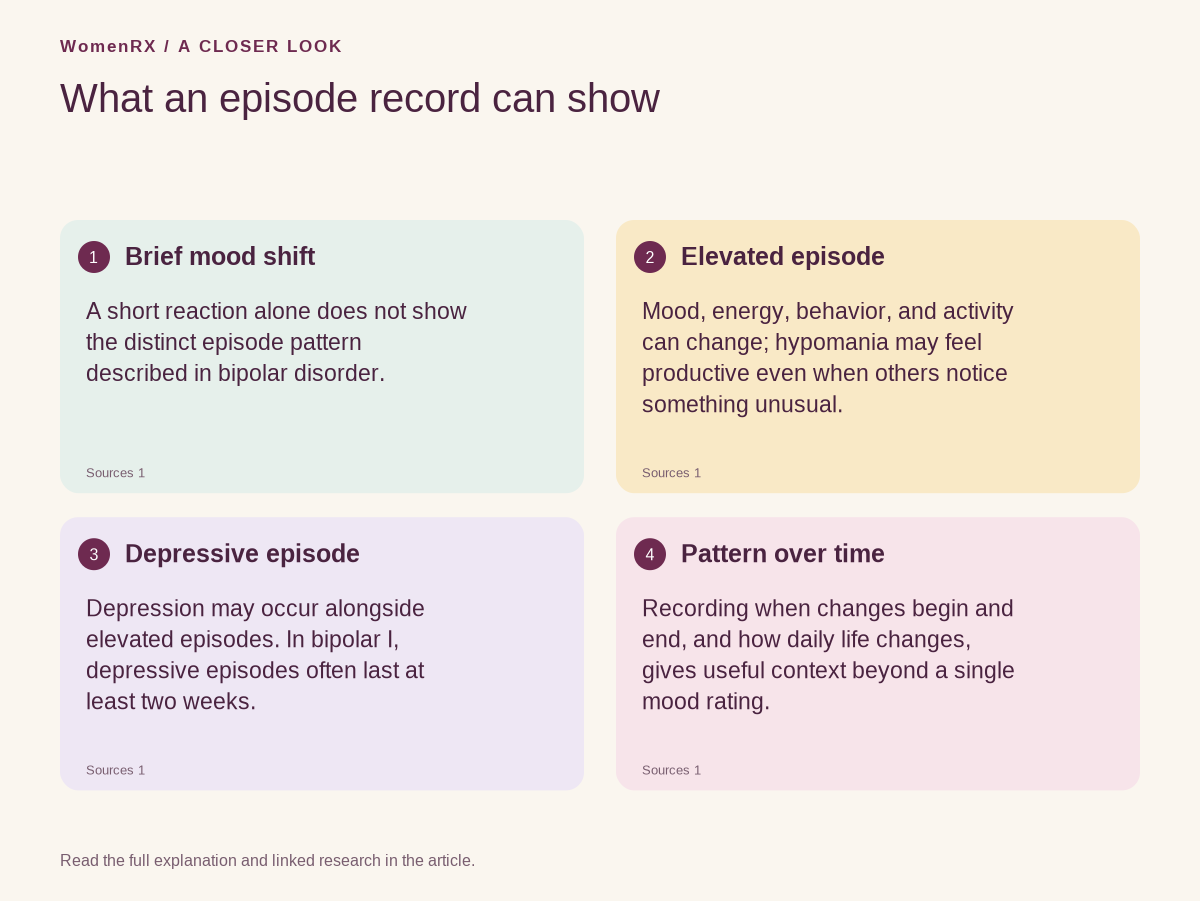
What an episode record can show
Brief mood shift: A short reaction alone does not show the distinct episode pattern described in bipolar disorder.1
Elevated episode: Mood, energy, behavior, and activity can change; hypomania may feel productive even when others notice something unusual.1
Depressive episode: Depression may occur alongside elevated episodes. In bipolar I, depressive episodes often last at least two weeks.1
Pattern over time: Recording when changes begin and end, and how daily life changes, gives useful context beyond a single mood rating.1
Read the figure as text
These distinctions help explain a pattern to an assessor. They do not form a diagnostic score.- Brief mood shift: A short reaction alone does not show the distinct episode pattern described in bipolar disorder.1
- Elevated episode: Mood, energy, behavior, and activity can change; hypomania may feel productive even when others notice something unusual.1
- Depressive episode: Depression may occur alongside elevated episodes. In bipolar I, depressive episodes often last at least two weeks.1
- Pattern over time: Recording when changes begin and end, and how daily life changes, gives useful context beyond a single mood rating.1
More questions, answered
Can a mood chart diagnose bipolar disorder?
No. It can help you describe when changes began, how long they lasted, and what else changed in your life. MedlinePlus describes mood journaling as a tool that may help with symptoms, not as a way to make a diagnosis. 1
Why might lithium come up in a treatment discussion?
Lithium is a mood stabilizer used for bipolar disorder. It requires regular blood tests to check the amount in your blood, so monitoring is part of the decision alongside potential benefits and side effects. 3 4
Sources you can check
- Bipolar Disorder: MedlinePlusAccessed 2026-09-25Return to first citation
- Depression: MedlinePlusAccessed 2026-09-25Return to first citation
- About lithium - NHSAccessed 2026-09-25Return to first citation
- Side effects of lithium - NHSAccessed 2026-09-25Return to first citation
- Patient-Important Outcomes in the Long-Term Treatment of Bipolar Disorder: A Mixed-Methods Approach Investigating Relative Preferences and a Proposed Taxonomy.Eiring Ø, Nylenna M, Nytrøen K. · The patient · 2016Return to first citation
- Pharmacological prevention of mood episodes in women with bipolar disorder during the perinatal period: A systematic review of current literature.Uguz F. · Asian journal of psychiatry · 2020Return to first citation
- Bipolar Disorder Incidence During Pregnancy and in the Postpartum Period: A Population-Based Study.Bergink V, Mægbæk ML, Blæhr EE, Liu X, Munk-Olsen T. · Bipolar disorders · 2026Return to first citation