Betaine HCl: With Meals, in the Morning, or at Night?
Research has examined betaine HCl after food, but it hasn’t established a morning-or-night schedule or shown that meal timing makes the supplement right for you.
There isn’t a research-backed morning-versus-night rule in the human study: it examined stomach pH after food, not time of day. Follow the directions on your specific product for its use, but don’t treat those directions as proof of benefit or safety. The study was small and doesn’t establish a women-specific schedule or use in pregnancy or breastfeeding. 1
What the timing study actually tested
A small, open-label crossover study in nine people looked at how food affected stomach acidity and whether betaine hydrochloride (HCl) could bring stomach pH back toward its baseline after a meal. It tested betaine HCl in capsules after food; it did not compare morning with evening, or test whether taking the supplement improves digestion or symptoms. 1
Without acid supplementation, stomach pH returned to baseline about 49.7 minutes after food, on average. In this study, 4,500 mg of betaine HCl brought it back in about 17.3 minutes. Those measurements describe stomach pH in this particular experiment. They are not evidence that the supplement helps you feel better, and the study’s dose is not a personal dosing recommendation. 1
Meal timing isn’t a morning-or-night rule
The research gives a limited reason to distinguish after food from time of day: food was part of the experiment, while morning and bedtime were not compared. It can’t tell you that breakfast is better than dinner, that bedtime is useful, or that one schedule works for women generally. The study doesn’t establish a women-specific schedule or answer questions about use during pregnancy or breastfeeding. 1
If you have a bottle, its directions tell you how that particular product is labeled for use. That’s different from research showing that a timing schedule works or is safe for you. Don’t assume that taking betaine HCl with food makes it appropriate for everyone, or change the label directions based on a study measuring stomach pH.
Don’t use timing to manage a medication
A separate study looked at betaine HCl in a specific medication context: healthy volunteers took the HIV medicine atazanavir with a light meal after taking the acid-reducing drug rabeprazole. Adding betaine HCl restored only part of the medication exposure that rabeprazole had reduced, and the researchers concluded it wasn’t enough to overcome that effect. This does not establish how betaine HCl interacts with your medicines generally, but it does show why supplement timing shouldn’t be used as a workaround for a medication interaction. 2
If you’re considering betaine HCl because of a symptom, a suspected stomach-acid problem, or a medicine you take, the timing study can’t determine whether the supplement is suitable for that reason. Ask a pharmacist or prescriber about the specific product and medicines involved rather than trying morning, bedtime, or meal timing as a substitute for that answer.
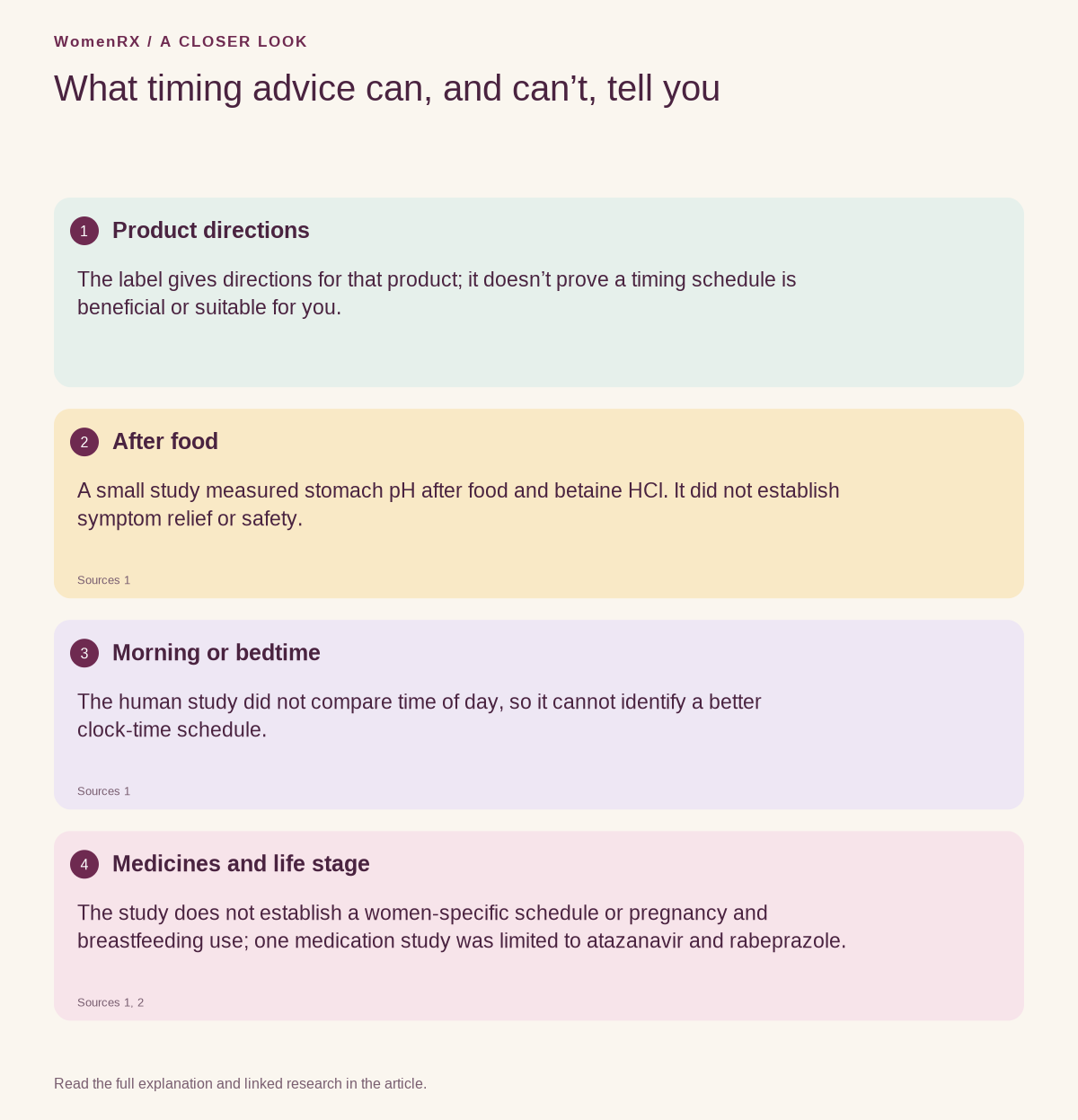
What timing advice can, and can’t, tell you
Product directions: The label gives directions for that product; it doesn’t prove a timing schedule is beneficial or suitable for you.
After food: A small study measured stomach pH after food and betaine HCl. It did not establish symptom relief or safety.1
Morning or bedtime: The human study did not compare time of day, so it cannot identify a better clock-time schedule.1
Medicines and life stage: The study does not establish a women-specific schedule or pregnancy and breastfeeding use; one medication study was limited to atazanavir and rabeprazole.12
Read the figure as text
Use these distinctions to separate the study’s meal-related pH finding from product directions and untested time-of-day claims.- Product directions: The label gives directions for that product; it doesn’t prove a timing schedule is beneficial or suitable for you.
- After food: A small study measured stomach pH after food and betaine HCl. It did not establish symptom relief or safety.1
- Morning or bedtime: The human study did not compare time of day, so it cannot identify a better clock-time schedule.1
- Medicines and life stage: The study does not establish a women-specific schedule or pregnancy and breastfeeding use; one medication study was limited to atazanavir and rabeprazole.12
More questions, answered
Does taking betaine HCl with food mean it’s safer?
The study examined stomach pH after food; it did not establish that taking betaine HCl with a meal prevents side effects or makes it safe for a particular person. 1
Did research compare taking it in the morning with taking it at bedtime?
This human study examined stomach pH after food, not morning-versus-night use. It can’t establish that either time of day is better. 1
Sources you can check
- Food, Acid Supplementation and Drug Absorption - a Complicated Gastric Mix: a Randomized Control Trial.Surofchy DD, Frassetto LA, Benet LZ. · Pharmaceutical research · 2019Return to first citation
- Meal Effects Confound Attempts to Counteract Rabeprazole-Induced Hypochlorhydria Decreases in Atazanavir Absorption.Faber KP, Wu HF, Yago MR, Xu X, Kadiyala P, Frassetto LA, Benet LZ. · Pharmaceutical research · 2017Return to first citation