Betaine HCl Safety: Burning, Stomach Conditions, and Medicines
Betaine HCl adds acid to the stomach, which makes digestive symptoms and certain prescription medicines worth checking before you use it.
Betaine HCl can briefly increase stomach acidity. If it causes new or worsening burning or digestive discomfort, don’t treat that as a cue to take more. Check with a pharmacist or prescriber before using it alongside acid-reducing medicine or a drug whose absorption depends on stomach acidity. The human research discussed here doesn’t establish safety during pregnancy or breastfeeding. 1 2
Betaine hydrochloride (HCl) is an acidifying supplement: it releases acid in the stomach. That makes three questions more useful than a blanket “Is it safe?”: How does your stomach feel, do you have a digestive condition, and could changing stomach acidity affect a medicine you take? Human research offers some answers, but not a complete side-effect or interaction list. 2
If it burns, don’t add more
New or worsening burning or digestive discomfort is a reason to pause betaine HCl, not a sign that you need a higher amount. Some approaches described in a review use a burning sensation to judge how much acid supplement a person can tolerate. But that approach doesn’t establish that the supplement is helping, or that it’s safe to continue through discomfort. 2
It’s tempting to take comfort from small volunteer studies in which no significant adverse effects were reported. Those studies tell us little about how often symptoms occur in everyday use, particularly for someone who already has digestive trouble. 2
There’s also a less reassuring finding, with an important distinction. A study summarized in the review followed 97 people with functional dyspepsia who used a supplement containing an amino acid hydrochloride and bovine protease, not a clearly identified betaine HCl-only product. Twenty-seven stopped using it because of GI symptoms, which they attributed to either insufficient treatment or worsening symptoms. There was no placebo group, and amounts used varied, so this is not a reliable side-effect rate for betaine HCl. It does show why the small studies reporting no adverse effects shouldn’t be the whole tolerability story. 2
A low-acid condition isn’t an automatic reason to self-start
Autoimmune gastritis can damage the stomach’s acid-producing cells. That might make adding acid sound logical, but a review specifically notes that how people with autoimmune gastritis tolerate betaine HCl is unknown. Having too little stomach acid doesn’t, by itself, answer whether an acidifying supplement will help your symptoms or feel tolerable. If you have this diagnosis or ongoing upper-digestive symptoms, ask about the condition and your current treatment before trying to correct stomach acidity yourself. 2
This research also doesn’t establish a complete set of contraindications for people with ulcers or other stomach conditions. Rather than treating an untested condition as either proven safe or categorically unsafe, get advice specific to what’s causing your symptoms.
Medicines are the clearest reason to check first
Stomach acidity affects the absorption of some oral drugs. In a randomized, single-dose crossover study in healthy volunteers, the acid-reducing medicine rabeprazole lowered exposure to dasatinib, a cancer medicine. Betaine HCl given after rabeprazole substantially reversed that change in drug exposure. This was an absorption study, not evidence that people should use a supplement to manage their prescriptions. 1
If you take an acid-reducing medicine or a prescription that may be sensitive to stomach acidity, have a pharmacist or prescriber check the specific combination before starting betaine HCl. The dasatinib result doesn’t predict what will happen with every medicine, and changing a prescribed treatment to make room for a supplement isn’t a safe assumption. 1 2
Pregnancy and breastfeeding need an individual answer
The human studies described here don’t establish whether betaine HCl is safe during pregnancy or breastfeeding. That’s an unanswered question, not evidence that it’s either safe or harmful. If you’re pregnant, planning a pregnancy, or breastfeeding, discuss why you’re considering it and what you’re already taking before you use it. 1 2
One last label distinction matters: betaine HCl is not betaine anhydrous. The latter is used for a different medical purpose; information about that form shouldn’t be read as a safety finding for an acidifying supplement. 2
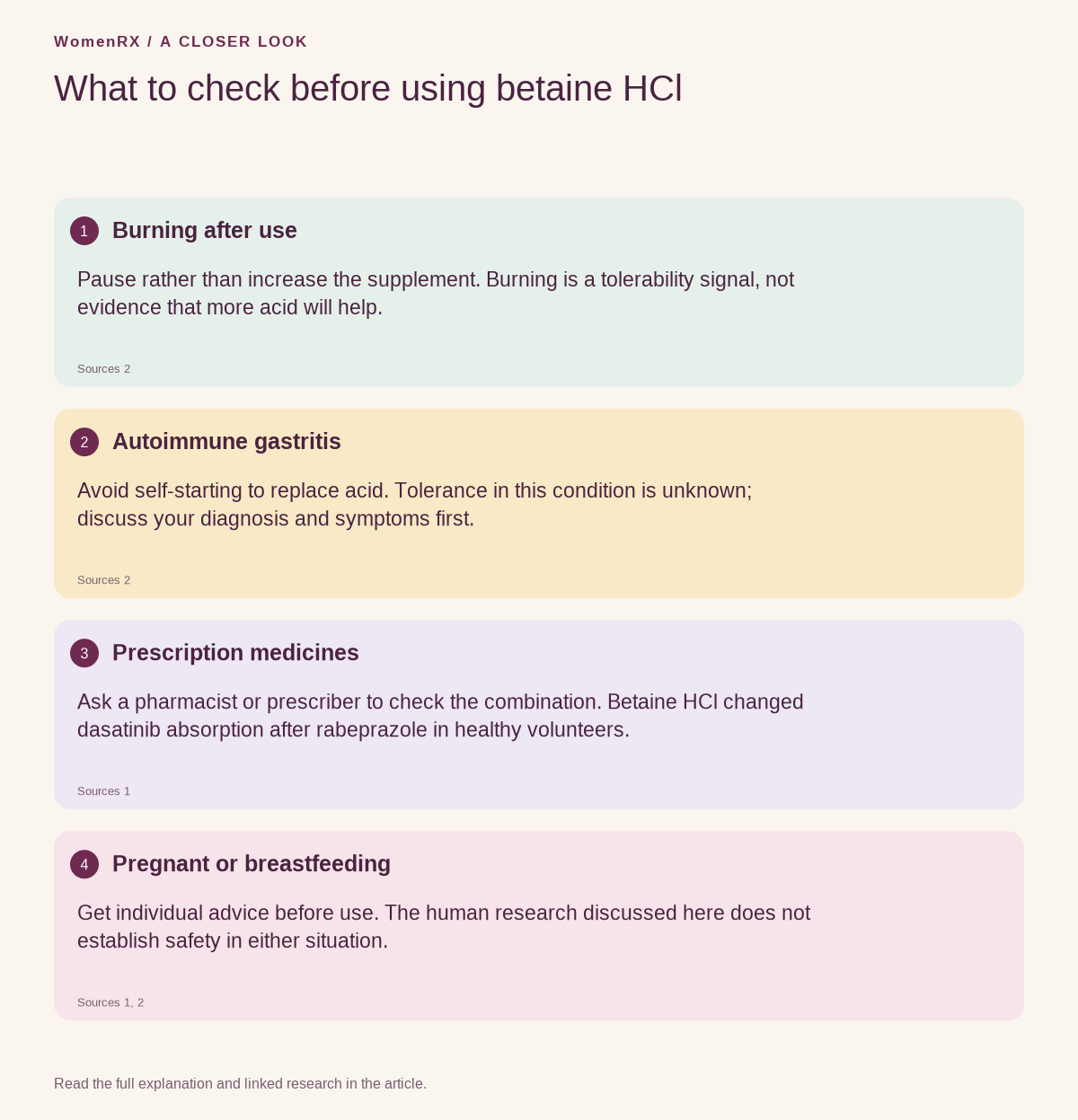
What to check before using betaine HCl
Burning after use: Pause rather than increase the supplement. Burning is a tolerability signal, not evidence that more acid will help.2
Autoimmune gastritis: Avoid self-starting to replace acid. Tolerance in this condition is unknown; discuss your diagnosis and symptoms first.2
Prescription medicines: Ask a pharmacist or prescriber to check the combination. Betaine HCl changed dasatinib absorption after rabeprazole in healthy volunteers.1
Pregnant or breastfeeding: Get individual advice before use. The human research discussed here does not establish safety in either situation.12
Read the figure as text
Use this checklist to spot situations where pausing or checking a specific concern is sensible. It is not an urgent-symptom guide or a complete safety screen.- Burning after use: Pause rather than increase the supplement. Burning is a tolerability signal, not evidence that more acid will help.2
- Autoimmune gastritis: Avoid self-starting to replace acid. Tolerance in this condition is unknown; discuss your diagnosis and symptoms first.2
- Prescription medicines: Ask a pharmacist or prescriber to check the combination. Betaine HCl changed dasatinib absorption after rabeprazole in healthy volunteers.1
- Pregnant or breastfeeding: Get individual advice before use. The human research discussed here does not establish safety in either situation.12
More questions, answered
Does the absence of burning mean betaine HCl is working?
No. A review describes using a burning sensation as a stopping point in some approaches to supplementation, but not feeling burning doesn’t show that you need more acid, that your symptoms will improve, or that a higher amount is safe. 2
Sources you can check
- The use of betaine HCl to enhance dasatinib absorption in healthy volunteers with rabeprazole-induced hypochlorhydria.Yago MR, Frymoyer A, Benet LZ, Smelick GS, Frassetto LA, Ding X, Dean B, Salphati L, Budha N, Jin JY, Dresser MJ, Ware JA. · The AAPS journal · 2014Return to first citation
- Creating a Framework for Treating Autoimmune Gastritis-The Case for Replacing Lost Acid.Taylor L, McCaddon A, Wolffenbuttel BHR. · Nutrients · 2024Return to first citation