Betaine HCl: Is a Daily Dose Supported?
A small study measured stomach acidity, not whether betaine HCl improves digestion or is safe to take every day.
A small human study of betaine HCl does not establish a daily dose to treat indigestion or presumed low stomach acid. It followed nine people and measured short-term changes in stomach acidity after a meal; its reported outcomes don’t address symptom relief, long-term use, or pregnancy and breastfeeding safety. Its experimental doses are not a dosing recommendation. 3
What the human study actually tested
The evidence most directly related to betaine HCl and stomach acid is a small crossover study involving nine people. Researchers measured how food changed stomach acidity and whether betaine HCl could bring acidity back toward its earlier level. That’s a measurement of stomach pH, not a test of whether people felt less bloated, had less pain, or digested food better. The study also doesn’t establish a daily schedule or long-term safety. 3
That distinction matters if you’re weighing a supplement for everyday symptoms. A dose used to change a measurement under study conditions isn’t automatically a dose that improves a health problem. The study’s results don’t support a recommended daily amount for digestion or a self-directed dose-finding routine. 3
Betaine isn’t one interchangeable ingredient
“Betaine” can refer to a dietary compound, while betaine hydrochloride (betaine HCl) is a formulation intended to affect stomach acidity. Evidence about one form or purpose doesn’t establish a benefit for the other. For example, research on dietary betaine and trimethylamine-N-oxide (TMAO) in mice examined metabolism, not betaine HCl as a treatment for digestive symptoms in people. 4
Symptoms alone don’t confirm low stomach acid
Upper abdominal burning or pain, feeling overly full after eating, and getting full unusually quickly can occur with functional dyspepsia. These symptoms can also overlap with other digestive conditions; the symptoms themselves don’t establish that stomach acid is low. Clinical assessment may involve considering symptom pattern and duration and, when appropriate, testing for causes such as H. pylori or other conditions. 1
Adding an acidifying supplement without knowing what’s behind your symptoms means acting on a presumed cause, not a confirmed one. The small betaine HCl study measured a short-term change in acidity; it didn’t show that acid supplementation is a useful treatment for these symptoms. 3
Seek medical assessment for difficulty swallowing, unexplained weight loss, persistent vomiting, or gastrointestinal bleeding. These symptoms were associated with a higher rate of major findings in a large endoscopy study of people under 60, though the study does not mean that a serious cause is certain for any individual. 2
What’s known about women, pregnancy, and breastfeeding
The reported details of the nine-person betaine HCl study don’t provide women-specific results or findings on pregnancy, breastfeeding, or long-term use. This study cannot establish a sex-specific daily dose or safety during pregnancy or breastfeeding. 3
For now, the most useful takeaway is simple: the human research described here shows that betaine HCl can alter a stomach-acidity measurement in a small, short-term experiment. It does not show a daily dose that relieves digestive symptoms or demonstrate that taking it long term is safe. If symptoms are bothering you, identifying their cause is a more evidence-grounded next step than assuming you need extra stomach acid.
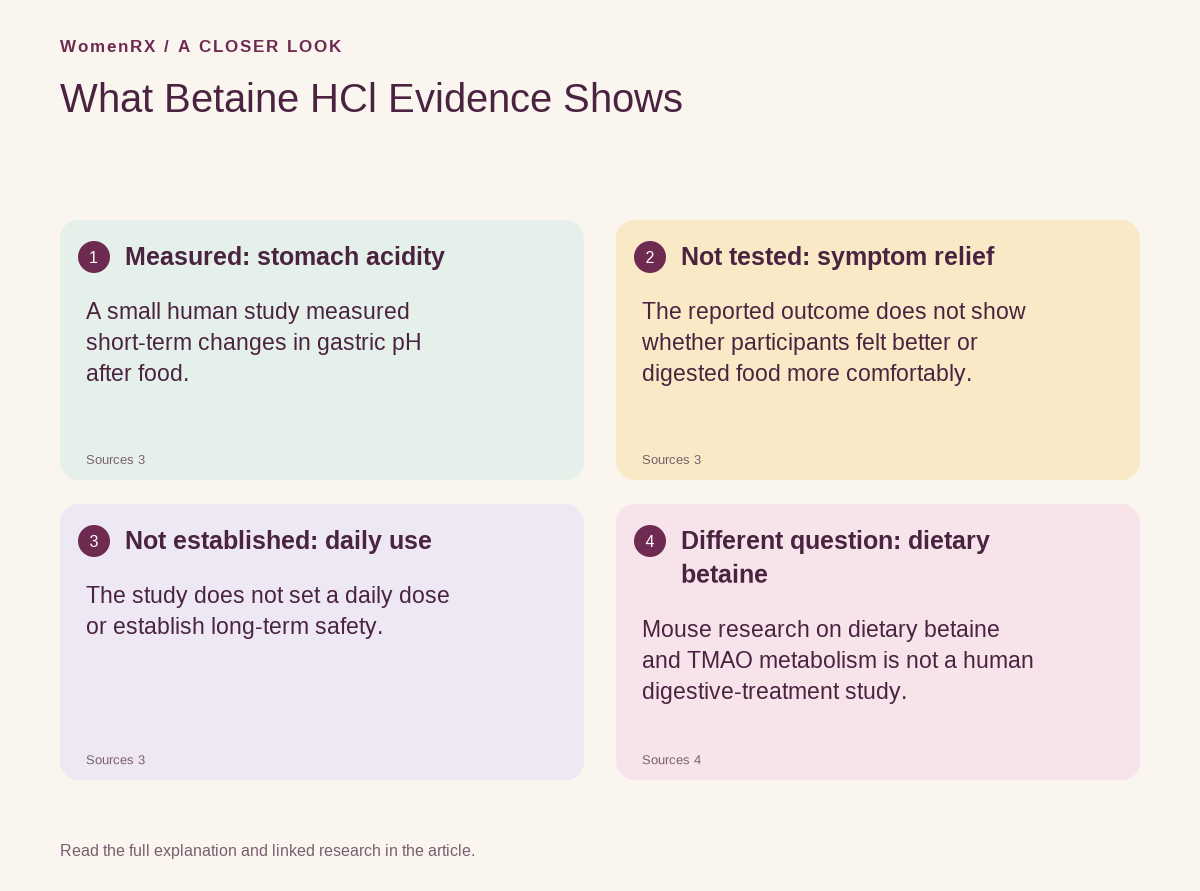
What Betaine HCl Evidence Shows
Measured: stomach acidity: A small human study measured short-term changes in gastric pH after food.3
Not tested: symptom relief: The reported outcome does not show whether participants felt better or digested food more comfortably.3
Not established: daily use: The study does not set a daily dose or establish long-term safety.3
Different question: dietary betaine: Mouse research on dietary betaine and TMAO metabolism is not a human digestive-treatment study.4
Read the figure as text
Separate the short-term acidity finding from the questions a daily supplement would need to answer.- Measured: stomach acidity: A small human study measured short-term changes in gastric pH after food.3
- Not tested: symptom relief: The reported outcome does not show whether participants felt better or digested food more comfortably.3
- Not established: daily use: The study does not set a daily dose or establish long-term safety.3
- Different question: dietary betaine: Mouse research on dietary betaine and TMAO metabolism is not a human digestive-treatment study.4
More questions, answered
Does betaine HCl prove that my stomach acid is low?
No. The study measured how betaine HCl changed stomach acidity; it did not validate symptoms as a way to diagnose low stomach acid. 3
Is betaine HCl the same as betaine in food or other supplements?
They shouldn’t be treated as interchangeable evidence. Research on dietary betaine in mice examined metabolism, not betaine HCl for digestive symptoms in people. 4
Sources you can check
- S1 Guideline of the German Society for Neurogastroenterology and Motility (DGNM) on Functional Dyspepsia (FD), a Disorder of Gut-Brain Interaction (DGBI) [English Language Edition].Storr M, Andresen V, Frieling T, Gschossmann JM, Keller J, Langhorst J, Pehl C, Stengel A, Tebbe J, Wiemer K, Madisch A, Stengel M. · Gastroenterology research and practice · 2026Return to first citation
- Alarm symptoms and the risk of upper gastrointestinal cancer in patients below the age of 60.Theunissen F, Ter Borg PCJ, Ouwendijk RJT, Bruno MJ, Siersema PD, Trans.IT foundation study group. · Digestive and liver disease : official journal of the Italian Society of Gastroenterology and the Italian Association for the Study of the Liver · 2025Return to first citation
- Food, Acid Supplementation and Drug Absorption - a Complicated Gastric Mix: a Randomized Control Trial.Surofchy DD, Frassetto LA, Benet LZ. · Pharmaceutical research · 2019Return to first citation
- Effects of dietary choline, betaine, and L-carnitine on the generation of trimethylamine-N-oxide in healthy mice.Yu ZL, Zhang LY, Jiang XM, Xue CH, Chi N, Zhang TT, Wang YM. · Journal of food science · 2020Return to first citation