Always Feeling Cold: Common Causes and When to Get Checked
Feeling cold can fit with thyroid problems or anemia, but it isn’t specific enough to identify a cause on its own.
If you’re often cold, notice whether it happens mainly in chilly surroundings or is new, persistent, or worsening, and whether other symptoms came along with it. Cold intolerance can occur with an underactive thyroid or anemia, but neither can be diagnosed from that feeling alone. Heavy periods and the postpartum period are useful context to mention; blood tests help assess these possibilities. 1 3 4 5
Feeling cold now and then, especially in a chilly room or outdoors, is different from a lasting change in how your body handles cold. If it’s persistent, getting worse, or showing up in settings that used to feel comfortable, consider the pattern and any accompanying symptoms rather than trying to identify a cause from coldness alone.
The clues that make thyroid testing worth discussing
An underactive thyroid can cause cold intolerance because thyroid hormones help regulate the body’s metabolism and heat production. Fatigue, weight gain, constipation, or dry skin alongside feeling unusually cold can make thyroid function a reasonable topic to raise. But these symptoms overlap with other conditions, and even a cluster of them can’t confirm hypothyroidism. Diagnosis is based on thyroid blood tests, not symptoms alone. 3 4
Mention if you’re pregnant, recently gave birth, or have had thyroid surgery or treatment. Pregnancy can affect how thyroid test results are interpreted, and postpartum thyroiditis can include a hypothyroid phase with cold intolerance, often around four to eight months after delivery. 4 5
If you already take levothyroxine, mention other medicines and supplements too. Iron and calcium carbonate can reduce absorption of the medicine; the prescribing information also identifies some antacids and proton pump inhibitors as potential factors. Don’t change your dose yourself, but do tell the prescriber what you take. 2
When heavy periods make anemia a consideration
Anemia can make you feel cold as well as tired, dizzy, short of breath, or headachy. Heavy menstrual bleeding is one possible cause; anemia can also result from low production of red blood cells or their increased destruction. If your periods are heavy and you’ve noticed a change in energy or cold tolerance, mention both. Blood tests are used to diagnose anemia, and treatment depends on its cause. 1
Menopause is useful context when discussing a new body-temperature change, but don’t assume that persistent coldness is explained by menopause. Cold intolerance is nonspecific, so thyroid function and anemia may still be relevant possibilities. 1 4
When the setting or a medicine may be part of the picture
Notice whether the feeling tracks with a cold room, weather, or time spent outside, and whether it eases when you’re warm again. A pattern limited to cold surroundings points toward a different question than feeling unusually cold in familiar, comfortable settings.
Also bring a current medication list, particularly if a medicine was started or changed around the time the cold intolerance began. Some medicines, including lithium and amiodarone, are recognized causes of hypothyroidism. That doesn’t mean a medication is necessarily responsible, but it can be relevant to the assessment. 4
A useful way to describe the pattern
For a clinician, a short account is more useful than a guess at the diagnosis: when the cold feeling started, whether it’s getting worse, what settings bring it on, and what else has changed. Include heavy periods, pregnancy or recent delivery, and medicines or supplements. Thyroid tests and blood tests for anemia can help assess those specific possibilities. 1 3 4
Feeling cold by itself doesn’t show that you have hypothyroidism or an iron deficiency. That’s why starting thyroid or iron supplements based only on this symptom isn’t a reliable way to find or treat the cause.
Follow the clues behind feeling cold
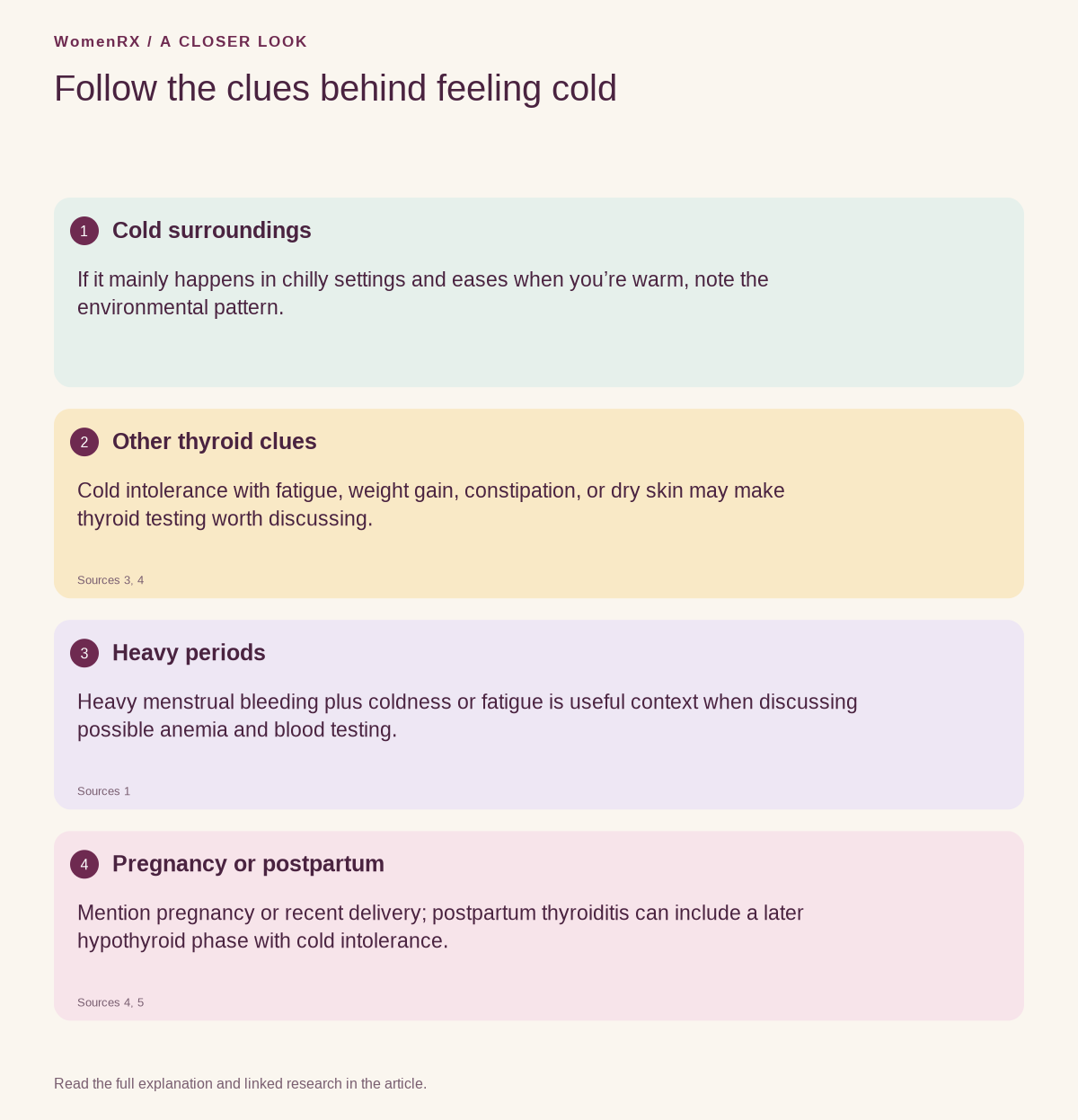
Cold surroundings: If it mainly happens in chilly settings and eases when you’re warm, note the environmental pattern.
Other thyroid clues: Cold intolerance with fatigue, weight gain, constipation, or dry skin may make thyroid testing worth discussing.34
Heavy periods: Heavy menstrual bleeding plus coldness or fatigue is useful context when discussing possible anemia and blood testing.1
Pregnancy or postpartum: Mention pregnancy or recent delivery; postpartum thyroiditis can include a later hypothyroid phase with cold intolerance.45
Read the figure as text
Use the pattern and accompanying context to decide what may be useful to discuss; none of these clues diagnoses a condition.- Cold surroundings: If it mainly happens in chilly settings and eases when you’re warm, note the environmental pattern.
- Other thyroid clues: Cold intolerance with fatigue, weight gain, constipation, or dry skin may make thyroid testing worth discussing.34
- Heavy periods: Heavy menstrual bleeding plus coldness or fatigue is useful context when discussing possible anemia and blood testing.1
- Pregnancy or postpartum: Mention pregnancy or recent delivery; postpartum thyroiditis can include a later hypothyroid phase with cold intolerance.45
More questions, answered
Can feeling cold by itself mean I have hypothyroidism?
No. Cold intolerance is one possible hypothyroidism symptom, but it is nonspecific and diagnosis is based on thyroid blood tests. Other symptoms can help provide context, but they can’t confirm the condition on their own. 3 4
Sources you can check
- Anemia | MedlinePlusAccessed 2026-09-25Return to first citation
- LEVOTHYROXINE SODIUM TABLET [CARDINAL HEALTH 107, LLC] | US prescribing information and patient instructionsAccessed 2026-09-25Return to first citation
- Epidemiology, Types, Causes, Clinical Presentation, Diagnosis, and Treatment of Hypothyroidism.Zamwar UM, Muneshwar KN. · Cureus · 2023Return to first citation
- Hypothyroidism.Taylor PN, Medici MM, Hubalewska-Dydejczyk A, Boelaert K. · Lancet (London, England) · 2024Return to first citation
- Postpartum ThyroiditisCarlson K, Mikes BA. · 2025Return to first citation