Alternatives to Bremelanotide Depend on What’s Behind Low Desire
A desire-focused medicine, sex therapy, and treatment for vaginal dryness solve different problems, so the useful comparison starts with what has changed for you.
There isn’t one interchangeable substitute for bremelanotide. If low desire began alongside a medication change, pain or dryness, or psychological factors, addressing that factor may make more sense than choosing another desire-focused drug. Flibanserin and, in some postmenopausal circumstances, testosterone are separate treatment discussions with different evidence, eligibility, and safety questions.146
First, name the problem you want treated
Low desire can be the concern itself, or it can sit alongside something else that makes sex less appealing. Medicines, chronic conditions, and concerns such as fear of pregnancy can affect sexual health. A clinical approach to hypoactive sexual desire disorder (HSDD) starts by distinguishing different patterns of low interest and looking for potentially changeable contributors before choosing treatment.14
For example, if your interest changed after starting a medicine, a review of that medicine addresses a different question from a prescription intended to increase desire. If vaginal irritation makes intimacy uncomfortable, treating the irritation is not the same as treating HSDD. You don’t have to decide which explanation fits before raising the concern; the distinction helps make the treatment conversation more useful.134
| If the main concern is… | Option to discuss | What it addresses, and what to check |
|---|---|---|
| Desire changed alongside a medicine or health condition | Review of medicines and contributing conditions | Looks for a potentially changeable contributor. Ask whether the timing fits and what options exist for the condition the medicine treats.14 |
| Desire is distressingly low, with psychological factors in the picture | Counseling or sex therapy | Addresses patterns of thought and behavior rather than acting like a drug substitute. Ask what approach fits your concern and how you’ll judge whether it’s helping.45 |
| Dryness or irritation is a prominent problem around perimenopause or after menopause | Assessment and treatment of vaginal symptoms, which may include local vaginal estrogen | Targets dryness and irritation, not desire directly. Ask whether vaginal estrogen fits your symptoms and health history, particularly if you have unexplained bleeding or a history of breast cancer.39 |
| Low desire remains the primary, distressing concern | A discussion of desire-focused treatment, including flibanserin or, in some postmenopausal circumstances, testosterone | A 2018 HSDD care pathway distinguished flibanserin for premenopausal women from off-label testosterone for postmenopausal women. Check current eligibility, expected benefit, and safety for each; neither is a simple switch from bremelanotide.467 |
How the medicine safety questions differ
Bremelanotide: Its US prescribing information says blood pressure rises temporarily and heart rate falls after a dose. It is contraindicated with uncontrolled high blood pressure or known cardiovascular disease. The label also warns of potential fetal harm based on animal studies and advises contraception during treatment and stopping the medicine if pregnancy is suspected. Those are reasons to bring up cardiovascular history and pregnancy plans when weighing it against another approach.2
Flibanserin: The 2018 professional HSDD pathway described it as FDA-approved for premenopausal women with HSDD. That description does not establish current eligibility, so check current US prescribing information and local prescribing rules rather than assuming it fits your circumstances.4 The safety conversation centers on fainting, low blood pressure, and central nervous system effects in particular combinations. Its US prescribing information says alcohol increases those risks; moderate or strong CYP3A4 inhibitors are contraindicated because they increase flibanserin exposure and the risk of low blood pressure and fainting. Examples listed include fluconazole, verapamil, clarithromycin, and grapefruit juice. Sedating medicines, including diphenhydramine, opioids, and sleep medicines, can add to drowsiness. A medication and alcohol review is therefore a specific part of considering flibanserin, not a generic precaution attached to every option.7
Vaginal estrogen: This is local treatment for menopause-related vaginal dryness and irritation, not a desire medicine. Headache, vaginal discomfort, and bleeding can occur. It isn’t suitable for everyone without further assessment: unexplained vaginal bleeding, a breast cancer history, and possible pregnancy are among the issues to raise. Guidance about its use for menopause symptoms shouldn’t be carried over automatically to postpartum dryness.389
Testosterone: A professional HSDD care pathway describes evidence supporting off-label use in postmenopausal women. That does not make it an equivalent or established choice for every woman with low desire. Testosterone needs its own assessment of potential benefits, eligibility, and risks rather than being ranked as safer or riskier than bremelanotide or flibanserin.4
These are different safety screens, not a safest-to-riskiest list. Likewise, not having a drug interaction list for sex therapy does not tell you how useful a particular therapy will be for your situation. A review of randomized studies found psychological interventions helpful for women with HSDD, but comparative and longer-term evidence was limited.5
What menopause status changes
Bremelanotide and flibanserin have been studied most extensively among drug treatments for HSDD, with trials in a review primarily enrolling premenopausal women with acquired, generalized HSDD. That research base cannot simply be applied to someone whose low desire began around menopause, after childbirth, or alongside pain. The HSDD care pathway separates treatment decisions in part by menopausal status and identifies testosterone as an off-label option supported by data for postmenopausal HSDD.46
If you’re pregnant or planning pregnancy, bremelanotide’s pregnancy warning matters.2 Guidance for vaginal estrogen’s menopause use is not, by itself, guidance for postpartum symptoms.3 The useful next question is not “What replaces bremelanotide?” but “Are we treating desire, discomfort, a contributing condition, or more than one of these?”4
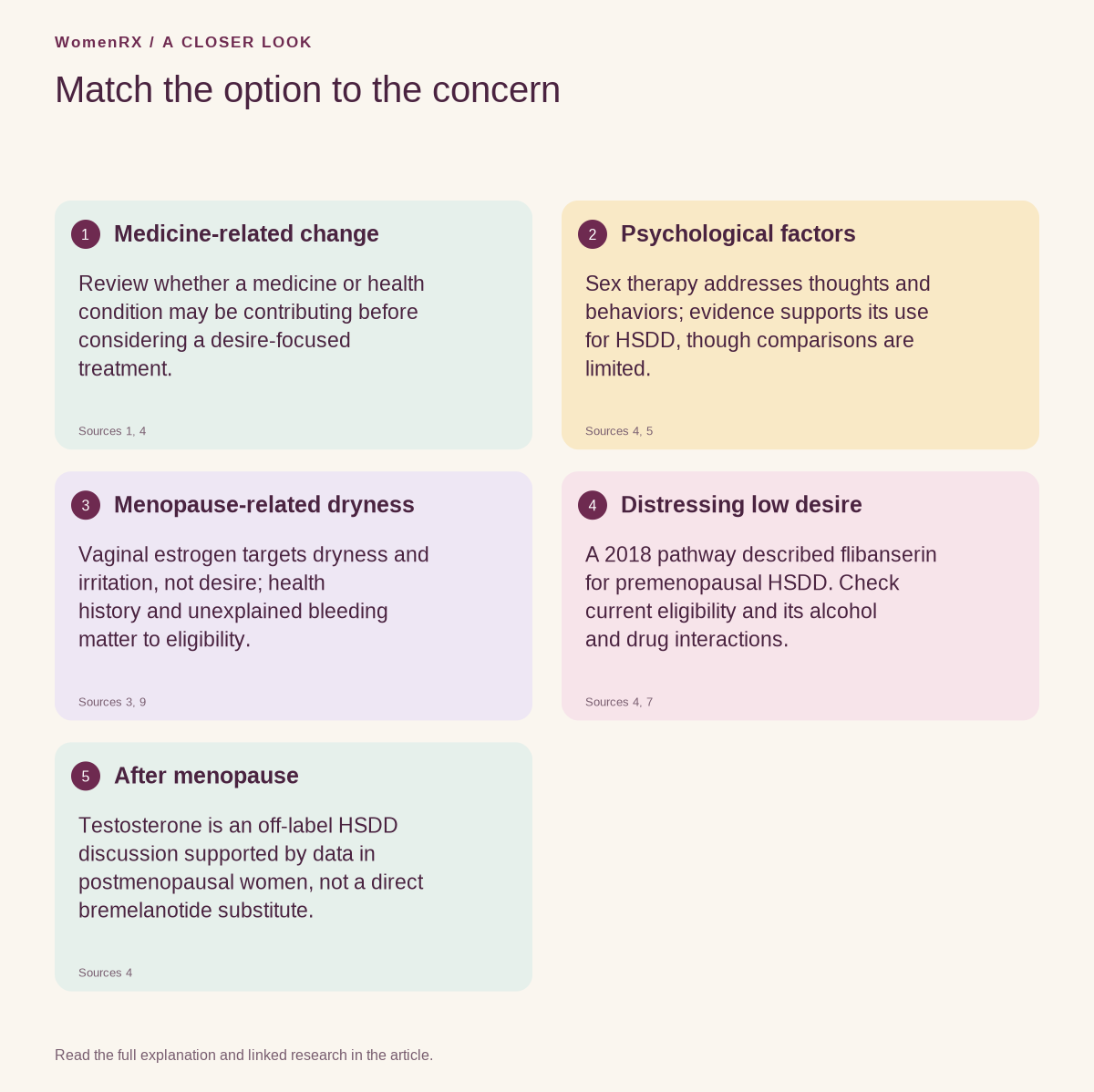
Match the option to the concern
Medicine-related change: Review whether a medicine or health condition may be contributing before considering a desire-focused treatment.14
Psychological factors: Sex therapy addresses thoughts and behaviors; evidence supports its use for HSDD, though comparisons are limited.45
Menopause-related dryness: Vaginal estrogen targets dryness and irritation, not desire; health history and unexplained bleeding matter to eligibility.39
Distressing low desire: A 2018 pathway described flibanserin for premenopausal HSDD. Check current eligibility and its alcohol and drug interactions.47
After menopause: Testosterone is an off-label HSDD discussion supported by data in postmenopausal women, not a direct bremelanotide substitute.4
Read the figure as text
The same phrase, “low desire,” can lead to different treatment conversations depending on what else is happening.- Medicine-related change: Review whether a medicine or health condition may be contributing before considering a desire-focused treatment.14
- Psychological factors: Sex therapy addresses thoughts and behaviors; evidence supports its use for HSDD, though comparisons are limited.45
- Menopause-related dryness: Vaginal estrogen targets dryness and irritation, not desire; health history and unexplained bleeding matter to eligibility.39
- Distressing low desire: A 2018 pathway described flibanserin for premenopausal HSDD. Check current eligibility and its alcohol and drug interactions.47
- After menopause: Testosterone is an off-label HSDD discussion supported by data in postmenopausal women, not a direct bremelanotide substitute.4
More questions, answered
Is flibanserin the oral version of bremelanotide?
No. Both have been studied for HSDD, but they are different medicines with different safety considerations. Flibanserin has notable alcohol and medication interactions; bremelanotide has a specific blood-pressure and cardiovascular warning. Choosing between them requires more than choosing a tablet or an injection.267
Will treating vaginal dryness increase desire?
Vaginal estrogen treats menopause-related dryness and irritation, not low desire directly. If discomfort is part of what has changed for you, treating that symptom addresses a relevant piece of the picture without assuming it will resolve every concern about desire.34
Sources you can check
- Sexual Health | MedlinePlusAccessed 2026-09-25Return to first citation
- VYLEESI (BREMELANOTIDE) INJECTION [COSETTE PHARMACEUTICALS, INC.] | US prescribing information and patient instructionsAccessed 2026-09-25Return to first citation
- About vaginal oestrogen - NHSAccessed 2026-09-25Return to first citation
- The International Society for the Study of Women's Sexual Health Process of Care for Management of Hypoactive Sexual Desire Disorder in Women.Clayton AH, Goldstein I, Kim NN, Althof SE, Faubion SS, Faught BM, Parish SJ, Simon JA, Vignozzi L, Christiansen K, Davis SR, Freedman MA, Kingsberg SA, Kirana PS, Larkin L, McCabe... · Mayo Clinic proceedings · 2018Return to first citation
- Efficacy of psychological interventions for sexual dysfunction: a systematic review and meta-analysis.Frühauf S, Gerger H, Schmidt HM, Munder T, Barth J. · Archives of sexual behavior · 2013Return to first citation
- Clinical trial evidence on emerging pharmacological therapies for hypoactive sexual desire disorder in women: a systematic review and analysis of completed studies registered on ClinicalTrials.gov.Ashour AM. · Frontiers in medicine · 2026Return to first citation
- ADDYI (FLIBANSERIN) TABLET, FILM COATED [SPROUT PHARMACEUTICALS, INC.] | US prescribing information and patient instructionsAccessed 2026-09-25Return to first citation
- Side effects of vaginal oestrogen - NHSAccessed 2026-09-25Return to first citation
- Who can and cannot use vaginal oestrogen - NHSAccessed 2026-09-25Return to first citation