A More Comfortable Holiday Meal on a GLP-1
Plan around how you feel that day, not a plate you think you’re supposed to finish.
A social meal doesn’t need to become a test of appetite or willpower. GLP-1 medicines can reduce food intake, and liraglutide can slow stomach emptying, so your usual portions may feel different. 1 2 4 Beforehand, check the menu if that helps; at the meal, choose what sounds comfortable and pause as you eat. There’s no need to compensate afterward.
Make a plan that leaves room for how you feel
A holiday meal can come with a set time, a full table, and the expectation that everyone will eat the same way. On a GLP-1 medicine, your appetite or tolerance for a large meal may not match those expectations. In a meta-analysis of three trials involving 209 adults, GLP-1 or GLP-1/GIP medicines reduced how much participants ate at a standardized lunch compared with placebo. That result helps explain why a familiar meal might feel different, but it doesn’t predict exactly what you’ll want at a particular gathering. 4
Before the event: If seeing the menu in advance would make the evening easier, take a look or ask what’s being served. You could decide on one or two foods that sound appealing, or plan to serve yourself a small amount first and get more if you want it. Those are flexible options, not rules. There’s no need to skip meals beforehand to “save room.”
If you have a caregiving schedule or a tight arrival window, think about the practical parts too: whether you can sit down when food is served, take a break if you need one, or bring home leftovers. These choices can make participation easier without requiring you to explain or defend how much you eat.
At the table, let comfort set the pace
Start with what feels appealing and comfortable. You can take a smaller serving, eat slowly enough to notice how you’re feeling, pause, or stop. You don’t have to finish what’s on your plate, and you don’t have to sample everything to be part of the occasion. If someone offers more, a simple “I’m good for now, thank you” can be enough.
A GLP-1 medicine is not a reason to force food when you feel full, or to make the meal a performance of eating less. Appetite and food intake can change with treatment, but weight loss and diet quality are not the same thing: a small 24-week observational study of 28 adults taking semaglutide or tirzepatide found lower energy intake without a significant improvement in measured diet quality. The study was small and can’t tell us what one holiday meal means for your nutrition. 3
If nausea or other stomach symptoms are already affecting your plans, choose the option that feels manageable, even if that means taking a break from the table or leaving early. The dietary studies discussed here don’t test an event-day schedule or food plan for preventing symptoms.
Afterward, return to your usual routine
The next meal doesn’t need to make up for what you ate, or for what you didn’t. Avoid turning the event into a reason to restrict food or exercise as punishment. Simply return to your usual pattern as you’re able. If you regularly struggle to eat enough or keep experiencing symptoms, that’s a treatment question worth raising with your prescriber, rather than something you have to solve at a holiday table.
Most trials of liraglutide, semaglutide, or tirzepatide have not reported dietary intake or diet changes as outcomes, so research doesn’t offer a precise formula for managing social meals. The practical goal here is simpler: stay connected to the occasion while responding to your own comfort. 5
Know when stomach pain needs attention
For liraglutide products, prescribing information warns about acute pancreatitis and describes persistent or severe abdominal pain, sometimes radiating to the back, with or without nausea or vomiting. If you have that kind of pain, seek prompt medical assessment rather than assuming it’s ordinary fullness from a meal. This warning is drawn from liraglutide product information, not a claim that every stomach symptom or every GLP-1 medicine has the same cause. 1
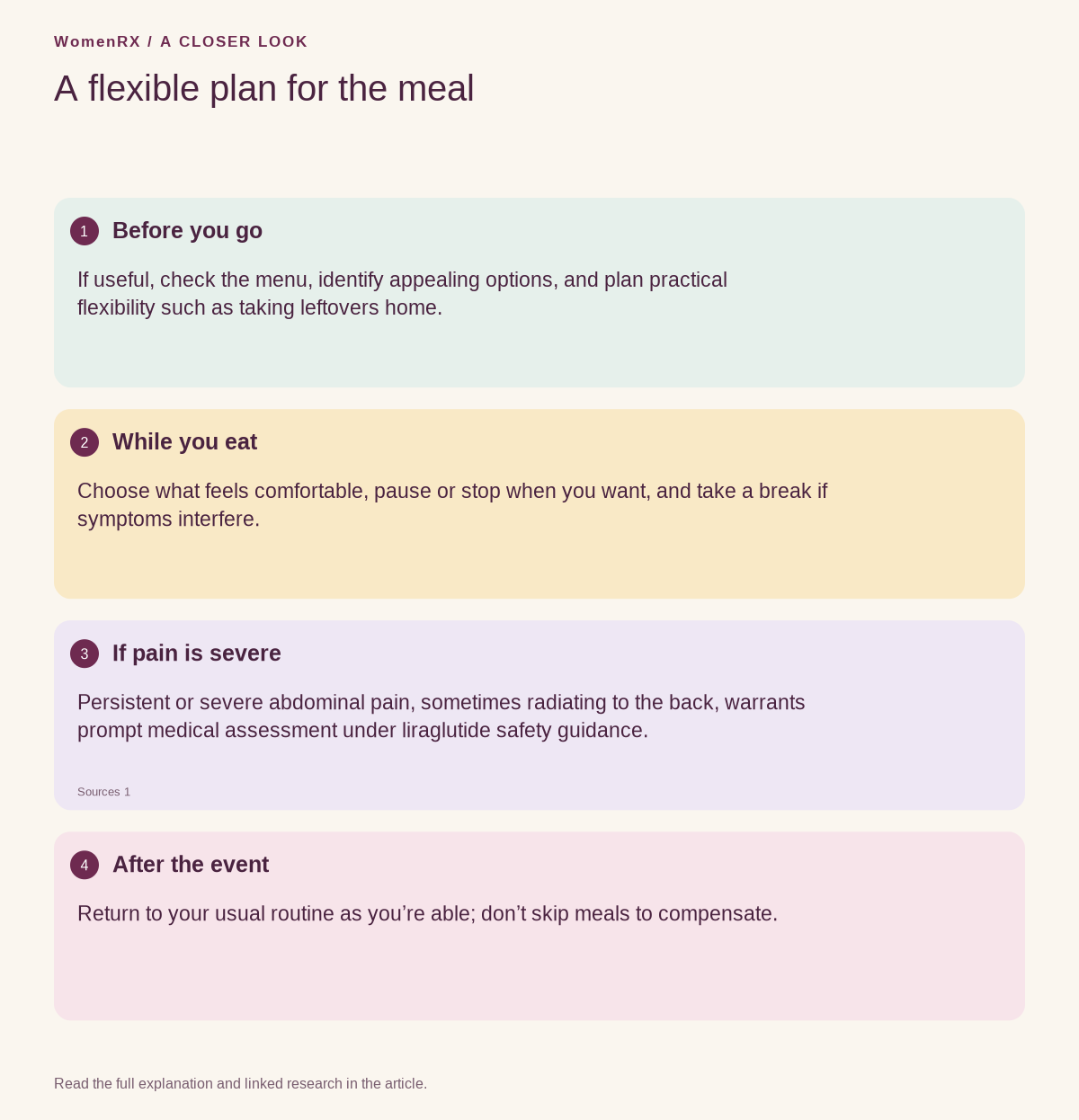
A flexible plan for the meal
Before you go: If useful, check the menu, identify appealing options, and plan practical flexibility such as taking leftovers home.
While you eat: Choose what feels comfortable, pause or stop when you want, and take a break if symptoms interfere.
If pain is severe: Persistent or severe abdominal pain, sometimes radiating to the back, warrants prompt medical assessment under liraglutide safety guidance.1
After the event: Return to your usual routine as you’re able; don’t skip meals to compensate.
Read the figure as text
Three points in the event can help you keep the focus on comfort and company rather than a prescribed portion.- Before you go: If useful, check the menu, identify appealing options, and plan practical flexibility such as taking leftovers home.
- While you eat: Choose what feels comfortable, pause or stop when you want, and take a break if symptoms interfere.
- If pain is severe: Persistent or severe abdominal pain, sometimes radiating to the back, warrants prompt medical assessment under liraglutide safety guidance.1
- After the event: Return to your usual routine as you’re able; don’t skip meals to compensate.
More questions, answered
What if I don’t want to explain why I’m eating less?
You can keep it simple: “I’m comfortable with this for now,” or “I’d love to take some home.” You don’t owe anyone a detailed explanation of your appetite or treatment.
Sources you can check
- SAXENDA (LIRAGLUTIDE) INJECTION, SOLUTION [NOVO NORDISK PHARMACEUTICAL INDUSTRIES, LP] | US prescribing information and patient instructionsAccessed 2026-09-25Return to first citation
- VICTOZA (LIRAGLUTIDE) INJECTION [NOVO NORDISK] | US prescribing information and patient instructionsAccessed 2026-09-25Return to first citation
- Changes in food cravings, dietary quality, body composition, and dietary intake during GLP-1 receptor agonist therapy: The CRAVE study.Babazadeh D, Therrien S, Fitch AK, Steinberg FM. · Obesity pillars · 2026Return to first citation
- Nutritional intake changes during GLP-1 receptor agonist therapy: A systematic review and meta-analysis.Quan AT, Nguyen HL, Nguyen TMT. · Diabetes & metabolic syndrome · 2026Return to first citation
- A Systematic Review Identifying Critical Evidence Gaps in Reporting Dietary Change in Randomized Controlled Trials Prescribing Liraglutide, Semaglutide, or Tirzepatide.Jansson AK, Gómez-Martín M, Hedin L, Clarke ED, Cross V, Stanford J, Taylor RM, Bogl LH, De Vlieger N, Koochek A, Löf M, Asher RC, Burrows T, Bucher T, Sullivan C, Nowicka P, Colli... · Obesity reviews : an official journal of the International Association for the Study of Obesity · 2026Return to first citation