Zone 2 Cardio: How to Judge Effort and Use It
Zone 2 can be a useful label for steady aerobic work, but its boundaries depend on how you define it.
Zone 2 doesn’t have one universal definition. A panel of 14 sport scientists and coaches preferred to define it as exercise just below the first lactate or ventilatory threshold, but the term has no broad consensus. Heart rate is an estimate, not a verdict; speaking comfort can help you judge effort, though it doesn’t pinpoint a threshold exactly. Zone 2 is an option, not a uniquely necessary intensity. 2 4 5
What “Zone 2” means depends on the system
If you’ve seen Zone 2 described as the one pace everyone should train at, the label is doing too much work. Exercise zones aren’t consistently defined across coaches, athletes, and scientists. A panel of 14 sport scientists and coaches preferred to define Zone 2 as exercise just below the first lactate or ventilatory threshold. That’s a useful technical reference, but it doesn’t mean every watch, app, or training plan uses the same boundaries. 2
Those thresholds describe changes measured during exercise testing. You don’t need to know yours to choose a steady effort, and a Zone 2 label on a device doesn’t necessarily mean your effort matches a lab-defined threshold. The label is most useful when you know which system produced it.
Use conversation as a rough effort check
Try speaking a few sentences while you move. If you can talk comfortably, that gives you one clue about effort. In a small study, participants read a passage aloud and rated speaking comfort. Those ratings related to exercise intensity, but the talk-test measures were more closely aligned with lactate threshold than with ventilatory threshold. So the test can help guide effort, but it isn’t an exact way to identify a particular Zone 2 boundary. 5
A separate study of 36 healthy young adults found that a structured counting talk test had moderate-to-good correlations with heart-rate-reserve and perceived-exertion methods, and was consistent across the exercise modes tested. That supports using speech as one practical signal, not treating it as a precise measurement for every person or workout. 4
You can combine the cue with how hard the activity feels. For example, during a brisk walk or bike ride, notice whether you can keep speaking comfortably and whether the effort feels sustainable. If you’re straining to get out a few words, you’re likely working harder than that conversational effort. That comparison is a practical guide, not a diagnosis of your exercise zone.
Heart-rate numbers are estimates, not ground truth
In a study of 51 physically active young adults, fixed percentages of maximum heart rate, heart-rate reserve, and oxygen uptake had limited accuracy for estimating exercise domains defined by ventilatory thresholds, with notable misclassification at the first threshold. The study included 19 women, but it wasn’t designed to establish different targets for women. These results don’t establish how well the same anchors work in other groups. 3
That matters if a device gives you a zone number. Treat it as one reference alongside your breathing and perceived effort, especially if the prescribed number doesn’t match how the workout feels. The research here doesn’t establish that a particular heart-rate formula works better for women across ages or reproductive stages.
Where it can fit in a routine
Steady aerobic work can be a way to build regular movement at an effort you can sustain. You might choose it for a comfortable cardio session or use it when you want to move without making every workout hard. It doesn’t have to replace strength training or all higher-intensity exercise. As a practical example, someone who already lifts might choose a conversational walk or ride on another day; that’s one possible arrangement, not a proven best schedule.
A 2025 narrative review concluded that current evidence doesn’t support Zone 2 as the optimal intensity for improving mitochondrial or fatty-acid oxidative capacity. The authors also pointed to evidence supporting higher-intensity exercise for cardiometabolic benefits, particularly when total exercise time is limited. This is a review of an evolving research question, not proof that one intensity is best for every person. 1
A trial in older women compared programs that paired resistance training with either moderate continuous aerobic exercise or high-intensity intervals, as well as a resistance-only program. It tested those programs in a specific group and did not test Zone 2 as a distinct training target. It can’t tell us which arrangement is best for you, but it does show why the choice needn’t be framed as aerobic training versus strength training. 6
What this evidence says about women
Some intensity-estimation research includes women, but these studies don’t establish different Zone 2 cutoffs by sex, menstrual-cycle phase, pregnancy, or menopause. One small study included 19 women among 51 young, physically active adults; another talk-test study included only two women. These results offer practical clues, not a personalized formula for every woman. 3 5
The useful takeaway is simple: choose a steady effort you can sustain, use conversation and perceived effort as checks, and don’t let a device’s zone label dictate your entire routine. If you enjoy Zone 2, it can have a place. It doesn’t need to be the only pace you train at.
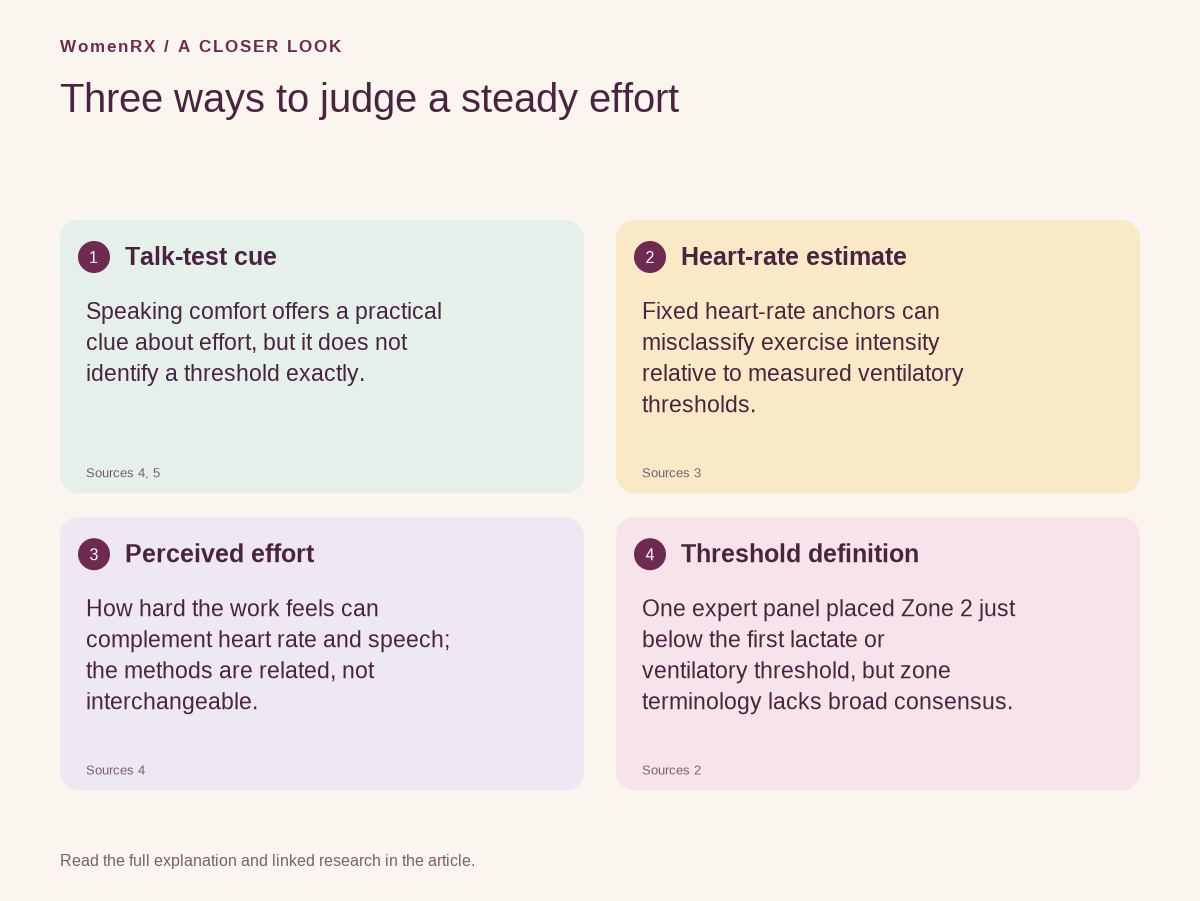
Three ways to judge a steady effort
Talk-test cue: Speaking comfort offers a practical clue about effort, but it does not identify a threshold exactly.45
Heart-rate estimate: Fixed heart-rate anchors can misclassify exercise intensity relative to measured ventilatory thresholds.3
Perceived effort: How hard the work feels can complement heart rate and speech; the methods are related, not interchangeable.4
Threshold definition: One expert panel placed Zone 2 just below the first lactate or ventilatory threshold, but zone terminology lacks broad consensus.2
Read the figure as text
These cues can inform one another, but they do not all measure the same thing or define identical zone boundaries.- Talk-test cue: Speaking comfort offers a practical clue about effort, but it does not identify a threshold exactly.45
- Heart-rate estimate: Fixed heart-rate anchors can misclassify exercise intensity relative to measured ventilatory thresholds.3
- Perceived effort: How hard the work feels can complement heart rate and speech; the methods are related, not interchangeable.4
- Threshold definition: One expert panel placed Zone 2 just below the first lactate or ventilatory threshold, but zone terminology lacks broad consensus.2
More questions, answered
Does Zone 2 mean the same thing on every watch or app?
No. Experts have not reached broad agreement on the term, and different training systems can set zone boundaries differently. Check what method your device uses before treating its label as a precise intensity measure. 2
Do women need different Zone 2 heart-rate targets?
These studies don’t establish different targets by sex or reproductive stage. Some included women, but they weren’t designed to determine whether targets should change across the menstrual cycle, pregnancy, or menopause. 3 5
Sources you can check
- Much Ado About Zone 2: A Narrative Review Assessing the Efficacy of Zone 2 Training for Improving Mitochondrial Capacity and Cardiorespiratory Fitness in the General Population.Storoschuk KL, Moran-MacDonald A, Gibala MJ, Gurd BJ. · Sports medicine (Auckland, N.Z.) · 2025Return to first citation
- What Is "Zone 2 Training"?: Experts' Viewpoint on Definition, Training Methods, and Expected Adaptations.Sitko S, Artetxe X, Bonnevie-Svendsen M, Galán-Rioja MÁ, Gallo G, Grappe F, Leo P, Mateo M, Mujika I, Sanders D, Seiler S, Zabala M, Valenzuela PL, Viribay A. · International journal of sports physiology and performance · 2025Return to first citation
- Prehypertension in young physically active adults: early vascular alterations and implications for exercise-intensity prescription.Turnšek G, Iskra S, Paravlić AH. · Frontiers in cardiovascular medicine · 2026Return to first citation
- Consistency of the counting talk test for exercise prescription.Loose BD, Christiansen AM, Smolczyk JE, Roberts KL, Budziszewska A, Hollatz CG, Norman JF. · Journal of strength and conditioning research · 2012Return to first citation
- The Talk Test and its relationship with the ventilatory and lactate thresholds.Quinn TJ, Coons BA. · Journal of sports sciences · 2011Return to first citation
- Effects of intensity and modality of community-based exercise programs on mood profile and functional physical capacity in older women under socioeconomic vulnerability: A randomized trial.Zanini GS, Teixeira do Amaral V, Fernandes B, Verardi CEL, Ciolac EG. · Women's health (London, England) · 2025Return to first citation