Who Should Avoid Wegovy Before Starting?
Wegovy has two label-listed contraindications, while pregnancy plans, breastfeeding, and certain health conditions call for a more specific conversation.
Don’t use Wegovy if you or a family member has had medullary thyroid carcinoma (MTC), you have multiple endocrine neoplasia syndrome type 2 (MEN 2), or you’ve had a serious allergic reaction to semaglutide or a Wegovy ingredient. Other concerns, including pregnancy plans, breastfeeding, severe stomach-emptying problems, and certain diabetes medicines, need review before starting rather than being treated as the same kind of prohibition. 1
The useful distinction is between “Wegovy says not to use it” and “your history could change the decision or how treatment is monitored.” Wegovy’s US prescribing information lists two contraindication categories. Its other warnings and precautions matter, but they aren’t an interchangeable list of automatic exclusions. 1
The two do-not-use categories
Wegovy is contraindicated if you have a personal or family history of medullary thyroid carcinoma (MTC), or if you have multiple endocrine neoplasia syndrome type 2 (MEN 2). MTC is a particular type of thyroid cancer, so “thyroid trouble” is not a precise substitute for this question. Wegovy’s thyroid warning comes from tumors seen in rodents; whether the drug causes MTC in humans is unknown. If a relative had thyroid cancer but you don’t know which type, find out before treating it as either a definite contraindication or a nonissue. 1
The other contraindication is a prior serious hypersensitivity reaction to semaglutide or an ingredient in the Wegovy product. Serious reactions, including anaphylaxis and swelling beneath the skin or around the face and throat, have been reported. A serious reaction to a different GLP-1 medicine calls for caution, but the Wegovy label does not place it in the same contraindication category as a prior serious reaction to semaglutide or a Wegovy ingredient. 1
Pregnancy needs its own decision
If you’re planning a pregnancy, timing matters: Wegovy’s label says to discontinue it at least two months before a planned pregnancy because semaglutide stays in the body for a long time. For Wegovy used for weight reduction, the label says to discontinue it when pregnancy is recognized. Weight loss offers no benefit during pregnancy and may cause fetal harm. These are pregnancy-specific directions, not the same as the label’s two formal contraindications. 1
Human pregnancy data are still too limited to establish Wegovy’s risk of birth defects, miscarriage, or other maternal or fetal outcomes. A review of five studies involving 1,128 semaglutide-exposed pregnancies found mixed results and no clear association with birth defects, but could not draw firm safety conclusions because the studies varied and had risks of bias. An exposure before you knew you were pregnant therefore isn’t proof of harm, or proof of safety. Tell the clinician caring for your pregnancy what you took and when. 13
There’s a distinction if Wegovy is being considered for MASH with advanced liver fibrosis, rather than weight reduction. Its label says use during pregnancy for that condition only if the potential benefit justifies the potential fetal risk. That calls for an individualized decision about the liver condition; it doesn’t change the direction to discontinue Wegovy used for weight reduction when pregnancy is recognized. 1
Breastfeeding: the tablet and injection differ
If you’re breastfeeding, ask which Wegovy formulation is being considered. Breastfeeding is not recommended during treatment with Wegovy tablets. A tablet ingredient that helps semaglutide absorption, called SNAC, or its metabolites has been found in human milk, and its potential effects on a breastfed infant are uncertain. The injection does not contain SNAC. For the injection, the label calls for weighing the benefits of breastfeeding alongside the mother’s need for treatment and possible effects on the infant; it does not give the tablet’s blanket recommendation against breastfeeding. 1
That distinction isn’t a guarantee of safety for the injection. In one small study, semaglutide was not detected in milk samples from eight women using injected semaglutide. Samples were not necessarily collected after concentrations had reached a steady level, and the study could not settle questions about longer-term infant outcomes. It’s useful information for a breastfeeding discussion, not a yes-or-no answer by itself. 2
Conditions that change the conversation, not the contraindication list
Stomach, pancreas, gallbladder, and kidneys. Wegovy is not recommended for people with severe gastroparesis, a condition in which the stomach empties very slowly. Tell the prescriber about past pancreas or kidney problems and gallbladder disease. Pancreatitis has been observed with Wegovy and related medicines; gallbladder disease has occurred in trials. Nausea, vomiting, or diarrhea can also cause dehydration that may lead to kidney injury. These concerns warrant a closer look at your history and what symptoms would require prompt attention, rather than a blanket claim that everyone with one of these conditions must avoid Wegovy. 1
Diabetes treatment and eye health. If you use insulin or a sulfonylurea, adding Wegovy can raise the risk of low blood sugar. If you have type 2 diabetes and a history of diabetic retinopathy, the label calls for monitoring for progression. Mention both the medicines you take and any history of diabetes-related eye disease before starting. 1
Other medicines and planned procedures. Wegovy delays stomach emptying and may affect absorption of oral medicines. The label reports increased levothyroxine exposure in a study with semaglutide tablets and recommends monitoring the effects of oral medicines, particularly those that need close clinical or laboratory monitoring. Wegovy also should not be used with another semaglutide product or another GLP-1 medicine. If you’re scheduled for a procedure using general anesthesia or deep sedation, tell that care team you take Wegovy: aspiration has been reported with GLP-1 medicines, and the label says evidence is insufficient to establish whether changing fasting or temporarily stopping Wegovy reduces that risk. Don’t guess at a stopping schedule on your own. 1
Before a decision is made, check the current prescribing information for the Wegovy injection or tablet you would actually use and share the relevant history. That’s especially worthwhile if the details are uncertain, such as the type of thyroid cancer in your family, whether a past reaction was serious, or which medicines you take for diabetes. Those details determine which question needs answering; the label alone can’t make the individual treatment decision. 1
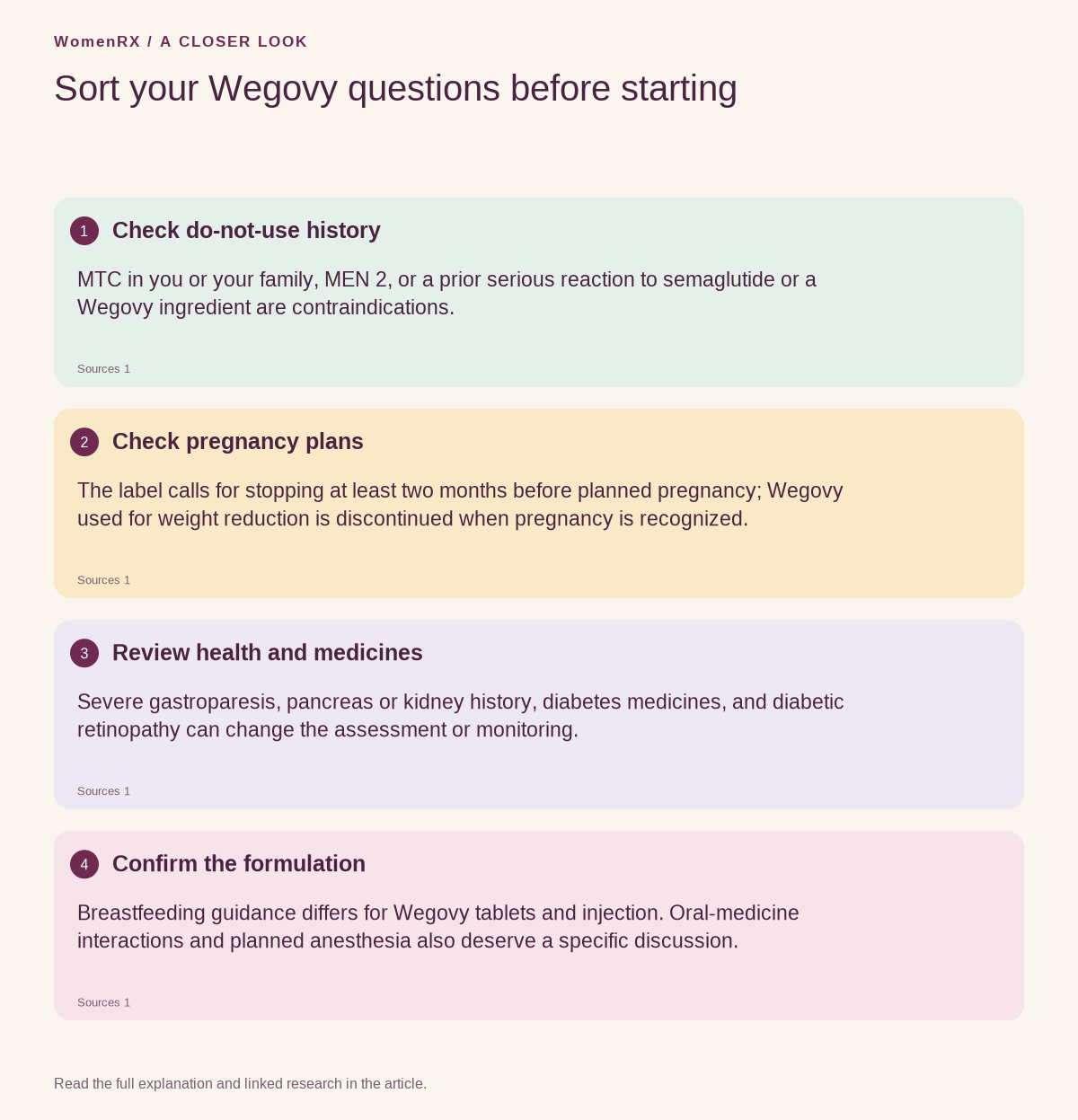
Sort your Wegovy questions before starting
Check do-not-use history: MTC in you or your family, MEN 2, or a prior serious reaction to semaglutide or a Wegovy ingredient are contraindications.1
Check pregnancy plans: The label calls for stopping at least two months before planned pregnancy; Wegovy used for weight reduction is discontinued when pregnancy is recognized.1
Review health and medicines: Severe gastroparesis, pancreas or kidney history, diabetes medicines, and diabetic retinopathy can change the assessment or monitoring.1
Confirm the formulation: Breastfeeding guidance differs for Wegovy tablets and injection. Oral-medicine interactions and planned anesthesia also deserve a specific discussion.1
Read the figure as text
Follow these checks in order. A precaution calls for a decision about your circumstances, not an automatic ruling.- Check do-not-use history: MTC in you or your family, MEN 2, or a prior serious reaction to semaglutide or a Wegovy ingredient are contraindications.1
- Check pregnancy plans: The label calls for stopping at least two months before planned pregnancy; Wegovy used for weight reduction is discontinued when pregnancy is recognized.1
- Review health and medicines: Severe gastroparesis, pancreas or kidney history, diabetes medicines, and diabetic retinopathy can change the assessment or monitoring.1
- Confirm the formulation: Breastfeeding guidance differs for Wegovy tablets and injection. Oral-medicine interactions and planned anesthesia also deserve a specific discussion.1
Sources you can check
- WEGOVY (SEMAGLUTIDE) INJECTION, SOLUTION WEGOVY (SEMAGLUTIDE) TABLET [NOVO NORDISK PHARMACEUTICAL INDUSTRIES, LP] | US prescribing information and patient instructionsAccessed 2026-09-25Return to first citation
- Subcutaneous Semaglutide during Breastfeeding: Infant Safety Regarding Drug Transfer into Human Milk.Diab H, Fuquay T, Datta P, Bickel U, Thompson J, Krutsch K. · Nutrients · 2024Return to first citation
- Impact of semaglutide exposure on fetal and neonatal outcomes in pregnant women: a systematic review.Mandal L, Andersen LU, Luef BM, Tanvig MH, Vinter CA. · European journal of obstetrics, gynecology, and reproductive biology · 2026Return to first citation